Protection of Civil Liberties & Rights (Edexcel A Level Politics): Revision Note

Exam code: 9PL0

Sarra Jenkins

Written by: Sarra Jenkins

Reviewed by: Steve Vorster

Updated on

Protection methods used

  • Groups have used multiple methods to protect civil rights, voting rights and affirmative action, with varying levels of success
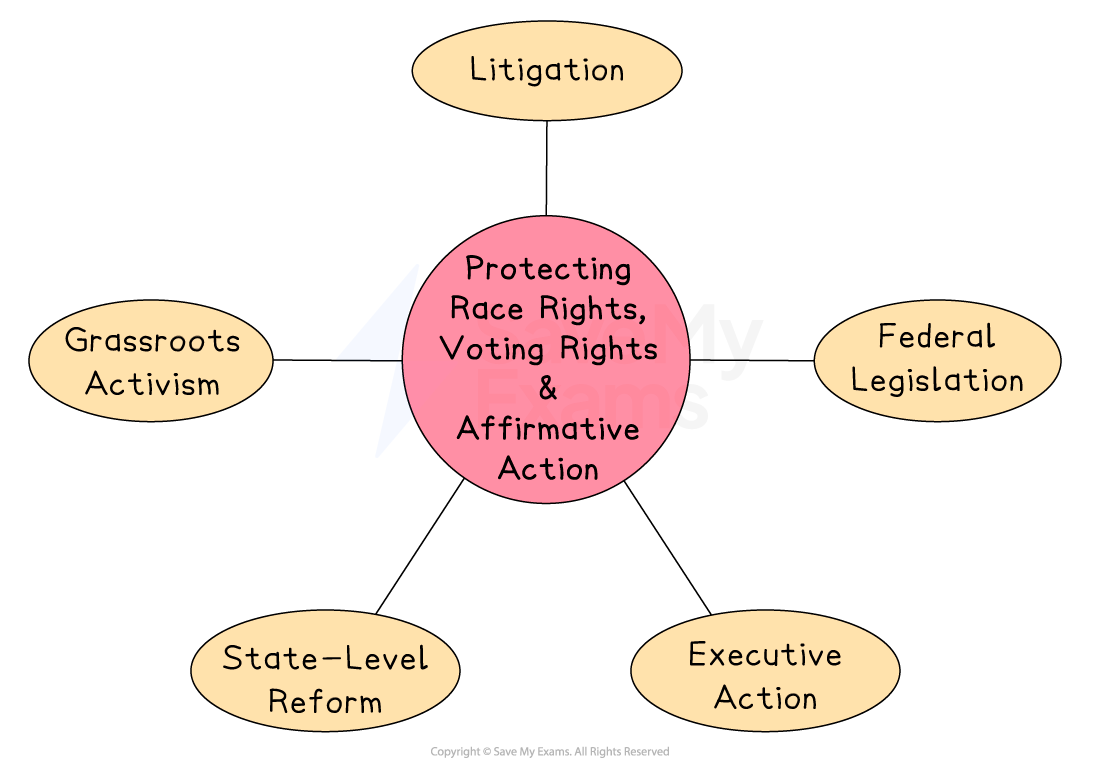
Diagram with central focus on protecting race rights, voting rights, and affirmative action, linked to litigation, legislation, executive action, activism, and reform.
Protection methods

Litigation through the US court system

  • Grutter v Bollinger (2003) allowed race to be used as one factor in university admissions (not in isolation)

  • Students for Fair Admissions v Harvard (2023) removed race as a factor that could be considered

Federal legislation

  • The Civil Rights Act (1964) and the Voting Rights Act (1965) offered protection

  • Shelby County v Holder (2013) reduced federal enforcement powers, weakening protections in states such as Alabama and Georgia

Grassroots activism and social movements

  • Black Lives Matter (BLM), particularly after the killing of George Floyd (2020), led to widespread protests

    • Some local reforms followed, including police oversight and body camera policies

  • Congressional action following these movements has been limited despite public outcry

Executive action

  • The Obama administration supported affirmative action in federal programmes

    • DACA (2012) protected immigrant rights

  • However, executive-led protections were vulnerable to rollback under later administrations

    • Some were overturned by the Supreme Court

State-level reform

  • States such as California strengthened voting protections and maintained affirmative action in university admissions despite federal challenges

  • However, Shelby County v Holder (2013) reduced federal enforcement powers, weakening protections in states such as Alabama and Georgia

Examiner Tips and Tricks

  • Overall, protecting race rights in the US requires legal, political and social strategies

  • Litigation and legislation can be powerful but are limited when court decisions constrain enforcement

  • Grassroots activism and state policies can provide additional protection and momentum

How effective has the protection been?

  • The protection of race rights has had both successes and failures in recent decades, particularly from 2000 onwards

Reasons for success

Reasons for limitations

  • Landmark Supreme Court rulings

    • Brown v Board of Education (1954) established that state-sanctioned discrimination is unconstitutional, creating a foundation for civil rights litigation in education

    • Shelby County v Holder (2013) upheld the principle that discriminatory voting practices could be challenged, even though it later weakened Section 5 of the Voting Rights Act

  • Voter restrictions and gerrymandering

    • States such as Georgia and Texas introduced strict voter ID laws, reduced early voting and drew district maps favouring certain parties

    • This increased particularly after Shelby County v Holder (2013) weakened federal oversight

  • Federal enforcement of civil rights laws

    • The Department of Justice (DOJ) has intervened in some cases to prevent discrimination

    • In 2018, the DOJ filed a lawsuit against North Carolina for discriminatory voter roll purges and restrictive voter ID laws

  • Mass incarceration

    • Mandatory minimum sentencing and the ‘War on Drugs’ disproportionately affected African Americans

    • In 2020, Black Americans made up 33% of the prison population despite being 13% of the population

  • Increased minority representation in government

    • The election of under-represented officials has strengthened civil rights advocacy

    • Kamala Harris became the first female, Black and South Asian Vice President in 2021

  • Weak enforcement mechanisms

    • Even where laws exist, limited enforcement reduces effectiveness

    • The DOJ has limited capacity to monitor compliance across all states

  • Public awareness and activism

    • Black Lives Matter increased pressure on policymakers

    • Protests after George Floyd’s murder in 2020 led to reforms in several major cities

  • Judicial rollbacks

    • The conservative majority has limited protections in recent cases

    • Students for Fair Admissions v Harvard (2023) restricted affirmative action

  • Constitutional amendments and civil rights legislation

    • The 14th Amendment and Voting Rights Act (1965) provide formal protections

    • Shelby County (2013) and Perez v Abbott (2021) show how these frameworks enable challenges to discriminatory practices

  • Structural inequality

    • Persistent inequality in education, healthcare, employment and wealth limits real-world equality

    • Schools in majority-minority districts often receive lower funding

Examiner Tips and Tricks

  • Overall, protection of race rights is mixed

  • Legal and legislative frameworks exist, but structural, political and judicial challenges limit effectiveness

Impact of rights campaigns on current domestic policy

  • Campaigns by interest groups have had both successes and failures in influencing current domestic policy
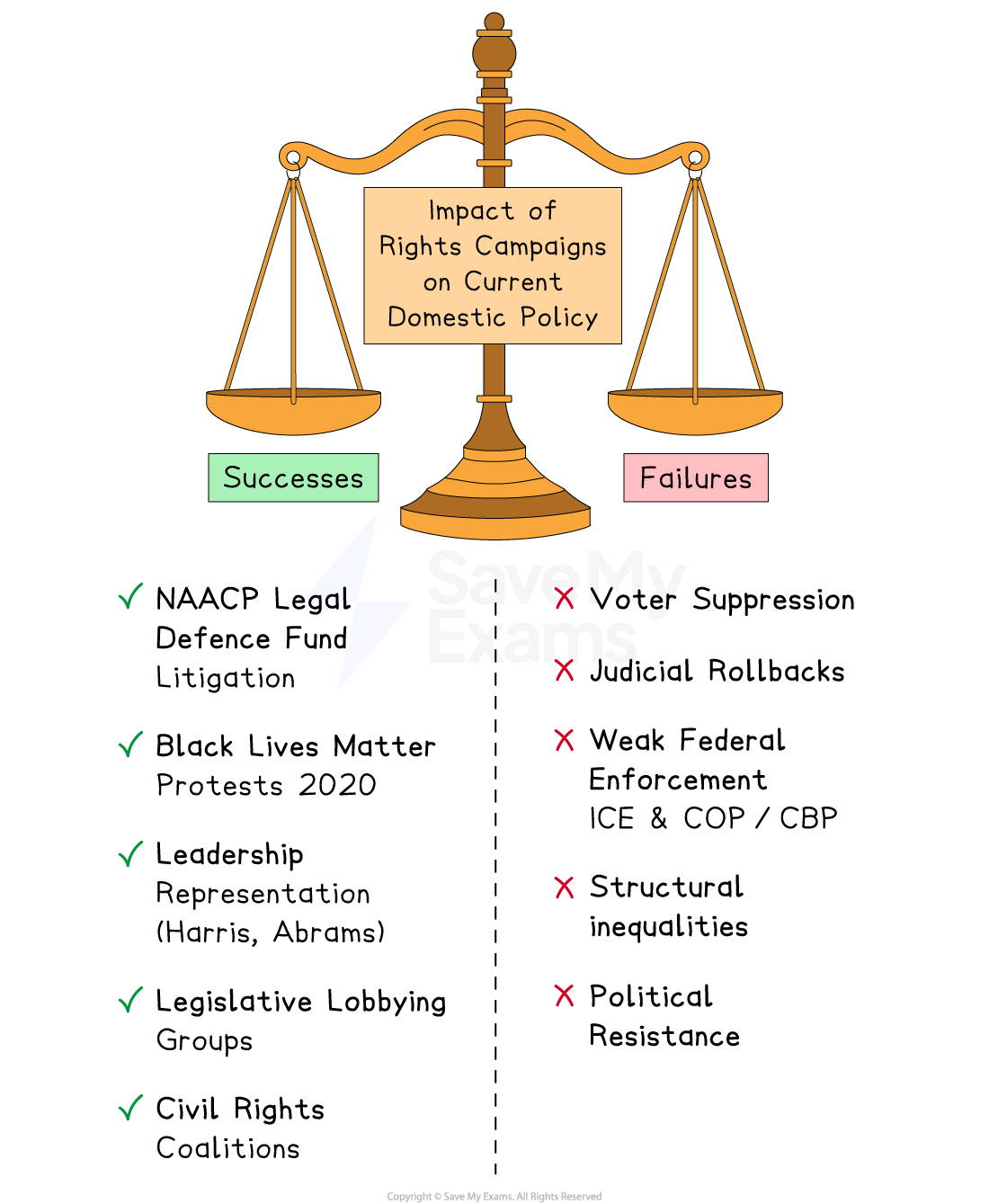
Scales balance successes, like NAACP litigation and Black Lives Matter, against failures such as voter suppression and judicial rollbacks, indicating policy impact.
Impact on current domestic policy

Examples of successes

Examples of failures

  • NAACP Legal Defense Fund (LDF) influences policy through litigation

    • In 2016, the LDF successfully challenged North Carolina’s discriminatory voter ID law

  • Voter suppression persistence

    • States such as Georgia and Texas passed restrictive voting laws after 2013

  • Black Lives Matter (BLM) has campaigned against police violence and systemic racism

    • The 2020 protests led to local policy changes, including bans on chokeholds in New York City and police budget reallocations in Minneapolis

  • Judicial rollbacks

    • Supreme Court decisions such as Shelby County v Holder (2013) and Brnovich v DNC (2021) weakened federal oversight

  • Leadership representation as advocacy

    • The election of Kamala Harris (2021) and officials such as Stacey Abrams enabled advocacy for voting rights legislation

  • Limited federal enforcement

    • Even successful advocacy can be undermined if federal agencies do not enforce civil rights laws

    • This could be seen in President Trump’s deployment of ICE and CBP officers across the US

  • Legislative lobbying groups

    • Groups such as the League of Women Voters and Color of Change have lobbied Congress

    • In 2021, Color of Change supported the John Lewis Voting Rights Advancement Act

  • Structural inequalities

    • Campaigns cannot fully address entrenched disparities in education, employment and housing

    • Educational funding disparities continue to reinforce inequality

  • Civil rights coalitions amplify influence

    • Coalitions filed amicus briefs in Shelby County v Holder and later voting rights challenges

  • Political resistance

    • Campaigns to expand voting access face organised opposition from state legislatures

    • Fair Fight Action demonstrates how reforms can be slowed or blocked

Examiner Tips and Tricks

  • Overall, protecting race and voting rights remains a multi-layered struggle requiring continuous legal, political and social strategies

  • Progress has been made through Supreme Court rulings, federal legislation and activism, but state resistance, judicial rollback and structural inequality continue to pose obstacles

Unlock more, it's free!

Join the 100,000+ Students that ❤️ Save My Exams

the (exam) results speak for themselves:

Sarra Jenkins

Author: Sarra Jenkins

Expertise: Content Writer

Sarra is a highly experienced A-Level Politics educator with over two decades of teaching and examining experience. She was part of the team that wrote the Edexcel 2017 Politics Specification and currently works as a Senior Examiner. A published author of 14 textbooks and revision guides, her expertise lies in UK and US politics, exam skills, and career guidance. She continues to teach, driven by her passion for this "evolving and dynamic subject".

Steve Vorster

Reviewer: Steve Vorster

Expertise: Economics & Business Subject Lead

Steve has taught A Level, GCSE, IGCSE Business and Economics - as well as IBDP Economics and Business Management. He is an IBDP Examiner and IGCSE textbook author. His students regularly achieve 90-100% in their final exams. Steve has been the Assistant Head of Sixth Form for a school in Devon, and Head of Economics at the world's largest International school in Singapore. He loves to create resources which speed up student learning and are easily accessible by all.