The Nature & Role of the Supreme Court (Edexcel A Level Politics): Revision Note
Exam code: 9PL0

Optional unit
Examiner Tips and Tricks
For Component 3, students only study ONE route: USA Politics (3A) or Global Politics (3B)
The Supreme Court and the Constitution
The Supreme Court is established in Article III of the US Constitution, which outlines its core powers and responsibilities
Article III
Article III establishes the Supreme Court as the highest court in the federal judiciary
It acts as a national body responsible for interpreting federal law and the Constitution
The Constitution does not specify the number of Supreme Court justices
This power is left to Congress
The number of justices has been set at nine since 1869
Article III grants justices life tenure, meaning they serve “during good behaviour”
Justices remain in office unless they resign, retire, or are impeached and removed
Article III protects judicial salaries, which cannot be reduced while justices are in office
This protects justices from political pressure by Congress or the President
The Supreme Court has original jurisdiction in specific cases
These include disputes involving ambassadors, public ministers, consuls, and conflicts between states
In all other cases, the Court has appellate jurisdiction, allowing it to hear appeals from lower federal courts and state supreme courts on constitutional matters
The Constitution implies, but does not explicitly state, the power of judicial review
This power allows the Supreme Court to declare acts of Congress or the executive unconstitutional
Judicial review was formalised in Marbury v Madison (1803) and Fletcher v Peck (1810)
The Supreme Court acts as the final interpreter of the Constitution
This gives it significant influence over civil rights and civil liberties through its rulings
Supreme Court independence
Judicial independence refers to the Supreme Court being protected from external political pressure when making decisions, particularly from the President and Congress
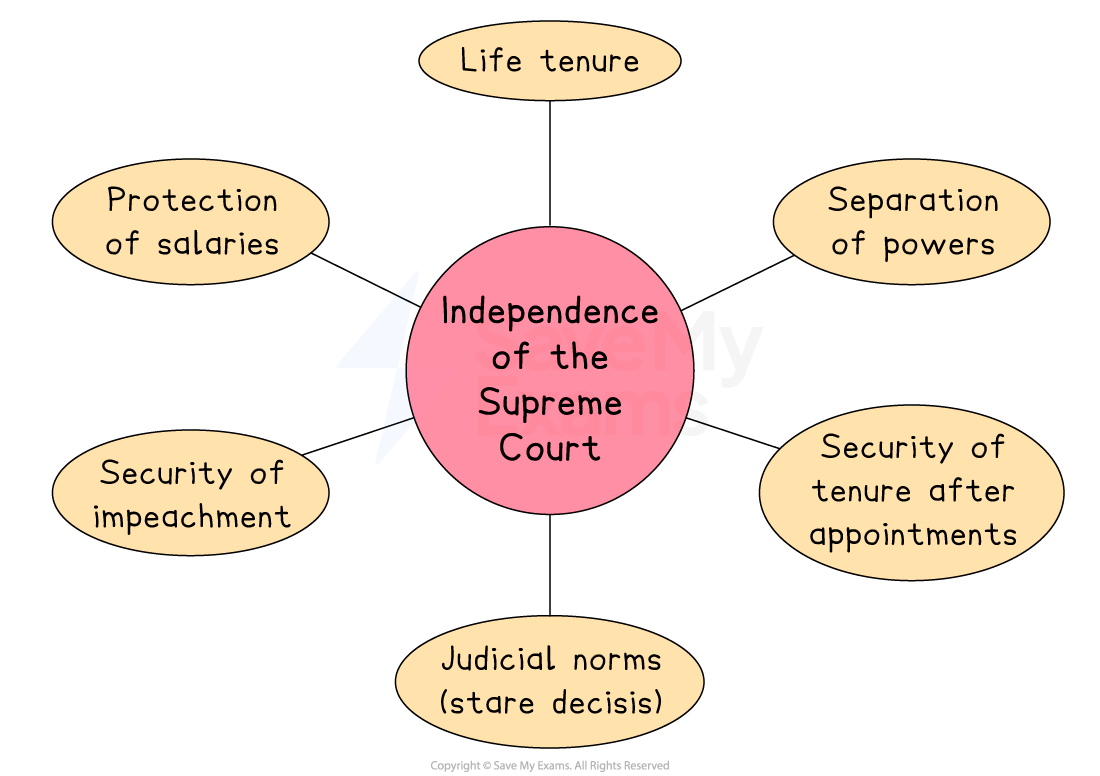
Independence is protected in several ways
Life tenure
Justices are not accountable to voters or politicians once appointed
This allows controversial rulings to be made without electoral pressure
For example, Obergefell v Hodges (2015) legalised same-sex marriage across the US
Protection of salaries
Congress cannot reduce judicial pay to punish unpopular decisions
Separation of powers
The judiciary operates independently from the executive and legislative branches
The Supreme Court has struck down presidential actions
For example, parts of President Trump’s executive actions on electoral procedures were struck down in League of Women Voters Education Fund v Trump (2025)
Security of tenure after appointment
Although the appointment process is politically influenced, justices cannot be removed for political reasons once confirmed
Chief Justice John Roberts ruled against Republican interests in NFIB v Sebelius (2012) without fear of losing his position
Security of impeachment
No Supreme Court justice has ever been removed from office
Samuel Chase was impeached in 1805 for partisan behaviour but acquitted, establishing a precedent protecting judicial independence
Judicial norms, including stare decisis
Respect for precedent encourages decisions to be based on legal reasoning rather than political preference

Unlock more, it's free!
Join the 100,000+ Students that ❤️ Save My Exams
the (exam) results speak for themselves:

Was this revision note helpful?