Comparative Approaches: Campaign Finance & Pressure Groups (Edexcel A Level Politics): Revision Note

Exam code: 9PL0

Sarra Jenkins

Written by: Sarra Jenkins

Reviewed by: Steve Vorster

Updated on

Comparing campaign finance in the US and UK

Examiner Tips and Tricks

In each of the similarities and differences below, a suggestion is given as to which theory might explain this.

  • This does not mean this is the ‘right’ answer

    • In most cases, multiple theories can be used to explain a similarity or difference

  • For Question 1a and 1b, no theories are required

    • They are only required in Question 2

  • More information on the three theories – structural, rational and cultural – can be found on the page 'Introduction to Comparative Approaches'
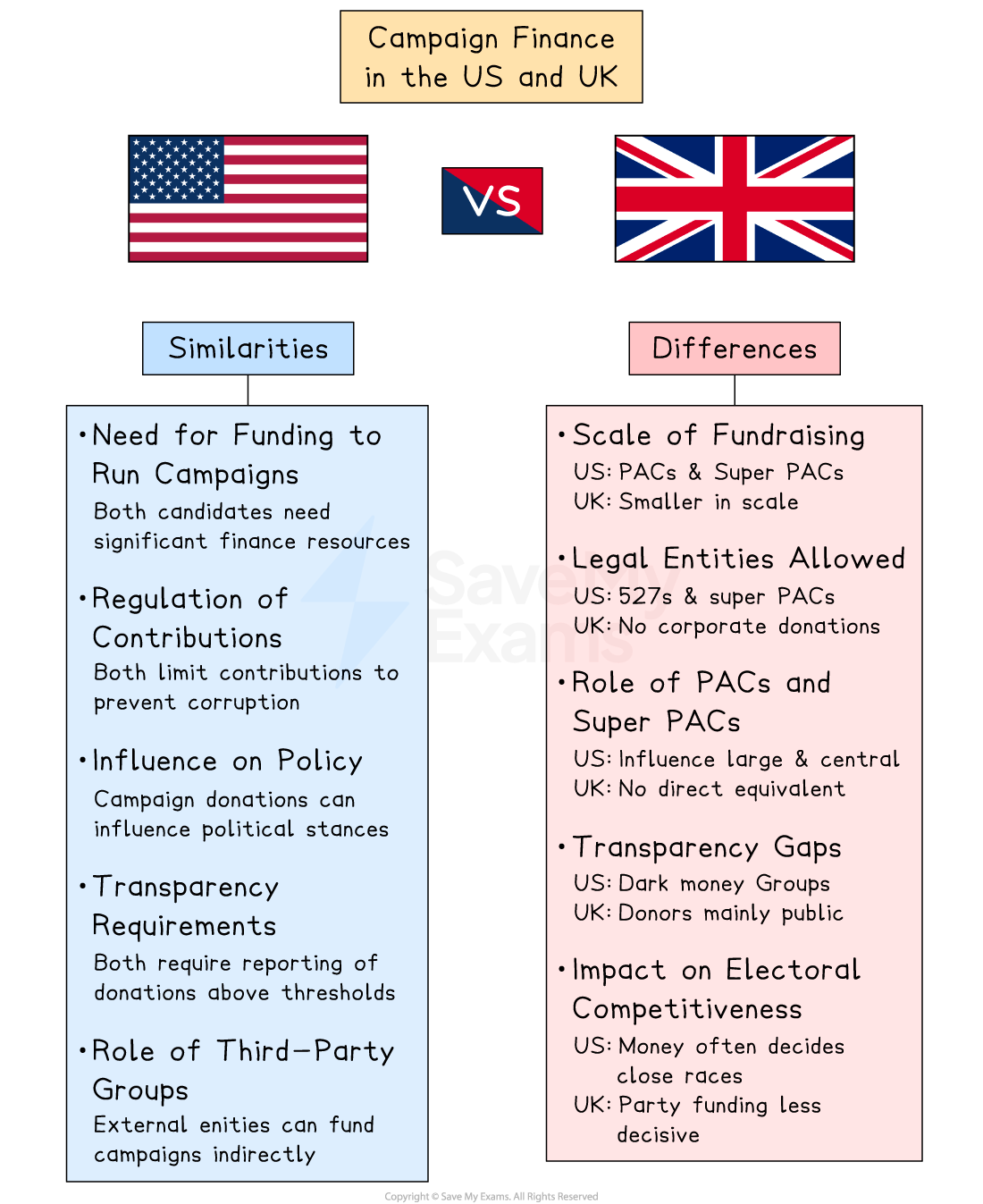
Comparing campaign finance

Similarities

Similarity

Explanation and example

Theory explanation

Need for funding to run campaigns

  • Both US and UK candidates require significant campaign finance resources

  • US: Biden raised $1.69 billion for the 2020 election

  • UK: Labour and Conservatives each spent £30 million+ in 2019

  • This could be explained by rational theory because parties act strategically to maximise electoral success through deployment of their resources

Regulation of contributions

  • Both countries have limits to prevent corruption

  • US Federal Election Commission regulates contributions

  • UK Electoral Commission sets limits

  • This could be explained by structural theory because formal institutions and policy shapes financial behaviour

Influence on policy

  • Campaign finance donations can influence policy positions

  • US: NRA donations affect gun legislation

  • UK: union donations can influence Labour Party policy on employment

  • This could be explained by rational theory through the strategic use of finance to gain policy advantages

Transparency requirements

  • Both systems require reporting of donations above thresholds

  • US through FEC filing

  • UK through Electoral Commission reports

  • This could be explained by structural theory as behaviour is shaped by legal frameworks

Role of third-party groups

  • Both systems allow external entities to fund campaigns indirectly

  • US Super PACs (e.g. Priorities USA Action 2020)

  • UK campaign groups like Britain Stronger in Europe (2016 Brexit referendum)

  • This could be explained by rational theory through strategic resource allocation to shape outcomes

Differences

Difference

Explanation and example

Theory explanation

Scale of fundraising

  • US campaigns rely heavily on billions from PACs and Super PACs

  • UK campaigns are smaller in scale

  • This could be explained by structural theory reflecting institutional funding structures and differences in funding limitations

Legal entities allowed

  • In the US, 527s and Super PACs can raise unlimited funds for independent expenditure

  • UK law bans corporate donations to candidates

  • This could be explained by structural theory reflecting formal legal differences in the electoral process

Role of PACs and Super PACs

  • US influence is large and central to elections

  • UK has no direct equivalent

  • This could be explained by structural theory arising from institutional design

Transparency gaps

  • US groups can obscure donors via shell organisations (dark money)

  • UK laws make donor identities largely public

  • This could be explained by structural theory reflecting formal rules shaping behaviour

Impact on electoral competitiveness

  • US money often decides close races

  • UK party funding plays less decisive role due to the smaller scale

  • This could be explained by rational theory explaining strategic allocation of resources to influence competitive advantage

Comparing pressure groups in the US and UK

Similarities

Similarity

Explanation and example

Theory explanation

Lobbying legislatures

  • Pressure groups both in the UK and UK lobby the legislature to try and influence legislative outcomes

  • AIPAC lobbying Congress on foreign aid

  • BMA lobbying Parliament on NHS reforms

  • This could be explained by rational theory reflecting strategic attempts to influence policy in the best interests of the pressure group

Litigation as a tool

  • In both the US and UK, legal challenges are used by pressure groups to achieve their desired end

  • NAACP in Shelby County v Holder

  • Liberty challenging the Investigatory Powers Act 2016

  • This could be explained by structural theory reflecting the formal legal channels available

Public campaigns

  • In both the US and UK, groups launch public campaign to mobilise grassroots support and gain substantial public support, or gain media headlines

  • This could be explained by cultural theory with societal norms and shared ideals shaping mobilisation

Coalition-building

  • Both the US and UK sees groups acting together to achieve their outcomes

  • US civil rights coalitions

  • UK: Liberty and Amnesty joint campaigns

  • This could be explained by rational theory, as strategic collective action makes a favourable outcome for a group more likely

Resource-based influence

  • Groups with better funding have a greater ability to utilise access points

  • This could be explained by rational theory, as it results in strategic resource deployment to achieve the best outcomes for a group

Differences

Difference

Explanation and example

Theory explanation

Access to courts

  • US groups can file constitutional challenges (e.g. Dobbs v Jackson)

  • UK groups primarily challenge executive actions

  • This could be explained by structural theory reflecting institutional differences in process and role

Electoral influence

  • US groups influence elections via PACs/Super PACs

  • UK groups cannot fund candidates directly or to the same level as the US

  • This could be explained by structural theory due to formal legal limits

Partisan alignment

  • US groups often closely align with political parties

  • NRA and Republicans

  • UK groups remain non-partisan

  • Liberty and Greenpeace

  • This could be explained by cultural theory, which explains norms guiding behaviour of groups

Scope of influence

  • US groups affect federal and state laws, having a much wider choice of access points

  • UK groups mostly influence Parliament and courts

  • This could be explained by structural theory reflecting the political system design

Frequency of litigation

  • US interest groups frequently litigate

  • UK groups less so due to cost and legal limitations

  • This could be explained by rational theory due to strategic deployment of resources

Unlock more, it's free!

Join the 100,000+ Students that ❤️ Save My Exams

the (exam) results speak for themselves:

Sarra Jenkins

Author: Sarra Jenkins

Expertise: Content Writer

Sarra is a highly experienced A-Level Politics educator with over two decades of teaching and examining experience. She was part of the team that wrote the Edexcel 2017 Politics Specification and currently works as a Senior Examiner. A published author of 14 textbooks and revision guides, her expertise lies in UK and US politics, exam skills, and career guidance. She continues to teach, driven by her passion for this "evolving and dynamic subject".

Steve Vorster

Reviewer: Steve Vorster

Expertise: Economics & Business Subject Lead

Steve has taught A Level, GCSE, IGCSE Business and Economics - as well as IBDP Economics and Business Management. He is an IBDP Examiner and IGCSE textbook author. His students regularly achieve 90-100% in their final exams. Steve has been the Assistant Head of Sixth Form for a school in Devon, and Head of Economics at the world's largest International school in Singapore. He loves to create resources which speed up student learning and are easily accessible by all.