Comparative Approaches: UK & US Democracy (Edexcel A Level Politics): Revision Note

Exam code: 9PL0

Sarra Jenkins

Written by: Sarra Jenkins

Reviewed by: Steve Vorster

Updated on

Comparing party systems

Examiner Tips and Tricks

In each of the similarities and differences below, a suggestion is given as to which theory might explain this.

  • This does not mean this is the ‘right’ answer

    • In most cases, multiple theories can be used to explain a similarity or difference

  • For Question 1a and 1b, no theories are required

    • They are only required in Question 2

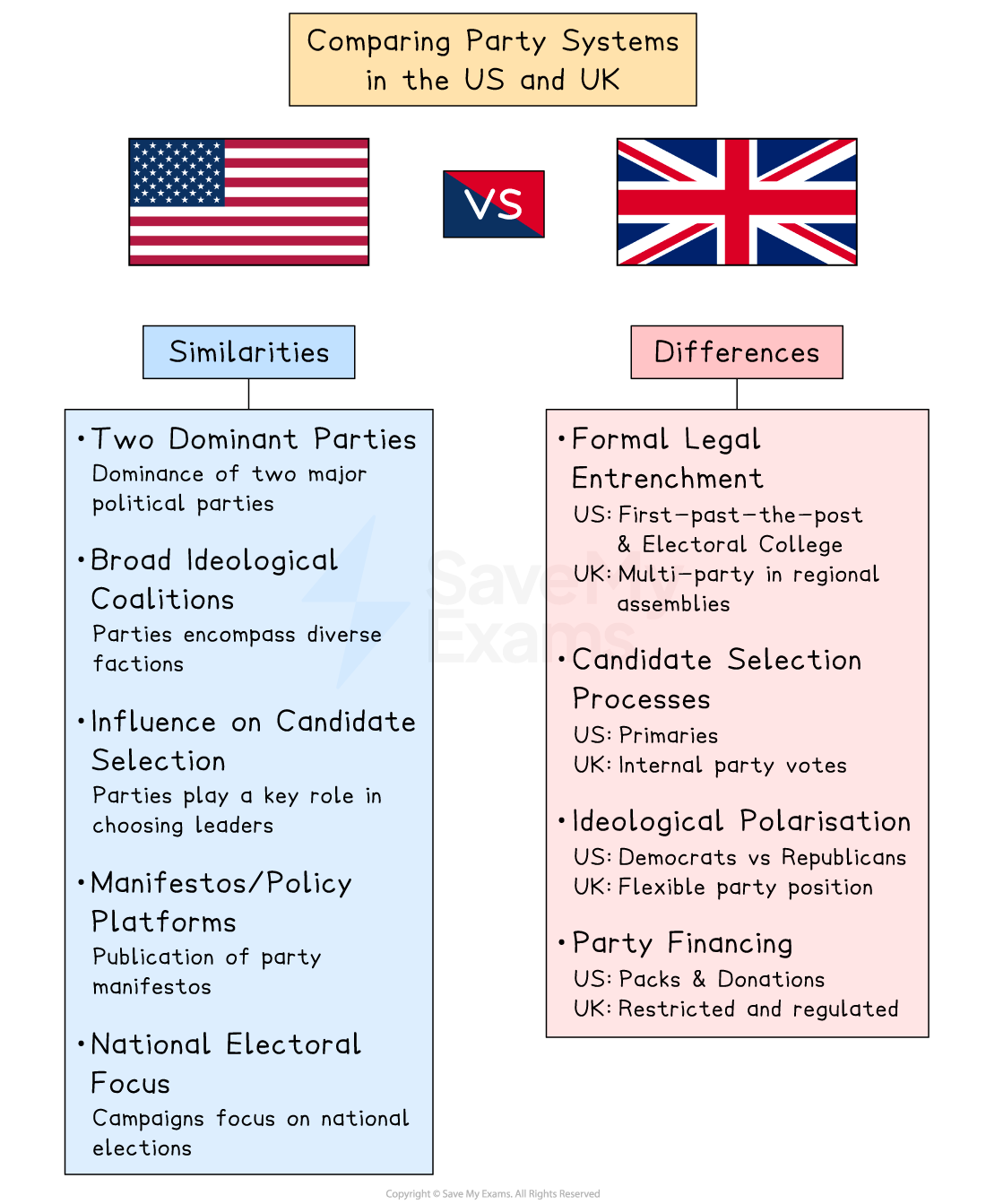
Comparing party systems

Similarities

Similarity

Explanation and example

Theory explanation

Two dominant parties

  • The US has the Democrats and Republicans

  • The UK has Labour and Conservatives

  • These parties dominate elections and policymaking

  • This could be explained by cultural theory because social and historical norms sustain party dominance

Broad ideological coalitions

  • US parties encompass diverse factions

  • UK parties also encompass ideological wings

  • This could be explained by rational theory with strategic coalition-building to win elections

Influence on candidate selection

  • Parties have considerable power to determine presidential/PM candidates strategically

  • US primaries and UK leadership elections shape the party’s electoral appeal

  • This could be explained by rational theory, with selection being based on the likelihood of victory and therefore strategic advantage

Policy platforms

  • Both parties produce manifestos to guide legislative priorities

  • Biden’s Build Back Better (2021)

  • Labour manifesto 2019

  • This could be explained by structural theory reflecting the formal mechanisms of policy formation

National electoral focus

  • Both systems focus campaigns on nationwide elections despite local representation differences

  • This could be explained by rational theory explaining strategic targeting of swing voters

Differences

Difference

Explanation and example

Theory explanation

Formal legal entrenchment

  • US two-party system reinforced by first-past-the-post throughout the US and the Electoral College

  • UK has some multi-party representation via regional assemblies

  • This could be explained by structural theory showing how electoral systems shape party systems

Candidate selection processes

  • US primaries allow voter involvement in candidate selection

  • UK party conferences or internal votes dominate

  • This could be explained by rational theory reflecting strategic control of nominations

Ideological polarisation

  • US parties are more polarised (Democrats vs Republicans)

  • UK parties more ideologically flexible

  • This could be explained by cultural theory with the US having a broader political spectrum than the UK

Party financing

  • US parties rely heavily on PACs and donations for expensive elections

  • UK party donations have stricter limits

  • This could be explained by structural theory reflecting formal finance rules

Impact of third parties

  • US third parties rarely succeed due to winner-takes-all

  • UK smaller parties like SNP or Liberal Democrats can win regional seats or maintain enough seats in Parliament to have a notable presence

  • This could be explained by structural theory explaining institutional constraints on party success

Internal party unity in the US and UK

Similarities

Similarity

Explanation and example

Theory explanation

Importance of party leadership

  • Both US and UK parties rely on leadership to maintain cohesion

  • US: House Speaker Nancy Pelosi maintained Democratic unity during the 2021 infrastructure bill votes

  • UK: Conservative whips ensured MP support for Boris Johnson’s Brexit Withdrawal Agreement (2019)

  • This could be explained by rational theory because leaders strategically manage party unity to achieve legislative success

Factional influence

  • Internal factions shape policy within parties

  • US Democrats: progressives and moderates influenced the Build Back Better debate (2021)

  • UK Labour: Blairites vs Corbynites affected policy proposals (2017–2019)

  • This could be explained by cultural theory as norms and ideologies guiding factional alignment and influence

Whipping systems

  • Both systems use mechanisms to ensure voting discipline

  • US party whips in 2021 encouraged support for pandemic relief bills

  • UK whips coordinated MPs in key votes such as Johnson’s Brexit votes

  • This could be explained by rational theory because whipping is a strategic tool to maximise legislative outcomes

Policy messaging

  • Unified messaging is key for electoral success

  • US Democrats emphasised pandemic recovery

  • UK Labour emphasised public services

  • This could be explained by cultural theory as party norms and values reinforce cohesion and shared political ideology

Cross-party coordination

  • Even with partisanship, both systems see temporary unity on major issues

  • US Congress passed COVID relief bills with bipartisan support (2020–21)

  • UK Parliament supported national COVID lockdown legislation (2020)

  • This could be explained by rational theory highlighting strategic cooperation to achieve policy goals

Differences

Difference

Explanation and example

Theory explanation

Degree of unity

  • UK parties tend to have stricter unity due to parliamentary voting pressures

  • US Congress allows more individual deviation

  • This could be explained by cultural theory with an expectation of shared beliefs with the party in the UK, which is more difficult in the US due to the breadth of the political spectrum

Influence of primaries

  • US primaries encourage ideological expression, sometimes weakening unity

  • In the UK, it is the party that dominates candidate selection, encouraging cohesion

  • This could be explained by structural theory due to the formal system incentivising divergence

Impact of federalism

  • US state-level party differences reduce national unity

  • UK parties are more centrally controlled

  • This could be explained by cultural theory with differences arising from differing loyalties and shared ideals

Leadership removal mechanisms

  • UK MPs can remove a party leader via confidence votes, enhancing party cohesion via threat

  • US leaders cannot be removed similarly, reducing a need for cohesion

  • This could be explained by structural theory reflecting the formal mechanisms shaping unity

Ideological polarisation

  • US parties are increasingly polarised, reducing internal compromise

  • UK parties often tolerate broader ideological wings for electoral appeal

  • This could be explained by cultural theory reflecting norms and political culture shaping behaviour

The policies of US and UK political parties

Similarities

Similarity

Explanation and example

Theory explanation

Economic policy focus

  • All four parties emphasise economic management as central to their platform

  • US Republicans: tax cuts for businesses (Tax Cuts and Jobs Act, 2017)

  • US Democrats: government stimulus (Build Back Better Plan, 2021)

  • UK Conservatives: business-friendly policies (2019 corporation tax cut)

  • UK Labour: infrastructure investment (Labour manifesto 2019)

  • This could be explained by rational theory as these similarities are strategic attempts to appeal to voters’ economic self-interest

National security

  • Each party emphasises defence, though differently

  • US Republicans under Trump: military spending and border security

  • Democrats under Biden: alliances and cyber-security

  • UK Conservatives: defence spending

  • Labour: supports NATO but stresses diplomatic solutions

  • This could be explained by structural theory due to institutional expectations of executive responsibility for national security

Environmental policy acknowledgment

  • All parties recognise climate change, though approaches differ

  • US Democrats push renewable investment

  • Labour supports making Britain a clean energy superpower

  • US Republicans and UK Conservatives acknowledge climate issues but emphasise market-based solutions

  • This could be explained by cultural theory showing shared political values shaping policy development

Healthcare as a policy issue

  • US Democrats advocate expanded coverage (Affordable Care Act)

  • UK Labour supports NHS expansion

  • UK Conservatives maintain NHS funding while promoting efficiency

  • US Republicans emphasise private healthcare markets

  • This could be explained by rational theory as parties act strategically to attract voters dependent on healthcare policies

Education policy priority

  • Parties aim to improve education access

  • US Democrats: student loan relief (Biden 2022 executive action)

  • Republicans: school choice and vouchers

  • UK Labour: increased public education spending

  • Conservatives: academies and selective school support

  • This could be explained by cultural theory reflecting societal consensus on education importance

Differences

Difference

Explanation and example

Theory explanation

Taxation philosophy

  • US Republicans and UK Conservatives emphasise low taxes and small government

  • US Democrats and UK Labour favour progressive taxation

  • This could be explained by cultural theory reflecting the shared political ideals of the parties on the right and left of the political spectrum

Social/moral issues

  • US Democrats support LGBTQ+ rights and abortion access

  • Republicans generally oppose abortion and limit rights expansions

  • UK Labour promotes social liberalism

  • UK Conservatives are more centrist socially

  • This could be explained by cultural theory explaining differences rooted in historical and societal norms and understanding of human nature

Welfare provision

  • US Democrats advocate expanded social programs (Medicaid, SNAP)

  • Republicans favour limiting welfare

  • UK Labour promotes social welfare (Universal Credit reform proposals)

  • Conservatives advocate more targeted benefits

  • This could be explained by rational theory reflecting strategic policy positioning to appeal to different voter bases

Healthcare system design

  • US parties diverge on public vs private healthcare

  • UK parties operate within an NHS framework but differ in management approaches

  • This could be explained by cultural theory reflecting the different views on the individual responsibility for healthcare provision

Approach to trade

  • US Republicans under Trump favour protectionism

  • Democrats support multilateral trade agreements

  • UK Conservatives support free trade agreements post-Brexit

  • Labour is more cautious, emphasising workers’ rights within such deals

  • This could be explained by rational theory explaining strategic positioning to appeal to economic constituencies

Unlock more, it's free!

Join the 100,000+ Students that ❤️ Save My Exams

the (exam) results speak for themselves:

Sarra Jenkins

Author: Sarra Jenkins

Expertise: Content Writer

Sarra is a highly experienced A-Level Politics educator with over two decades of teaching and examining experience. She was part of the team that wrote the Edexcel 2017 Politics Specification and currently works as a Senior Examiner. A published author of 14 textbooks and revision guides, her expertise lies in UK and US politics, exam skills, and career guidance. She continues to teach, driven by her passion for this "evolving and dynamic subject".

Steve Vorster

Reviewer: Steve Vorster

Expertise: Economics & Business Subject Lead

Steve has taught A Level, GCSE, IGCSE Business and Economics - as well as IBDP Economics and Business Management. He is an IBDP Examiner and IGCSE textbook author. His students regularly achieve 90-100% in their final exams. Steve has been the Assistant Head of Sixth Form for a school in Devon, and Head of Economics at the world's largest International school in Singapore. He loves to create resources which speed up student learning and are easily accessible by all.