Electoral Systems in the USA: Presidential Elections (Edexcel A Level Politics): Revision Note
Exam code: 9PL0

Optional unit
Examiner Tips and Tricks
For Component 3, students only study ONE route: USA Politics (3A) or Global Politics (3B)
The process of electing a president
The process of electing a US president is long and complex, designed to test candidates’ popularity, organisation and electability
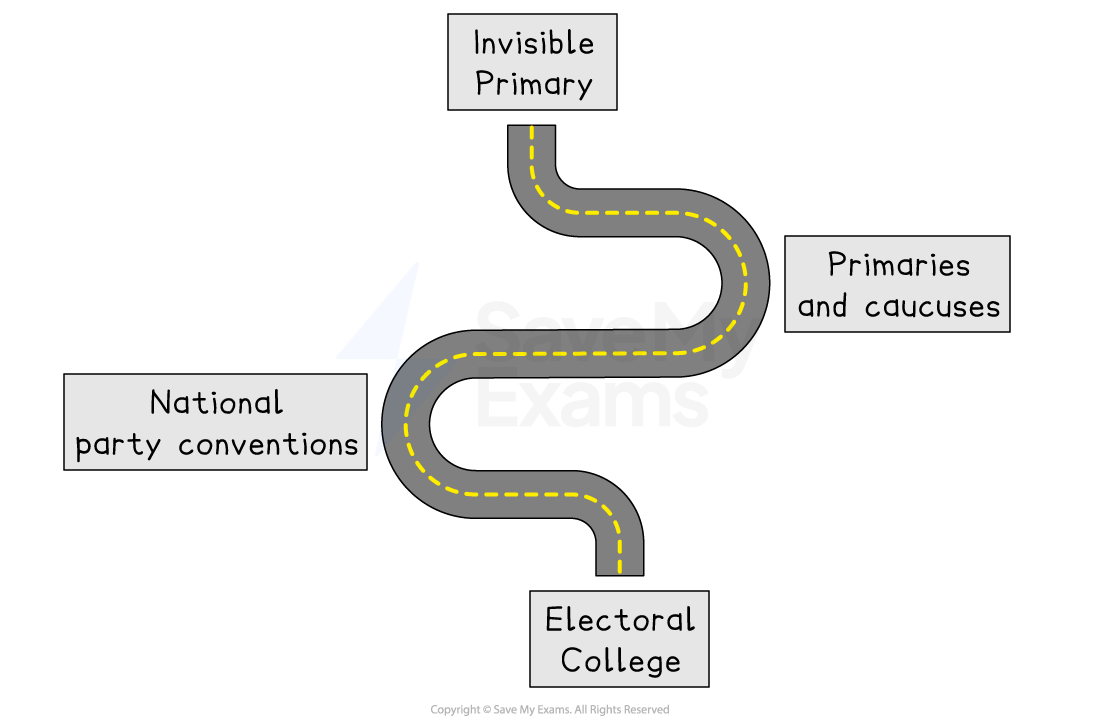
Stage 1: The invisible primary
The invisible primary occurs before formal voting and involves candidates securing endorsements, media attention and fundraising
In 2023 Joe Biden quickly gained endorsements from party leaders such as Hakeem Jeffries, discouraging serious challengers
Benefit
It filters out weak candidates early, reducing overcrowded ballots
Drawback
It favours establishment candidates with elite connections, limiting grassroots choices
Many candidates drop out during this stage
Stage 2: Primaries and caucuses
Primaries | Caucuses |
|---|---|
|
|
Primaries and caucuses allow party members to vote for their preferred nominee
States like Iowa (caucus) and New Hampshire (primary) traditionally vote first
In 2024, Donald Trump won the Iowa Republican caucus in January with over 50% of the vote, reinforcing his frontrunner status
Benefit
Voters directly influence candidate selection rather than leaving it to the party to decide on candidates
Drawback
Turnout is often very low, particularly in caucuses, which can distort representation
Stage 3: National party conventions
Party conventions formally nominate candidates, unite the party and outline the party platform
In August 2024, the Democratic National Convention officially nominated Joe Biden and Kamala Harris as candidates for the 2024 election
Benefit
The development of party unity around a single candidate and the subsequent media exposure for that candidate
Drawback
Outcomes are largely predetermined by the primary and caucus stage, reducing their democratic significance
Stage 4 - Electoral College
Voters technically vote for electors from their state to be pledged to a particular candidate, with 270 votes needed to win
In 2024, battleground states such as Pennsylvania and Arizona were decisive
Benefit
It preserves federalism by valuing all states, with each state having a minimum of three Electoral College votes
Drawback
It can override the popular vote, undermining democratic legitimacy, as in 2000 and 2016
The importance of incumbency
Incumbency means being the current holder of a political office
Incumbency provides significant advantages to candidates seeking re-election at both congressional and presidential levels
Benefit of incumbency | Explanation |
|---|---|
Name recognition |
|
Access to media coverage |
|
Fundraising |
|
Constituency service |
|
Rose Garden strategy |
|
However, incumbency does not make a candidate unbeatable
Donald Trump, the incumbent in 2020, was not re-elected
Poor performance and public dissatisfaction can outweigh advantages
Joe Biden had to withdraw in 2024 to be replaced by Kamala Harris
Poor performances at debates led to increasing questions about his health and mental state
Case Study
Donald Trump and the 2020 Election

Donald Trump ran for re-election in 2020 as an incumbent president
Despite this, he lost the election to Democratic candidate Joe Biden
This outcome can be explained by a combination of policy failures, economic conditions and electoral context
Impact of the COVID-19 pandemic
Trump’s handling of the COVID-19 pandemic damaged public confidence
By November 2020, over 230,000 Americans had died from COVID-19
Critics argued that inconsistent messaging and resistance to public health measures undermined perceptions of presidential leadership
The pandemic became the central issue of the campaign, outweighing traditional incumbency advantages
Economic conditions and retrospective voting
Trump had previously relied on strong economic performance as a key campaign message
However, the pandemic triggered a sharp economic downturn
Unemployment peaked at 14.7% in April 2020, weakening support for Trump
Voters were less likely to reward the incumbent for economic management
Turnout and electoral dynamics
The 2020 election saw the highest voter turnout since 1900
Expanded mail-in voting increased participation, particularly among Democratic voters
High turnout benefited Biden in key swing states such as Pennsylvania and Michigan
Polarisation and voter coalitions
Joe Biden successfully appealed to moderate voters and suburban constituencies
Trump’s polarising rhetoric mobilised opposition voters as much as his own supporters

Unlock more, it's free!
Join the 100,000+ Students that ❤️ Save My Exams
the (exam) results speak for themselves:

Was this revision note helpful?