Republican Party: Key Ideas & Principles (Edexcel A Level Politics): Revision Note

Exam code: 9PL0

Sarra Jenkins

Written by: Sarra Jenkins

Reviewed by: Lisa Eades

Updated on

Social and moral issues

  • The Republican Party generally adopts socially conservative positions, with increasing emphasis on cultural issues over time

  • Under Trump, Republican social policy has moved toward stronger cultural conservatism and decentralisation of moral regulation

Election

Policies

2016

  • Abortion restrictions were strongly supported

    • Trump promised to appoint conservative Supreme Court justices to overturn Roe v Wade, a pledge fulfilled with appointments such as Neil Gorsuch in 2017

  • Religious liberty was prioritised

    • This included opposition to mandates perceived to infringe religious freedom, such as contraceptive coverage under the ACA

  • Gun rights were defended

    • Republicans opposed expanded background checks following mass shootings

2020

  • Social conservatism intensified

    • Republicans reaffirmed opposition to abortion and support for traditional family values

  • Law and order rhetoric increased

    • Particularly during the Black Lives Matter protests of 2020, with Trump criticising Democratic-led police reform efforts

  • Opposition to LGBTQ+ protections expanded

    • This including support for state-level restrictions on transgender participation in sports

2024

  • Abortion policy shifted toward state control

    • Following Dobbs v Jackson (2022), Republicans supported state bans such as Texas’s near-total abortion prohibition

  • Cultural issues dominated

    • This included opposition to woke education and gender-affirming healthcare for minors, highlighted by Florida Governor Ron DeSantis

  • Gun rights remained central

    • Republicans opposed Democratic gun reform after New York State Rifle & Pistol Association v Bruen (2022) expanded Second Amendment protections

Governmental intervention

  • Republicans traditionally support limited government intervention and free-market economics

  • Economic policy remains rooted in free-market principles but increasingly incorporates nationalist and protectionist elements

Election

Policies

2016

  • Tax reduction was central

    • This led to the Tax Cuts and Jobs Act (2017), which reduced corporation tax from 35% to 21%.

  • Deregulation was prioritised

    • Trump pledged to remove two regulations for every new one introduced

2020

  • Economic nationalism

    • Trump emphasised protectionist trade policies, including tariffs on Chinese imports introduced in 2018

  • Opposition to COVID-19 restrictions reflected prioritisation of economic activity over federal intervention

2024

  • Opposition to 'big government' spending intensified

    • Republicans criticised Biden’s Inflation Reduction Act (2022)

  • Support for fossil fuels expanded

    • This included calls to expand domestic oil drilling and reverse climate regulations

  • Tax cuts remained central

    • This included proposals to extend Trump-era tax reductions set to expire in 2025

Government provision of social welfare and personal responsibility

  • Republicans generally favour limited welfare provision and individual responsibility

  • Welfare policy reflects ideological opposition to expansive federal provision

Election

Policies

2016

  • Repeal of the Affordable Care Act was a major goal

    • Trump promised a market-based alternative

  • Opposition to Medicaid expansion reflected concerns about federal spending

2020

  • Welfare reform rhetoric emphasised work requirements

    • This included proposals to limit food stamp eligibility

  • Pandemic relief was supported reluctantly

    • Republicans backed the CARES Act (2020) but criticised prolonged benefits

2024

  • Calls to reform of Social Security and Medicare re-emerged

    • Some Republicans advocated spending restraint

  • Opposition to student debt forgiveness increased

    • Republicans criticised Biden’s loan cancellation attempts blocked by the Supreme Court in Biden v Nebraska (2023)

  • State-level welfare control was prioritised, reinforcing decentralisation

Moderates, social conservatives and fiscal conservatives

  • The Republican Party contains several factions with distinct ideological goals, each exerting influence over legislation and leadership

    • These factions often clash, contributing to legislative gridlock but also ensuring that Republican policy reflects a broad range of conservative priorities

1. Freedom Caucus

  • The Freedom Caucus represents the most ideologically conservative faction

    • It advocates limited government, deep spending cuts and social conservatism

    • Members such as Jim Jordan and Matt Gaetz have repeatedly blocked budget deals

      • This led to government shutdown threats in 2018 and 2023 and influenced leadership instability

2. MAGA Republicans

  • Trump-aligned MAGA Republicans prioritise populism and loyalty to Donald Trump

  • Marjorie Taylor-Greene and Matt Gaetz are strong MAGA Republicans

Man in suit and woman in sleeveless checked dress walk together in a professional setting, carrying documents and looking ahead.
Marjorie Taylor-Greene and Matt Gaetz
  • They support nationalist policies such as restrictive immigration and election denial rhetoric

  • This faction influenced the Republican Party platform in 2020 and continues to shape opposition to immigration reform and Ukraine aid in Congress

3. Traditional conservatives

  • Traditional conservatives emphasise fiscal discipline and institutional norms

  • They are represented by figures such as Mitt Romney and the late John McCain
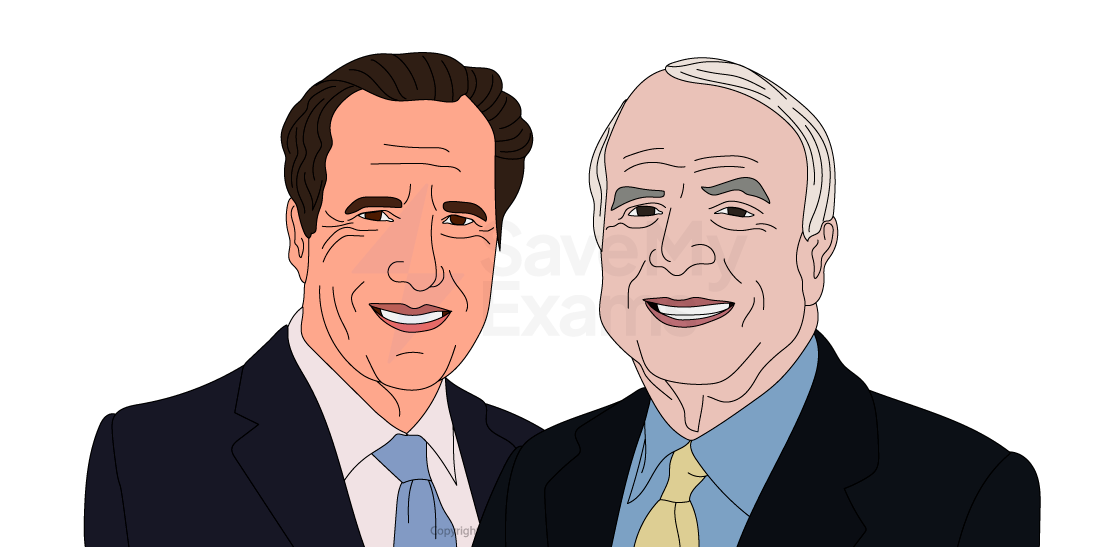
Two men in suits, one gesturing with hands outstretched, the other listening intently. Both appear engaged in a discussion or debate.
Mitt Romney and John McCain
  • Their influence has declined, but they have occasionally supported bipartisan legislation, such as the 2021 infrastructure bill

4. Religious conservatives

  • Religious conservatives focus on social and moral issues, particularly abortion and religious liberty

    • This faction strongly supported Trump’s Supreme Court nominees, whose rulings culminated in Dobbs v Jackson (2022), achieving a long-standing policy objective

5. Libertarian Republicans

  • Libertarian Republicans prioritise individual liberty and minimal state intervention

    • Senator Rand Paul opposed COVID-19 restrictions and federal surveillance legislation, including aspects of the PATRIOT Act renewal

Case Study

The Freedom Caucus
A group of men in suits stands in front of multiple microphones during a press conference outside a government building with a dome and columns.
Chip Roy, Republican elected official from Texas, and members of the conservative Freedom Caucus in Washington, 2023
  • The House Freedom Caucus is a faction of conservative Republican members of Congress

  • It is committed to limited government, fiscal conservatism and socially conservative values

  • Although relatively small in size, the caucus is highly disciplined and ideologically united

Methods of influence

  • The Freedom Caucus exerts influence by withholding support for legislation

  • Its members are willing to block bills, budgets and leadership initiatives rather than compromise

  • This gives the group disproportionate power in a closely divided House of Representatives

Impact under Paul Ryan

  • During Paul Ryan’s Speakership, the Freedom Caucus repeatedly challenged party leadership

  • It opposed budget deals and healthcare reform

  • In 2017, the caucus initially blocked the American Health Care Act, contributing to the failure to repeal the Affordable Care Act

Influence under Kevin McCarthy

  • The caucus gained greater leverage during Kevin McCarthy’s Speakership

    • In January 2023, Freedom Caucus members forced 15 rounds of voting before agreeing to support McCarthy

  • They secured key concessions, including allowing a single member to trigger a motion of no confidence

Removal of the Speaker

  • In October 2023, Freedom Caucus member Matt Gaetz used this rule to initiate a motion to remove McCarthy

  • The motion was successful, making McCarthy the first Speaker removed in this way

  • This demonstrated the caucus’s ability to shape leadership outcomes

Unlock more, it's free!

Join the 100,000+ Students that ❤️ Save My Exams

the (exam) results speak for themselves:

Sarra Jenkins

Author: Sarra Jenkins

Expertise: Content Writer

Sarra is a highly experienced A-Level Politics educator with over two decades of teaching and examining experience. She was part of the team that wrote the Edexcel 2017 Politics Specification and currently works as a Senior Examiner. A published author of 14 textbooks and revision guides, her expertise lies in UK and US politics, exam skills, and career guidance. She continues to teach, driven by her passion for this "evolving and dynamic subject".

Lisa Eades

Reviewer: Lisa Eades

Expertise: Business Content Creator

Lisa has taught A Level, GCSE, BTEC and IBDP Business for over 20 years and is a senior Examiner for Edexcel. Lisa has been a successful Head of Department in Kent and has offered private Business tuition to students across the UK. Lisa loves to create imaginative and accessible resources which engage learners and build their passion for the subject.