Globalisation & Contemporary Issues (Edexcel A Level Politics): Revision Note
Exam code: 9PL0

Globalisation and poverty
Poverty is a condition where individuals or groups lack sufficient income and resources to meet basic needs such as food, housing, healthcare and education
It is a global issue impacting all nation states to varying degrees
Multiple actors at the local, national, regional and international level are working to address poverty
Positive impacts on poverty | Negative impacts on poverty |
|---|---|
|
|
Case Study
The United Nations Sustainable Development Goals
The United Nations Sustainable Development Goals were agreed upon by all member states of the United Nations in 2015
The aim of these goals is to promote global peace and prosperity with a unified, multi-national approach
Progress towards goals
Many states have aligned their domestic policies with SDGs
Examples include investing in renewable energy, improving access to education and reducing extreme poverty
International organisations and NGOs also use the goals to guide funding and development programmes
However, progress varies between states due to differences in wealth, political stability and capacity
The goals are not legally binding, meaning states retain sovereignty and cannot be forced to comply
Globalisation and conflict
On an international level
Liberalism claims that interconnected nation states are less likely to resort to conflict to resolve differences, as global governance institutions such as the United Nations can mediate
Due to interdependence, inter-state conflict impacts multiple states and it is in the best interest of all nation-states to promote peace and conflict resolution
Realists would argue powerful states will always prioritise their own interests and that globalisation has little impact on the decision to engage in conflict
Less powerful states are left more vulnerable by the false sense of security that interdependence may bring
Within the state
Globalisation can intensify economic inequalities and these can cause internal conflict
Political and societal changes brought on by globalisation can lead to instability and conflict
However, globalisation may reduce the likelihood of conflict in the long term as standards of living improve
Globalisation and human rights
A world government is still a theoretical concept
The United Nations and many non-government organisations argue that all nation states promote and enforce the universality of the Universal Declaration of Human Rights and other human rights laws and treaties
There is a greater awareness of human rights globally and greater pressure has been placed on states to promote and enforce these rights
National sovereignty still determines whether or not these human rights are enforced
In extreme cases humanitarian intervention may be used, but this is very rare
There is some debate as to whether these rights should be universally applied, as some argue this is an attempt to force global homogenisation and monoculturalism
Case Study
Iran

Criticisms of Iran
Iran has been repeatedly criticised for its poor human rights violations, including:
Severe discrimination against women and religious and ethnic minorities
Overuse of the death penalty and violence
Suppression of free speech
A corrupt judicial system
Addressing concerns
A multilateral approach to pressure Iran to address these concerns involves many actors and is ongoing
It includes
NGOs, including Amnesty International and Human Rights Watch
The United Nations Human Rights Council
Sanctions from the UN’s Security Council and many states, including the USA and the United Kingdom
Assessing the approach
Results of a globalised approach to improving human rights are not easy to assess
Some claim that global pressure and sanctions has left the Iranian government on the brink of collapse
Others argue that despite decades of sanctions and condemnation Iran has not improved its human rights record
Globalisation and the environment
Negative Impacts | Positive Impacts |
|---|---|
|
|
Case Study
The impact of shipping on air quality
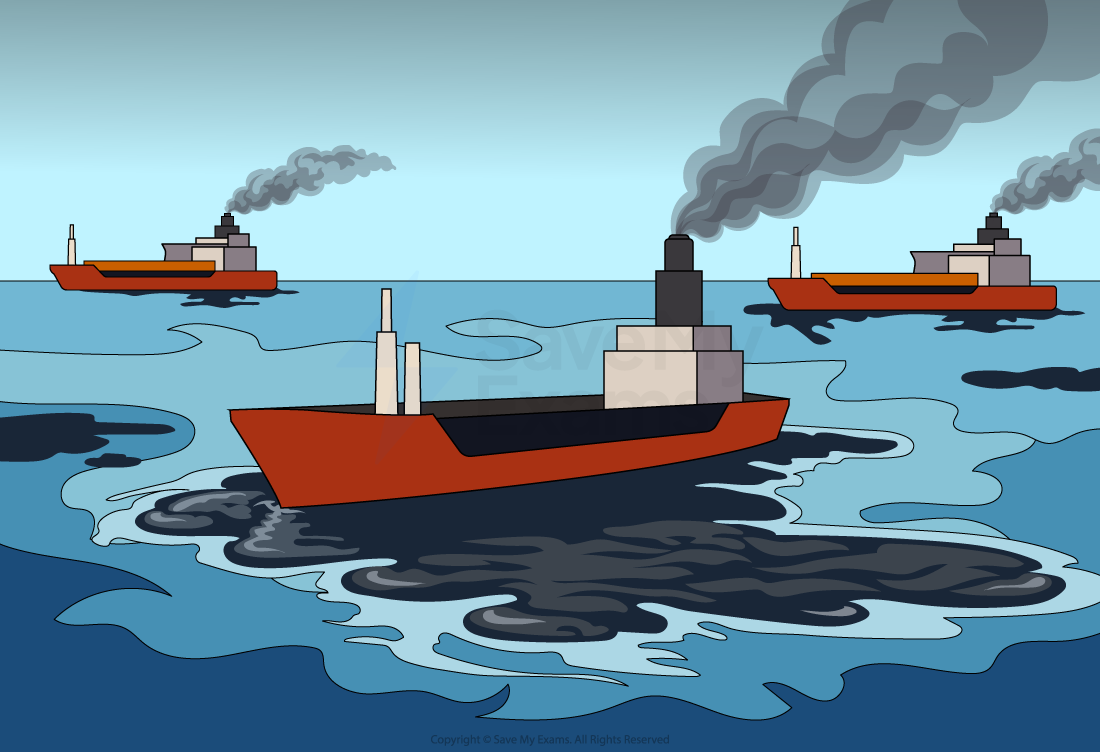
The issue
Around 90% of global trade is transported by sea, and the expansion of global supply chains has led to a growing number of cargo ships worldwide.
Most ships use heavy fuel oil, which produces large amounts of carbon emissions, sulphur oxides and nitrogen oxides
These pollutants contribute not only to climate change, but also to poor air quality, particularly in port cities and coastal areas where shipping traffic is concentrated
This can harm public health and increase pressure on governments to act
Difficulties of regulation
Because shipping mainly operates in international waters, no single state can regulate emissions effectively on its own
Regulation depends on international cooperation, especially through the International Maritime Organisation (IMO), showing the limits of national sovereignty

Unlock more, it's free!
Join the 100,000+ Students that ❤️ Save My Exams
the (exam) results speak for themselves:

Was this revision note helpful?
