Liberalism (Edexcel A Level Politics): Revision Note
Exam code: 9PL0

Morality, optimism and human nature
Liberalism is an ideology that emphasises individual freedom, limited government, and the protection of civil liberties and rights
All human beings should be free to live the life they choose
With dignity and respect
They should have personal freedoms and liberty
They should have free speech and religious choices
They should be able to choose who rules over them
All people have a duty to protect and enforce these principles
Because it is the right way to live and leads to a more peaceful world
The most powerful actor in global politics is the state and it is the duty of the state to protect its people
Other actors such as IGOs, NGOs and MNCs also play an important role in global politics
Liberalism has an essentially an optimistic worldview of human nature
Human beings are essentially good if they are treated well
People are less likely to want conflict if their needs are met
People working together are powerful and can bring about positive change
Empathy and caring for others are part of human nature
Possibility of harmony and balance
Liberals believe that peace (harmony and balance) is more sustainable in the world if:
There is a natural harmony of existence whereby governments should interfere less with social and economic mechanisms
Social order and personal freedoms are balanced
Diverse views and beliefs within society are accepted so that individuals can coexist without conflict
Power must only be used to control an individual against their will if they are a threat to others
Democratic states are more peaceful because in conflict it is the ordinary people who suffer most, and they will not choose a pathway to conflict
Complex interdependence
Liberals see global politics as a complex web of interdependence between actors and stakeholders
The result is a peaceful and prosperous planet
Today's interdependent world
Interdependence | Explanation |
|---|---|
Economically |
|
Politically |
|
Socially |
|
Liberals argue
It is impossible, and not at all desirable, for states to be completely isolated in our modern global political world
States that attempt to isolate themselves, such as North Korea, are seen as hostile, unstable places
People and governments are impacted by events taking place in other states, both good and bad
For example, technological developments or conflict have global implications
Due to the complex interdependence of the natural world, issues like climate change impact all actors and stakeholders
Likelihood of global governance
The term 'international community' is often used by global governance institutions when justifying or explaining their actions or policies
For Liberals the international community exists, supporting their belief in the universality of
desire for human rights
desire for peace
hope for a better life (development and economic stability)
Although the state is the most powerful actor in global politics, global governance institutions are essential to address the wider concerns of the international community
Especially when the state is unable or unwilling to provide safety, peace and a comfortable life for its citizens
The United Nations and global governance
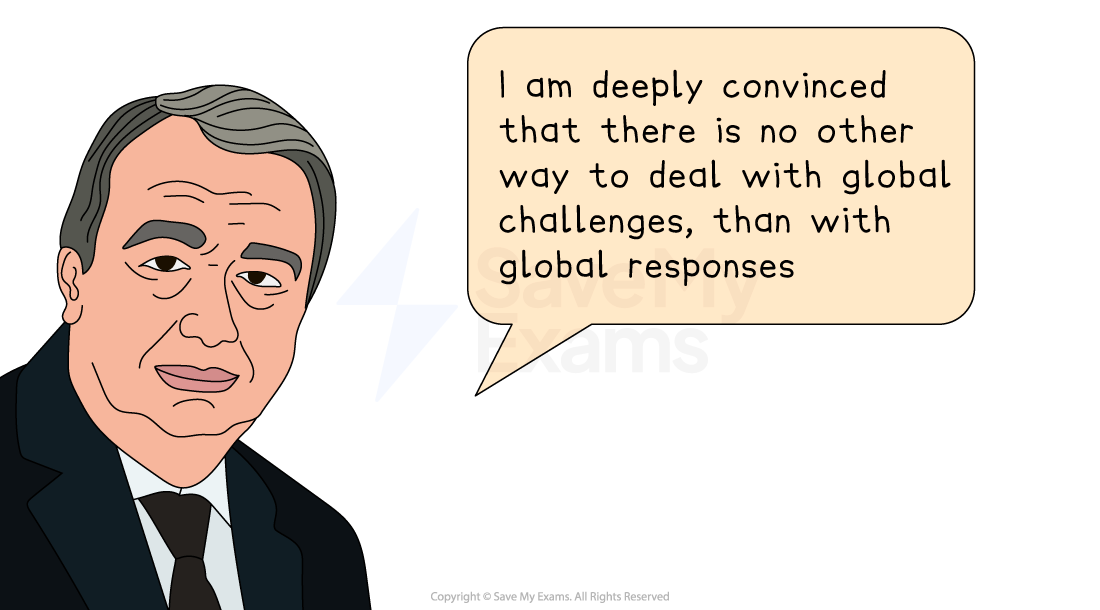
Liberals argue that the UN, though it has its faults, is an absolute necessity to address widespread global political challenges
They fear the consequences of our increasingly fractured world where the USA dominates the political agenda
Impact and growth of international organisations
International organisations include
Intergovernmental organisations
Non-government organisations
Multinational companies
Growth
Liberals argue that the most significant reason for the growth of international organisations is a desire for a world with a rule-based international system and a reduction of barriers between states
States have been persuaded to join IGOs as they can see the advantages to cooperating either both the international and regional level
Non-government organisations (NGOs) grew extensively from the 1980s, driven by an increase in democracies where people have agency and a belief in universalism
With reduced trade barriers and the promotion of economic development by IGOs, successful companies have been incentivised to expand globally
Rules and norms provide stability - Liberals argue the growth of these organisations reflect this
Impact
The impact of international organisations is variable depending on the purpose and size of the organisations and how the organisations interact with state and non-state actors
Examples
The World Health Organisation has achieved success in
Eradicating smallpox
Greatly reducing diseases such as polio through its vaccine programs
Working collaboratively with multiple NGOs and NSA to lead a global response to the Covid pandemic
The EU has mandated laws regarding the safety of consumer products in EU member states
The UN has promoted gender equality and driven legal change supporting access to education
Literacy rates for women has increased dramatically from 60% to over 80% globally since 1980
The World Bank published a report stating that only 14 states in the world have full gender equality as of 2023, demonstrating that impacting state laws does not equate to them being enforced

Unlock more, it's free!
Join the 100,000+ Students that ❤️ Save My Exams
the (exam) results speak for themselves:

Was this revision note helpful?
