Operational Performance (AQA AS Business): Exam Questions

Exam code: 7131

54 mins13 questions
1
3 marks

A small theatre business opens at the weekends.

This is the data recorded for one weekend.

Saturday

Sunday

Number of seats sold

850

980

Capacity of theatre (number of seats)

1000

1000

Calculate the capacity utilisation for the weekend above.

2
3 marks

Read the source in the Insert.

In 2023, PE Ltd had 120 employees.

The number of products it produced increased by 10% from 2022 to 2023.

Using Figure 1, calculate PE Ltd’s annual labour productivity in 2023.

3
1 mark

A business manufactures one product on a large scale. If the business introduces mass customisation, which of the following is least likely to occur?

  • Greater responsiveness to changes in consumer tastes

  • Higher added value

  • More flexible machinery

  • Reduced unit costs

4
9 marks

Case Study

Napara plc

Napara plc is a large mass market manufacturer of cars. Currently it produces four models of cars. Napara plc’s reputation had previously been for reliability. This reputation has declined in recent years. Napara plc carried out some market research. This research highlighted that customers want:

  • reliable cars

  • cars supplied without waiting times.

Table 3 Operational data for 2021

Operational data

Napara plc

Industry average

Average cars produced per 100 employees in 2021

3150

5500

Percentage of cars requiring recall for faults

2.4%

0.8%

Average time from customer order to delivery

1 month

3 months

The employees in the Napara plc factory are highly skilled but have low motivation. There is high trade union membership amongst the employees. The union members took industrial action last year when they felt management bought incorrect safety equipment that put employees at risk. The action caused negative news headlines. The employees distrust management as a result. None of Napara plc’s management have experience working on the production line. Employees worry their jobs are not being done safely and efficiently. This distrust has led to poor employee performance.

In 2023, the business has made the decision to move into the rapidly growing and highly profitable electric car market. Two of the company’s current models will be replaced with electric models. The move would require the high-end skills of many of the workers. However, some jobs may be lost.

Customers in the electric car market:

  • expect high-quality cars

  • are very concerned with the ethics of the brand

  • are willing to pay high prices.

Napara plc knows the market for these cars is rapidly changing. Napara plc’s shareholders want the company to launch its first electric car as quickly as possible. The business is considering involving employees in the planning for the new production line.

Analyse the implications of the operational data in Table 3 on the prices that Napara plc can charge its customers.

5
9 marks

Case Study

Fit Gym plc

Eamon is Chief Executive of a large gym chain called Fit Gym plc. Eamon established the business in 2008, aged 30. He is passionate about people getting fit and providing a great gym experience for customers. Eamon has £45 million in personal savings.

Eamon’s personal objectives are to:

  • continue to develop the premium image of Fit Gym

  • work within the fitness industry for at least the next decade.

The market for gym membership is growing rapidly. Fit Gym operates premium gyms based in city centres; they are open 8 am to 6 pm every day of the week. Fit Gym’s target market is city workers, who work at offices near the gym. Its busiest hours tend to be around the start and finish of the office working day.

Fit Gym’s customers are not price sensitive but expect to have easy access to the equipment. In recent weeks, capacity has been a problem as customers have complained about growing queues to use the gym equipment at busy times. Compared to rival gyms, Fit Gym has double the level of staffing to maintain a high level of customer service. Most staff are paid by the hour; the hourly pay is high for the industry.

Fit Gym became a public limited company in 2016. It has 100 million shares issued. Eamon retained 10% ownership. The current share price is 50p.

Table 2 Data comparing Fit Gym to competitors in 2020

Fit Gym

Average for competitor gyms

Monthly membership price

£60

£35

Opening hours per week

70

104

Customer satisfaction rating on gym review website

92%

78%

Staff costs

55% of total costs

30% of total costs

Line graph showing Fit Gym share price from 2016 to 2020, peaking at £3.75 in 2019, with significant fluctuations throughout the period.

Eamon has consistently argued for high levels of investment in staff, premium facilities and top-quality equipment; this has led to low dividends. Most of the other shareholders now want to cut costs to improve profitability. The shareholders have asked Eamon to cut staffing levels and sell off less profitable gyms. They want Eamon to relocate many of the remaining gyms to cheaper sites. They also want increases in dividends and have threatened to replace Eamon as Chief Executive if this does not happen.

Meanwhile, a highly profitable American gym chain is considering expanding into the UK market. It has a reputation for buying out rival chains and cutting costs.
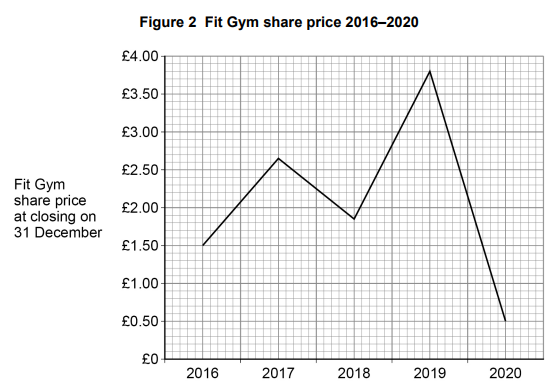
To increase capacity, Eamon is considering increasing the opening hours of its gyms.

Analyse how Fit Gym might be affected if it made this decision.

6
1 mark

The data in Table 2 refer to Abacus plc in 2018 and 2019.

Table 2

2018

2019

Number of employees

20

40

Output (units)

50

100

Capacity (units)

100

200

Statement 1: ‘Labour productivity has stayed the same between 2018 and 2019’.

Statement 2: ‘Capacity utilisation has stayed the same between 2018 and 2019’.

Read statements 1 and 2 and select the correct option from the following:

  • Statement 1 is true. Statement 2 is true.

  • Statement 1 is true. Statement 2 is false

  • Statement 1 is false. Statement 2 is true.

  • Statement 1 is false. Statement 2 is false.

7
3 marks

Read the source in the Insert.

Using the data in Figure 1, calculate the average weekly capacity utilisation in 2019.

8
1 mark

A business wishes to reduce its capacity. Which of the following actions is not a method that a business will use to achieve this aim?

  • Cutting back on capital equipment

  • Rationalising its labour force

  • Reducing output

  • Selling a factory to another business

9
1 mark

The data below applies to two different factories.

Factory

Capacity (units)

Actual output (units)

Number of employees

Cost of equipment

A

100

80

10

£1m

B

200

170

40

£1m

Statement 1: ‘Factory A has a higher capacity utilisation than Factory B.’

Statement 2: ‘Factory B uses more capital-intensive production than Factory A.’

Read statements 1 and 2 and select the correct option from the following:

  • Statement 1 is true. Statement 2 is true.

  • Statement 1 is true. Statement 2 is false.

  • Statement 1 is false. Statement 2 is true.

  • Statement 1 is false. Statement 2 is false.

10
5 marks

The total output of a business increased by 15.5% between 2017 and 2018. Using the table below calculate the change in labour productivity. Show your workings.

Labour productivity (units)

Number of employees

Total units output

2017

80

40

2018

42

11
1 mark

In 2016 a business had 12 employees and produced 60 units of output. Its capacity utilisation was 75%. In 2017 it achieved 100% capacity output with the same labour force. Labour productivity per employee in 2017 was

  • 6.67 units.

  • 6 units.

  • 5 units.

  • 3.75 units.

12
16 marks

Read the case study in the insert booklet.

Was HS right to sell the three hostels in 2016? Justify your view.

13
1 mark

Actual output for a factory in April 2017 was 35 500 units and its maximum possible output was 46 500. What was its capacity utilisation?

  • 73.09%

  • 76.34%

  • 82.13%

  • 83.25%