Synoptic Exam Questions (AQA AS Chemistry): Exam Questions

Exam code: 7404

2 hours11 questions
1a
2 marks

An unknown sample of pure magnesium is analysed using a time-of-flight (TOF) mass spectrometer. The sample is ionised by electron impact to form Mg+ ions.

Explain why magnesium has a higher melting point than sodium.

1b
3 marks

The first ionisation energy of magnesium is higher than that of aluminium.

State the full electron configuration of a magnesium atom and use it to explain why this is the case.

1c
3 marks

In the mass spectrometer, a 25Mg+ ion travels along a 1.50 m flight tube. The ion takes 5.58 x 10⁻⁶ s to reach the detector.

Calculate the kinetic energy, in J, of one 25Mg+ ion.

(The Avogadro constant, L = 6.022 × 10²³ mol-1)

1d
1 mark

The mass spectrum of the sample showed three peaks with the following abundances:

m/z

Relative abundance

24

79.0

25

10.0

26

11.0

Calculate the relative atomic mass of this sample of magnesium. Give your answer to one decimal place.

1e
2 marks

A different ion with a mass of 4.32 x 10⁻²⁶ kg is accelerated to the same kinetic energy as the 25Mg+ ion.

Deduce whether this ion will take a longer or shorter time to travel through the flight tube. Explain your answer.

2a
2 marks

Butane (C4H10) is a saturated hydrocarbon used as a fuel in camping stoves.

Butane is a member of the alkane homologous series. State two characteristics of a homologous series.

2b
1 mark

Write a balanced equation for the complete combustion of butane gas.

2c
4 marks

A mass of 5.25 g of butane gas is burned completely in oxygen. The carbon dioxide gas produced is collected at a temperature of 50 °C and a pressure of 105 kPa.

Calculate the volume of carbon dioxide gas produced, in dm3.
(The ideal gas constant R = 8.31 J K-1 mol-1)

2d
1 mark

Butane exists as structural isomers. The isomer, 2-methylpropane, is also used as a fuel.

Draw the skeletal formula of 2-methylpropane.

2e
4 marks

The enthalpy of combustion of 2-methylpropane is -2869 kJ mol-1.

Use the mean bond enthalpies in the table to calculate the enthalpy of combustion for butane (C4H10) and suggest a reason, based on bonds, why the values for the two isomers are different.

Bond

Bond Enthalpy / kJ mol⁻¹

C–H

413

C–C

347

O=O

498

C=O

805

O–H

464

3a
3 marks

A chemist is investigating reactions of 3-bromopropan-1-ol, shown below.

Structural formula of 1-bromo-2-propanol: three carbon chain with bromine on first carbon, hydroxyl group on third. Hydrogen atoms fill remaining bonds.

In the first experiment, 3-bromopropan-1-ol is heated with an excess of aqueous sodium hydroxide. The C–Br bond is broken and a new organic product, propane-1,3-diol, is formed.

Outline the mechanism for this reaction.

Include curly arrows, relevant lone pairs and dipoles.

3b
3 marks

The chemist wants to confirm that the bromide ion has been produced.

Describe a chemical test that could be carried out on the resulting solution to confirm the presence of bromide ions.

Include the reagents used and the expected observation.

3c
2 marks

The reaction in part (a) is repeated using 3-chloropropan-1-ol.

The rate of reaction is observed to be significantly slower.

Explain this difference in rate.

3d
3 marks

Explain why propane-1,3-diol has a significantly higher boiling point (214 °C) than 3-bromopropan-1-ol (162 °C).

3e
1 mark

In a second experiment, 3-bromopropan-1-ol is heated with hot, ethanolic potassium hydroxide. This causes an elimination reaction to occur.

Draw the displayed formula of the organic product of this elimination reaction.

4a
1 mark

Geraniol is a primary alcohol found in rose oil. Its structure is shown below.

Chemical structure of geraniol, showing two isopropenyl groups and an alcohol group (OH) at the end of a hydrocarbon chain.

Geraniol is heated under reflux with an excess of acidified potassium dichromate(VI). A new product, Z, is formed.

Name the functional group in product Z that is formed from the alcohol group in geraniol.

4b
1 mark

State the expected colour change during this reaction.

4c
2 marks

The chemist wants to confirm that the reaction has occurred. The product Z is separated from the reaction mixture.

Describe a chemical test, other than using Tollens' reagent or Fehling's solution, that would give a positive result with product Z but a negative result with the starting material, geraniol.

4d
2 marks

The chemist performs another test by shaking a sample of geraniol with bromine water.

State the expected observation and name the type of reaction occurring.

4e
2 marks

In the reaction in part (a), the dichromate(VI) ion, Cr2O72-, is converted to the Cr3+ ion.

Deduce the oxidation state of chromium in the Cr2O72- ion and write a balanced half-equation for the conversion of Cr2O72- in acidic solution to Cr3+ ions.

4f
2 marks

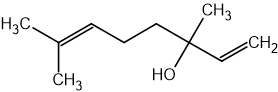
Another naturally occurring alcohol is linalool, shown below, which is a structural isomer of geraniol.

Chemical structure of linalool.

Explain why linalool would not react with acidified potassium dichromate(VI).

5a
2 marks

Strontium is a Group 2 element that reacts with nitrogen gas at high temperatures to form an ionic compound, strontium nitride.

Strontium has a higher first ionisation energy than barium but a lower first ionisation energy than calcium.

Explain why strontium has a higher first ionisation energy than barium.

5b
1 mark

The nitride ion is formed when a nitrogen atom gains three electrons.

Write the full electron configuration for a nitride ion (N3-).

5c
5 marks

A 3.55 g sample of pure strontium nitride is added to 200 cm3 of deionised water. It reacts completely according to the equation below. The resulting solution is transferred to a 250 cm3 volumetric flask and made up to the mark with deionised water.

Sr3N2 (s) + 6H2O (l) → 3Sr(OH)2 (aq) + 2NH3 (aq)

A 25.0 cm3 sample of this strontium hydroxide solution is then titrated with 0.150 mol dm-3 hydrochloric acid.

Calculate the volume of hydrochloric acid, in cm3, required to reach the end-point.

5d
3 marks

State and explain the shape of the ammonia molecule, NH3.