Market Research (OCR GCSE Business): Exam Questions

Exam code: J204

49 mins21 questions
1
9 marks

Case Study

J Sainsbury plc (Sainsbury’s)

Sainsbury’s is one of the UK’s largest supermarket chains. Sainsbury’s targets middle to high income customers nationally. Sainsbury’s is owned by shareholders who have limited liability.

The supermarket industry is very competitive, and marketing promotions are important. An example is Sainsbury’s price match against similar products sold by Aldi, one of its competitors. Sainsbury’s also spends a large proportion of its marketing budget on television advertising.

Developing new products is important to remain competitive, as customers are always looking for something new. Sainsbury’s uses market segmentation to support successful product development.

Sainsbury’s managers believe that good food should be accessible to everyone. They use primary market research to ensure the business develops products that meet the needs of its customers.

(i) Identify two primary market research methods.

[2]

(ii) Evaluate whether Sainsbury’s should use primary or secondary market research methods in the future.

[7]

2
3 marks

Case Study

C & J Clark International Ltd (Clarks)

Clarks is a successful UK footwear brand with ranges for children, women, and men. Their market is very competitive. Clarks employs specialist designers who create new shoe styles in response to fast-changing fashion trends.

The designers interpret quantitative data carefully when planning new shoe styles. The designers work closely with employees from other functional areas of the business, such as marketing, finance, and retail, to ensure that the new shoe styles meet customers’ needs profitably.

Clarks works hard to retain its team of designers, as they are central to its success. However, Clarks sometimes needs to recruit new designers and uses several selection methods to help find the best person available to fill the vacancy.

Analyse one advantage for Clarks of interpreting quantitative data when designing new products.

3
1 mark

A small business that sells baby clothes has done some market research using a range of information sources.

Which of the following would have been obtained from internal data?

  • Articles in parenting magazines

  • Competitor websites

  • Government statistics on birth rates

  • Sales figures showing the shop’s best-selling products

4
1 mark

A firm only has the resources to introduce one new product to the market. The results of its market research survey are shown below.

  • 5% of women and 18% of men said they would consider buying the product.

  • Of these, 30% favoured the basic model and 70% favoured the advanced model.

Which one of the following does the market research suggest it would be best for the firm to do?

  • Produce the advanced model and target men

  • Produce the advanced model and target women

  • Produce the basic model and target men

  • Produce the basic model and target women

5
1 mark

A restaurant constantly monitors the dishes on its menu. It has collected data about customers’ preferred flavours of soup for three years.

Year

Percentage of customers who preferred each flavour of soup

Tomato

Leek and potato

Chicken

2020

40%

25%

35%

2021

37%

28%

35%

2022

32%

32%

36%

According to the data, over the last three years which of the following is true?

  • Chicken soup has never been the customers’ preferred flavour

  • In 2020, chicken soup and tomato soup were equally popular with customers

  • Leek and potato soup has gained in popularity with customers over the years

  • Tomato soup has always been the customers’ preferred flavour

6
1 mark

What is not a secondary source of market research?

  • Focus groups

  • Internal business data

  • Newspapers

  • Websites

7
1 mark

Mia is the owner of a small, independent, fashion store. She is wondering whether to start selling clothing specifically targeted at people aged over 65.

Which type of market research activity would best help Mia make this decision?

  • Searching lifestyle magazines for articles about saving for retirement

  • Searching national census data to find out how many people live in the UK

  • Searching the internet for charities that support the elderly

  • Searching the local government’s website for age‑related population figures

8
6 marks

Case Study

Walkers Snack Foods Ltd

Walkers Snack Foods Ltd (Walkers) manufactures well‑known snacks, including Walkers crisps, Quavers and Wotsits. The company has a market share of more than 50% of the UK potato snack market. The company aims to maintain its market share and to increase profitability.

Walkers uses different marketing strategies as the snacks move through the stages of the product life cycle. Flavours are regularly added to Walkers’ range of crisps, often trialling new flavours before launching them. Recent examples have included ‘fish & chips’ and ‘chicken burrito’ flavours.

Walkers have responded to concerns about healthy eating by adapting its product range, including:

  • recipe changes to reduce added salt by 25% and saturated fats by up to 70%

  • a reduction in bag size

  • multipacks now containing 22 bags rather than 24, with no change in price.

These changes were supported by a marketing strategy which affected all elements of the marketing mix.

An independent market research company arranged focus groups in both 2017 and 2022 to look at healthy eating trends. It found that:

  • 46% of people were concerned about healthy eating in 2017, compared with 60% in 2022.

  • In 2022, 36% of people considered whether a snack was healthy before buying it.

  • In 2017, 26% of people thought that snack companies were trying to produce more healthy products. By 2022 this figure had increased to 29%.

Analyse two advantages for Walkers of trialling new products before launching them.

9
1 mark

An entrepreneur is thinking of opening a restaurant in their local area.

What is an example of qualitative market research data they could use?

  • The number of adults who live and work in the local area

  • The percentage of the population who eat out once a week

  • The preferences of local residents when eating out

  • The prices charged by local competitors

10
1 mark

A store sells a range of alcoholic and non-alcoholic drinks. Nina, the owner of the store, is trying to decide whether to stock a new range of non-alcoholic herbal drinks.

Which type of market research activity would help Nina make this decision?

  • Analysing data in the most recent census

  • Reading articles in specialist fine wine magazines

  • Studying the sales data for the store’s best-selling alcoholic drink

  • Trialling the new drinks in the store and monitoring sales

11
1 mark

The owner of a salad bar has done some market research.

Which of the following is an example of a secondary research source the salad bar owner could have used?

  • Giving out free samples of the salads and collecting feedback

  • Looking at magazines on healthy eating and nutrition

  • Online questionnaires emailed to regular customers

  • Visiting a rival store and noting down the types of salads it sells

12
2 marks

Case Study

Waitrose

Waitrose is a supermarket chain with over 300 stores throughout the UK. Waitrose specialises in good quality food, targeted at customers with high levels of income. The company is owned by its employees, who receive a range of benefits including profit sharing. Waitrose continues to offer profit sharing to its employees, even though another UK supermarket chain has replaced this type of benefit with higher rates of pay.

Waitrose has over 50 000 employees. Many employees are recruited externally. As part of the selection process, potential employees take part in lengthy interviews, group activities and tests. References are requested for all new employees. Once appointed, all employees receive regular training.

The supermarket industry is very competitive, so new product development is important to Waitrose. Qualitative market research data is collected using methods including focus groups and customer trials. This data then needs to be communicated effectively between employees at Head Office.

Explain what is meant by a focus group.

13
2 marks

Case Study

Waitrose

Waitrose is a supermarket chain with over 300 stores throughout the UK. Waitrose specialises in good quality food, targeted at customers with high levels of income. The company is owned by its employees, who receive a range of benefits including profit sharing. Waitrose continues to offer profit sharing to its employees, even though another UK supermarket chain has replaced this type of benefit with higher rates of pay.

Waitrose has over 50 000 employees. Many employees are recruited externally. As part of the selection process, potential employees take part in lengthy interviews, group activities and tests. References are requested for all new employees. Once appointed, all employees receive regular training.

The supermarket industry is very competitive, so new product development is important to Waitrose. Qualitative market research data is collected using methods including focus groups and customer trials. This data then needs to be communicated effectively between employees at Head Office.

Explain one advantage for Waitrose of using customer trials.

14
3 marks

Case Study

Greggs

Greggs is a modern ‘food-on-the-go’ retail brand. It specialises in selling sandwiches, cakes, pastries and pies. Most of these are made by Greggs, using raw materials such as flour, meat and yeast. The company opened its first bakery 80 years ago and has since grown significantly. It currently has 20 000 employees. Greggs’ aim is to become the customer’s favourite for ‘food-onthe-go’ in the UK. This sector is growing quickly and is forecast to be worth £23.4 billion by 2024 (up from £18.5 billion in 2019).

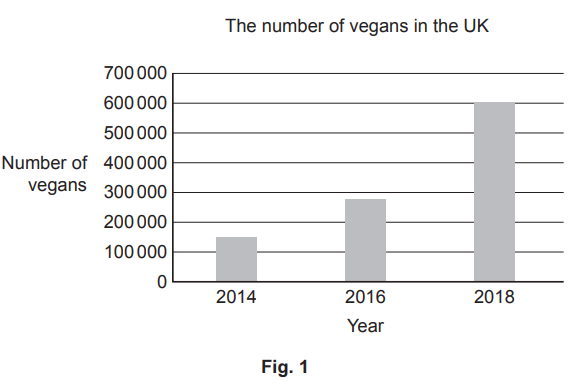
According to The Vegan Society, the number of people in the UK choosing a vegan diet has increased during recent years (see Fig. 1).

Bar chart showing the increase in the number of vegans in the UK from 150,000 in 2014 to 276,000 in 2016, reaching 600,000 in 2018.

Using the market data, Greggs responded to this change by launching vegan sausage rolls in January 2019. The publicity generated helped Greggs’ total sales to increase by 9.6% in its next seven weeks of trading. Following this success the business launched other products, including vegan doughnuts and vegan steak bakes, based on consumer demand.

Managers at Greggs constantly monitor changes in consumer tastes. Similarly, they keep up-to-date with changes in employment law. Greggs’ managers also take pride in the business being named one of the happiest places to work in the UK. Greggs offers many ways of working, including part-time roles.

Analyse one benefit for Greggs of using market data to create new products.

15
1 mark

Understanding customer needs is the main purpose of:

  • employee retention

  • innovation

  • market research

  • the product lifecycle

16
1 mark

Sailing Clothes Ltd is about to produce a new jumper. The company has collected market research data on the clothing size of 800 sailing enthusiasts.

Clothing size

Number of sailing enthusiasts who are this size

XXS

20

XS

25

S

140

M

80

L

130

XL

165

XXL

200

XXXL

40

Which sizes of the sailing jumper does the data suggest Sailing Clothes Ltd should concentrate on producing?

  • L, XL and XXL

  • M, L and XL

  • S, L and XXL

  • S, XL and XXL

17
9 marks

Case Study

EDF

EDF is a limited company which supplies gas and electricity to homes and businesses throughout the UK. It is the largest producer of low-carbon electricity in the UK and owns two fossil fuel power stations, three wind farms and eight nuclear power stations.

In 2016, EDF started to build the new Hinkley Point C nuclear power station in Somerset, which will eventually provide 7% of the UK’s electricity needs for 60 years. Managers at EDF expect it to open in 2025.

During the construction stage, the project has created thousands of jobs. A number of these construction jobs are filled by self-employed workers. Once it is fully operational, the power station will employ over 900 people, most of whom will be employed by EDF.

EDF produces around 20% of the UK’s electricity and is the largest supplier. As EDF operates in a competitive market, the price that it charges its customers is very important.

Analyse one benefit to EDF of using each of the following primary market research methods.

(i) Focus groups

[3]

(ii) Questionnaires

[3]

(iii) Recommend whether focus groups or questionnaires is the best primary market research method for EDF to use. Give reasons for your answer.

[3]

18
1 mark

Madame Co is a women’s clothing manufacturer. To identify trends in the market, the firm carries out a lot of market research.

The cost of the market research for Madame Co in the last year is shown in the table below.

Quarter 1

Quarter 2

Quarter 3

Quarter 4

Cost of market research

£1.2 million

£0.7 million

£1.5 million

£0.9 million

Madame Co’s average quarterly spend on market research is:

  • £1.05 million

  • £1.075 million

  • £2.15 million

  • £4.3 million

19
1 mark

The table below shows market data for three fizzy drinks. The recipes used to make the drinks were changed to reduce the amount of sugar.

Quantity of drinks sold before the recipe was changed

Quantity of drinks sold after the recipe was changed

Drink A

9.4 million litres per month

10.3 million litres per month

Drink B

8.0 million litres per month

7.2 million litres per month

Drink C

6.5 million litres per month

4.0 million litres per month

According to the table, which one of the following statements is true?

  • Demand for all three drinks decreased significantly

  • Demand for Drink A increased by 1.1 million litres

  • Demand for Drink B fell by 10%

  • Demand for Drink C decreased by a smaller percentage than Drink B

20
1 mark

A national retailer intends to trial a new product in some of its stores.

Which of the following is not a benefit of trialling the product?

  • It avoids wasting money on an unsuccessful national launch

  • It helps identify the target market

  • It requires a lot of national advertising and promotion

  • It shows whether there is sufficient demand for the product

21
2 marks

Case Study

The Ford Motor Company Ltd

The Ford Motor Company Limited (Ford Motors) is a global manufacturer of a range of vehicles including cars, vans, trucks and buses. Ford Motors has been one of Britain’s best-selling car brands for over 30 years, with a range of models including the KA, Fiesta, Focus, Mondeo and Galaxy. The company’s large range of products includes models that differ in size to meet the individual needs of different market segments, including eco-friendly small cars, family cars, sports cars and 7-seater people carriers.

Ford Motors carries out a lot of market research when developing new car designs and uses both primary and secondary research. This ensures that new car designs and models meet the needs of potential customers.

Each model’s sales levels are regularly monitored against the product lifecycle.

State two secondary market research sources which Ford Motors could use.