How are towns & countryside in the UK changing? (WJEC Eduqas GCSE Geography B): Revision Note
Exam code: C112

Specification links
The notes on this page cover part 1.2.1 of the WJEC Eduqas B specification
1.2.1 - What changes are taking place in where people live in both urban and rural areas of the UK?
An overview of urban change in the UK includes the processes of urbanisation, suburbanisation, counter-urbanisation, re-urbanisation and infill.
The impact of change on rural areas of the UK includes villages which have become commuter settlements.
Urban changes in the UK
Urban change in the UK has occurred in distinct phases over time, shaped by:
Economic shifts
Industrial decline
New planning policies
Urban settlements first appear as a result of agglomeration:
People gather together in one area to sell goods and live
Small trading posts and villages begin to develop
These are the first signs of urbanisation
Urbanisation (1750–1950)
Causes
Growth of manufacturing during the Industrial Revolution
Rural–urban migration as people sought work in factories
Development of transport (railways, canals) connecting towns
Consequences
Rapid growth of industrial cities like Manchester, Birmingham, Glasgow, and Cardiff
Overcrowded housing, poor sanitation, and pollution
Creation of the first large working-class urban communities
Modern relevance
Many of these industrial areas still face regeneration challenges after deindustrialisation
Suburbanisation (1950s–1970s)
As areas grew, they expanded outward through a process known as suburbanisation
This adds to the built-up area, but the building densities are generally lower than in the older parts of the town
The new suburbs are made up of mostly houses, but also include places of employment and services
Causes
Post-war housing demand and the expansion of the railway and motorway network
Rising car ownership made commuting easier
Desire for larger homes, gardens, and cleaner environments
Consequences
Growth of suburban estates and new housing developments
Decline in inner-city population as wealthier families moved out
Urban sprawl and loss of farmland on city edges
Examples
Expansion of Bristol, Manchester, and London suburbs such as Croydon and Harrow
Evaluation
The quality of life for many families improved
However, there is now an increased car dependency and pressure on greenfield sites
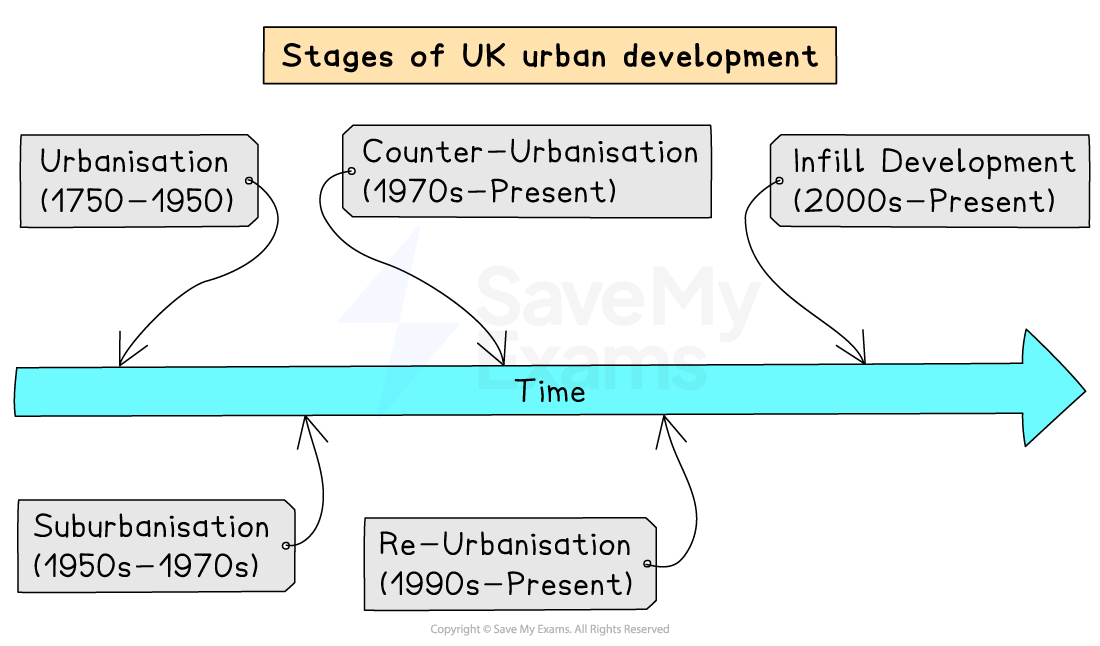
Counter-urbanisation (1970s–present)
This is the movement of people from an urban area into the surrounding rural region
Urban settlements continue to prosper and grow, while many people move out of the town or city entirely and commute to work, forming commuter settlements
They continue to have links with the town or city they have left
They still make use of urban services, shops, education, and healthcare
Causes
Growth of teleworking and flexible employment
Improved road and rail links, enabling longer commutes
Desire for rural lifestyle, safety, and open space
Rising inner-city house prices are driving people outward
Consequences
Growth of small towns and villages near cities
Increased demand for housing, leading to commuter settlements
Changes in village character and rising property prices
Examples
Sevenoaks (Kent), Marlow (Buckinghamshire), and Chepstow (South Wales) have become commuter towns for London, Reading, and Bristol
Rural areas around Leeds and Manchester (e.g. Ilkley, Hebden Bridge) have grown significantly
Evaluation
Revitalises rural economies and services
It has led to:
Congestion
Loss of village character
Unaffordable housing
Re-urbanisation (1990s–present)
Re-urbanisation is the process of people moving back into declining inner-city areas, reversing previous trends of suburbanisation and counter-urbanisation
Causes
Driven by urban regeneration, gentrification and redevelopment of brownfield sites
New employment in services, creative industries, and technology
Desire for urban amenities
Growth of city-centre universities attracting young populations
Government investment in housing and transport
Consequences
Population growth in city centres: reversal of previous decline
Increase in leisure, retail, and cultural activities
Rising property prices and gentrification are displacing lower-income residents
Examples
Manchester – redevelopment of Salford Quays, where derelict areas were redeveloped into new communities and MediaCityUK
Cardiff – regeneration of Cardiff Bay, creating new housing and leisure spaces
Bristol – Harbourside redevelopment with mixed housing and offices
Evaluation
It has created vibrant, modern city centres and boosted local economies
However, gentrification has increased inequality and reduced affordable housing
Infill development (2000s–present)
Definition
Using vacant or derelict plots (brownfield land) within cities for new housing, shops, or community projects
Causes
Government policy encouraging the use of brownfield sites
Reduces urban sprawl and preserves rural land
Examples
London Docklands regeneration: new apartments and offices built on disused land
Urban infill projects in Bristol’s Temple Quarter and Leeds Waterfront
Evaluation
Efficient use of space improves derelict areas and reduces commuting distances
Can cause overcrowding and loss of green space within cities
The impact of urban change
Positive Impacts
Job creation and new investment
Better housing and transport
Revitalised city centres with tourism and cultural opportunities
Negative Impacts
Rising inequality between rich and poor areas
Pressure on infrastructure and public services
Environmental problems like pollution and congestion
Rural change in the UK
Population changes, economic issues, and increased service demand have impacted UK rural areas
Counter-urbanisation is having a bigger impact on rural areas, which is leading to commuter settlements
These changes bring opportunities but also challenges — especially for housing affordability and community ties
Causes of rural change
Improved transport links (motorways, high-speed rail) make daily commuting possible
Growth of remote and flexible working
Desire for a rural lifestyle and lower crime rates
The expansion of nearby cities is increasing housing demand
Young people are leaving rural areas to look for jobs
Characteristics of commuter settlements
Predominantly residential, with many residents working elsewhere
High proportion of middle-income professionals
Growth of new housing estates and renovated farm buildings
Examples
South Oxfordshire villages (e.g. Kidlington) – popular with commuters to Oxford and London
South Wales valleys (e.g. Pontypridd, Caerphilly) – connected to Cardiff by rail
Cotswold villages – increasing in population due to proximity to Bristol and Birmingham
Positive impacts of rural change
More customers for rural services such as pubs, shops, and schools
Improved broadband and public transport links
Refurbishment of old buildings and improved infrastructure
Diversification of local economies (tourism, small business, creative industries)
Negative impacts of rural change
New developments and the influx of wealthier residents increase house prices, which exclude younger or lower-income locals
Increase in car ownership and traffic congestion and a strain on infrastructure
Decline in traditional farming and local employment
Reduced sense of community as populations become more transient
An ageing population and fewer services
Comparison – urban vs rural change
Type of Area | Main Process | Key Causes | Main Impacts |
|---|---|---|---|
Urban (cities) | Urbanisation, suburbanisation, re-urbanisation, infill | Economic restructuring, regeneration, and transport improvements | Growth, gentrification, inequality |
Rural (villages) | Counter-urbanisation, commuter settlement growth | Transport access, lifestyle changes, and teleworking | Rising house prices, loss of rural identity, and improved services |
Worked Example
Explain one cause and one effect of counter-urbanisation in the UK. [4 marks]
Answer
One cause of counter-urbanisation is that people want to live in quieter rural areas while keeping access to city jobs [1], made possible by better transport and home working. [1]
An effect is that rural villages near cities such as Sevenoaks or Marlow [1] have grown rapidly, with new housing and rising property prices. [1]
Mark allocation
1 to 2 marks – identifies cause and effect.
3 to 4 marks – explains consequences and uses place example.
Examiner Tips and Tricks
Always name a process (e.g. counter-urbanisation, re-urbanisation).
Include one cause and one effect to reach 4 marks.
Use specific examples — even small place names impress examiners.
For six-mark questions, compare positive and negative effects for full balance.

Unlock more, it's free!
Join the 100,000+ Students that ❤️ Save My Exams
the (exam) results speak for themselves:

Was this revision note helpful?
