What drives change in towns and villages? (WJEC Eduqas GCSE Geography B): Revision Note
Exam code: C112

Specification links
The notes on this page cover part 1.2.3 of the WJEC Eduqas B specification
1.2.3 - What factors help drive urban and rural change across the UK?
The factors that drive urban renewal include economic, social, and environmental aspects and the brownfield/greenfield debate.
A number of factors contribute to the depopulation of certain rural areas in the UK.
Drivers of urban renewal in the UK
Urban renewal in the UK is driven by economic change, social trends, and environmental goals
Many older industrial cities have had to reinvent themselves following deindustrialisation
Economic factors
Deindustrialisation:
Manufacturing decline in the 1970s–80s left many inner-city areas with high unemployment
Cities like Sheffield, Glasgow, and Liverpool lost traditional industries (steel, shipbuilding, textiles)
Regeneration and investment:
Urban renewal projects attract new businesses and investment
Government and private sector partnerships redevelop brownfield land (e.g. Salford Quays, Cardiff Bay)
Tertiary and quaternary growth:
Shift to service and technology industries encourages city-centre redevelopment
Bristol’s Temple Quarter and Manchester’s MediaCityUK are examples of digital and creative hubs
Globalisation and connectivity:
Improved transport links, airports, and broadband attract international firms
Evaluation:
Regeneration creates jobs and new opportunities
Economic benefits can bypass lower-income communities, increasing inequality
Social factors
Population growth and migration:
Young professionals and students move back to city centres (re-urbanisation)
Internal and international migration increases diversity and demand for housing
Lifestyle change:
Growing interest in city-centre living and leisure opportunities
Redevelopment of waterfronts, canals, and old warehouses into flats and restaurants
Housing demand:
Rising population pushes housing prices up, creating affordability challenges
Demand drives both brownfield and greenfield developments
Evaluation:
Increases vibrancy and diversity
Risk of displacement (gentrification) and reduced affordability
Environmental factors
Derelict land and pollution:
Brownfield sites in old industrial areas are often contaminated
Regeneration cleans up land and improves urban image
Sustainability goals:
Green transport, renewable energy, and urban greening reduce emissions
Example: London’s Docklands redevelopment included parkland and riverside walkways
Climate adaptation:
Urban design now includes flood defences, tree planting, and sustainable drainage
Evaluation:
Improves air quality, health, and attractiveness of cities
Environmental goals can increase costs and delay redevelopment
Greenfield vs brownfield
Urban growth involves building on land, which is in short supply in the urban centres
This makes the open land around the urban fringe desirable for:
housing
industry
shopping
recreation
public utilities such as reservoirs and sewerage works
However, some people feel that too much countryside is being lost through the outward growth of towns and cities
Some urban areas have a planned and protected greenbelt on which no development is allowed, but urban areas still need to grow
This means there are two choices: either build on a greenfield or a brownfield site
The brownfield vs greenfield debate shapes how cities expand and regenerate
Brownfield development
Advantages:
Reuses existing land, reducing pressure on the countryside
Often close to city centres, with transport and utilities already in place
Can revitalise derelict or polluted areas
Reduces the risk of informal settlements developing
Disadvantages:
High cost of cleaning up contaminated sites
Limited space and potential for high-density housing
May increase inner-city congestion
Often surrounded by rundown areas, so does not appeal to wealthy people
Example: Bristol Harbourside and London Docklands
Greenfield development
Advantages:
Cheaper and quicker to build on
Land is easier to prepare, and allows modern housing layouts
Expansion is not restricted by the existing layout
Attractive rural environment appeals to buyers
Healthier environment
Access and infrastructure are easier to build
Disadvantages:
Destroys habitats and green space
Valuable farmland lost
Increases car dependency and urban sprawl
May face opposition from local communities (‘NIMBYism’)
Lacks access to public transport
Development causes noise and light pollution in the surrounding countryside
Cost of installing services such as water, electricity, sewage, etc.
Example: Milton Keynes expansion and Cambridge Science Park
Evaluation
There are no clear winners in this debate
It depends on the particular land use:
Housing is flexible in terms of where it could be built
However, shops and offices need more space and specific locations
Depends on the needs of the town or city
What value does the greenspace really have for the town or city?
The issues and costs in reusing the brownfield site (asbestos, etc.) need to be considered
The UK's planning policy now encourages 'brownfield first' to protect the countryside
However, housing shortages mean some controlled greenfield development is still necessary
Sustainable planning aims to blend both, ensuring infrastructure and green space are provided
Rural depopulation
Rural areas are defined as areas with a population of less than 10,000
Not all parts of the UK are growing—some remote rural areas are losing population, especially in upland or coastal regions
In the UK, 19% of people live in rural areas
Rural depopulation results from limited job opportunities, ageing populations, and poor connectivity
Economic factors
There has been a decline in farming due to mechanisation
There are now fewer local job opportunities in traditional rural industries, manufacturing or services
Younger workers migrate to towns and cities for employment
Example: The Scottish Highlands and parts of rural Wales have experienced long-term population loss
Social factors
As young people move out, it leaves behind an ageing population that requires higher amounts of social care, which will have social and economic impacts
There are now fewer schools, shops, and healthcare services, reducing community appeal
Outmigration causes a negative multiplier effect or ‘spiral of decline’—fewer people mean fewer services, which drives more people away
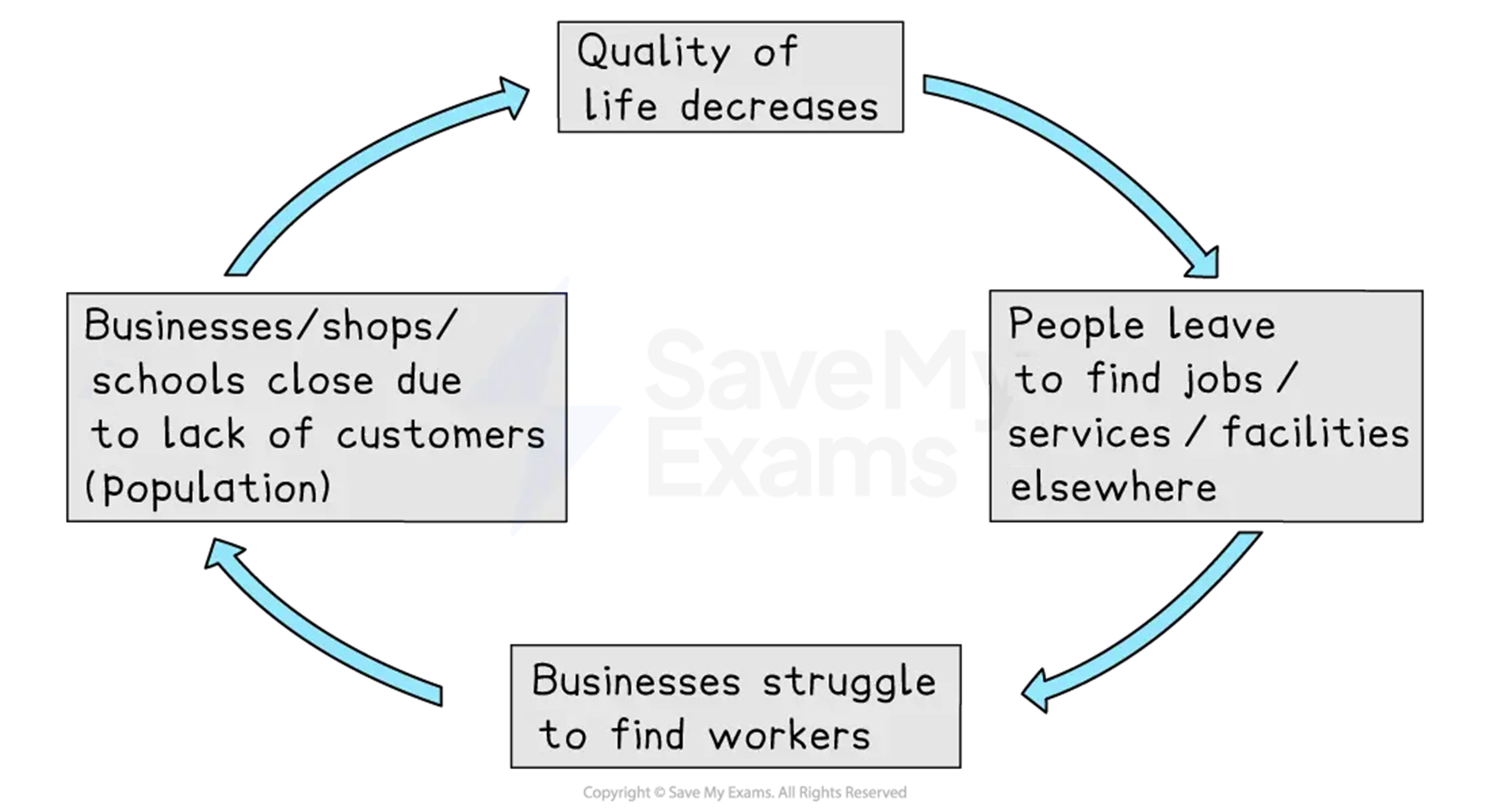
Environmental factors
Harsh climate and limited transport in upland areas discourage investment
Isolation and poor broadband reduce access to modern work opportunities
Some coastal villages are affected by erosion or flood risk
Consequences of rural depopulation
Positive impacts |
|
|---|---|
Negative impacts |
|
Government and community responses
Diversification: Encouraging tourism, renewable energy, and digital industries in rural areas
Infrastructure investment: Broadband, transport, and healthcare improvements to retain residents
Affordable Housing Schemes: Supporting young families to stay in rural communities
Protected landscapes: Using National Parks and Areas of Outstanding Natural Beauty (AONBs) to attract sustainable tourism
Example: Snowdonia National Park promotes eco-tourism and digital connectivity projects to slow depopulation
Management, therefore, requires a balanced, sustainable planning that supports growth while protecting communities and the countryside
Worked Example
Explain one economic factor and one social factor that drive urban renewal in the UK. [4 marks]
Answer
One economic factor driving urban renewal is deindustrialisation [1], which leaves older industrial areas vacant and in need of regeneration. [1]
One social factor is population change, as more young professionals and students move back into cities [1], creating demand for housing and leisure services. [1]
Mark allocation
1–2 marks: Basic statements about factors with limited explanation or no examples (e.g. ‘People move back to cities for jobs’).
3-4 marks: Clear explanation of at least two different factors (economic and social) showing cause and effect, with examples or named cities (e.g. ‘Deindustrialisation in Manchester led to regeneration such as MediaCityUK’).
Command word focus: 'Explain' means 'give reasons and show how one thing leads to another'.
Examiner Tips and Tricks
Always pair one factor with one effect or reason.
Use specific examples of cities or regions (e.g. Bristol, Manchester, rural Wales).
Link economic and social factors to earn top Level 2 marks.

Unlock more, it's free!
Join the 100,000+ Students that ❤️ Save My Exams
the (exam) results speak for themselves:

Was this revision note helpful?
