Why do people move within the UK? (WJEC Eduqas GCSE Geography B): Revision Note
Exam code: C112

Specification links
The notes on this page cover part of 1.2.3 of the WJEC Eduqas B specification –
1.2.3 - What factors help drive urban and rural change across the UK?
Regional inequalities and social factors contribute to population movement within the UK.
Commuting and teleworking influence where people live and work in the UK.
Migration from outside the UK has social and economic consequences for both urban and rural areas.
Regional inequalities and social factors
Regional inequality is the uneven distribution of wealth, opportunities, and living standards between different geographic areas within a country
It includes economic disparities, such as income and job opportunities
It can also involve differences in access to services like healthcare, education, and infrastructure
These gaps can arise as economic development is often concentrated in certain areas, like large cities, while other regions may lag behind
Causes of regional inequality
Economic change has not benefited all parts of the UK equally
Deindustrialisation hit northern and western regions hardest (e.g. North East England, South Wales Valleys)
Growth of service and tech industries concentrated in London, the South East, and major university cities
This creates an economic divide often described as the ‘North–South divide’
North-south UK divide
The divide reflects the political, regional, and economic gap between the north and south of England
Policies such as aggressive deindustrialisation, privatisation, and the Housing Act, widened the gap between these regions
These policies caused unemployment, strikes, and rising costs for people who lived in or identified as part of the North
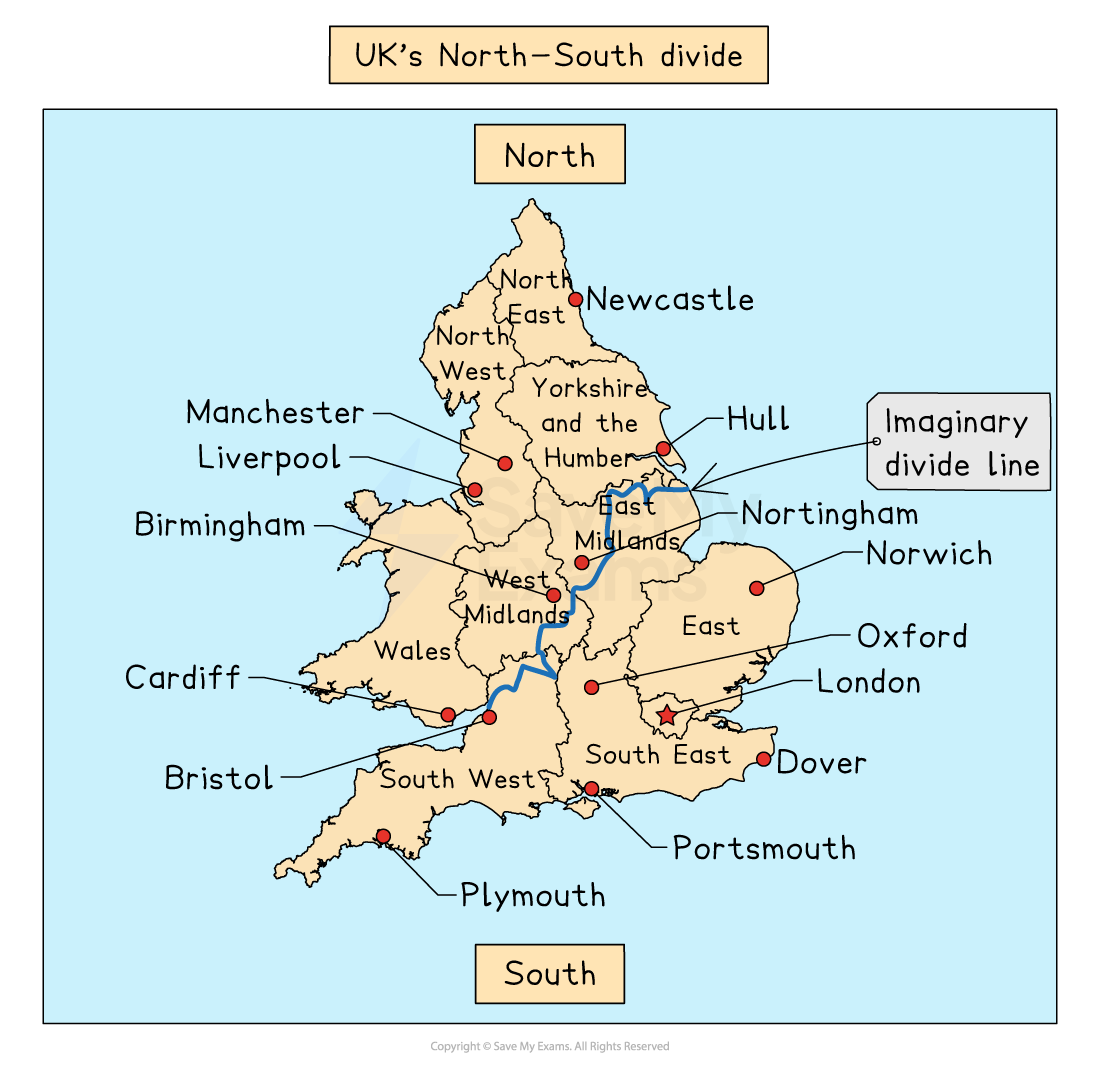
Average weekly pay in London is about 30% higher than in the North East (ONS, 2024 (opens in a new tab))
Life expectancy is also higher in the South East, showing wider quality-of-life inequality
Effects on population movement
People move towards regions with more jobs, higher wages, and better opportunities
Younger adults and graduates often migrate southwards or towards large cities
Rural depopulation occurs in remote areas where services and employment decline
Examples:
Migration from North East England to London and the South East for finance, tech, and healthcare jobs
Movement from West Wales and Cornwall towards Bristol, Cardiff, and Reading
In contrast, some people later return north or west later in life, seeking affordability and lifestyle
Evaluation:
Urban centres gain skilled workers and economic growth
Rural and northern areas lose young talent, leading to ageing populations and service decline
Commuting and teleworking
Commuting patterns
Millions commute daily between urban and rural areas, linking towns, suburbs, and city centres
Growth in motorway networks, rail services, and flexible working has extended commuting zones
Example:
The London commuter belt extends into counties such as Kent, Essex, Surrey, and Buckinghamshire
Rural towns such as Sevenoaks, Marlow, and Guildford have become commuter settlements
Impacts on urban areas:
Reduced city-centre housing demand as workers live further out
Increased rush-hour congestion and transport pressure
Supports city economies through a large daily workforce
Impacts on rural areas:
Growth in housing development and rising property prices
Improved local services (schools, shops, broadband)
Traditional community structures change as commuter lifestyles dominate
Evaluation:
Connects people to jobs and supports regional economies
Increases carbon emissions and weakens rural identity
The rise of teleworking
Technology and high-speed internet now allow people to work from home or remote locations (teleworking)
Driven by the COVID-19 pandemic, many businesses adopted hybrid working models
Teleworking increases opportunities for rural living while keeping urban employment links
Examples:
Growth of home-based professionals in rural and remote counties such as Devon, Norfolk, and Powys
Increase in digital start-ups in small towns like Hebden Bridge or Frome
Scotland’s Islands Deal (2023) promotes remote working hubs to sustain small communities
Social and economic impacts:
Reduces commuting costs and stress
Supports rural economies and housing demand
Increases pressure on rural infrastructure (broadband, transport)
Risk of isolation or loss of workplace culture
Impact of migration from outside the UK
Patterns and reasons
The UK has seen significant immigration since the mid-20th century
Migrants arrive for work, study, safety, or family reunification
Main sources: European Union, South Asia, Africa, and Eastern Europe
Recent Trends (ONS, 2024):
Net migration to the UK exceeded 500,000 per year in recent years
London, Birmingham, and Manchester are the main destinations, but some rural areas (e.g., Lincolnshire and Herefordshire) have also received new communities
Social consequences
Positive:
Greater cultural diversity enriches cities and towns (festivals, food, music, religion)
Expands population in areas with ageing demographics
Supports education, healthcare, and hospitality sectors
Negative:
Pressure on housing, schools, and healthcare services in some areas
Challenges in integrating new communities if resources are limited
Risk of social tension or misunderstanding
Examples:
Leicester – thriving multicultural city; one of the most diverse populations outside London
Boston (Lincolnshire) – rapid Eastern European immigration supporting agriculture and food processing
Economic consequences
Positive:
Migrants fill skill shortages in construction, the NHS, and hospitality
Contribute to tax revenue and consumer demand
Encourage entrepreneurship – around 15% of UK start-ups founded by migrants (UK Gov, 2023 (opens in a new tab))
Negative:
In some low-wage sectors, competition can depress local pay
Over-reliance on migrant labour can limit training for local workers
Impacts on rural areas
Migration can help reverse rural depopulation, especially in farming regions
New communities revitalise local schools and services
Some rural tensions arise if infrastructure or housing is limited
Example:
Eastern European workers are vital for agriculture in Lincolnshire and Herefordshire
Worked Example
Explain one way that migration has affected urban or rural areas in the UK. [4 marks]
Answer
Migration has increased cultural diversity and boosted the workforce in UK cities such as Birmingham. [1] Many migrants work in healthcare, hospitality, and construction, helping fill skill shortages. [1] This growth has also led to a wider variety of shops, restaurants, and festivals that attract tourism. [1] However, housing demand has risen, increasing costs for local residents. [1]
Mark allocation
1-2 marks: Simple statements about migration or effects with limited explanation or no example (e.g. ‘People come to the UK for work’).
3-4 marks: Clear explanation of how migration affects either urban or rural areas with social and/or economic consequences, supported by a named place example (e.g. ‘Migration to Birmingham increased cultural diversity and filled skill shortages’).
Command word focus: Explain = show how or why migration causes specific changes.
Examiner Tips and Tricks
Regional inequalities drive migration from less prosperous areas (the North, Wales, and Scotland) to the South and major cities.
Commuting and teleworking blur the boundaries between urban and rural living, shaping new settlement patterns.
International migration brings diversity and economic benefits but can also increase housing and service pressures.

Unlock more, it's free!
Join the 100,000+ Students that ❤️ Save My Exams
the (exam) results speak for themselves:

Was this revision note helpful?
