Hot semi-arid regions & desertification (WJEC Eduqas GCSE Geography B): Revision Note
Exam code: C112

Specification Link
The notes on this page cover part 3.4.1 of the WJEC Eduqas GCSE B Geography.
3.4.1 - What are the physical processes operating in hot semi-arid regions that make them vulnerable to desertification?
An overview of the location and global distribution of environments vulnerable to desertification.
How this distribution pattern is changing over time.
The relationship of this distribution to the global circulation of the atmosphere and to the dominance of high pressure systems.
Changing climatic patterns over periods of decades to include unreliable rainfall patterns and higher rates of evapotranspiration in hot semi-arid regions.
Smaller scale processes related to changing patterns of vegetation, evapotranspiration and micro-climate.
Location and global distribution of vulnerable environments
The distribution of hot semi-arid lands has changed over time
They are areas of water scarcity, where rainfall is seasonal (semi-arid)
Temperatures are high, leading to high rates of evaporation and transpiration
These areas have high levels of climatic uncertainty, and many areas can experience drought for several years
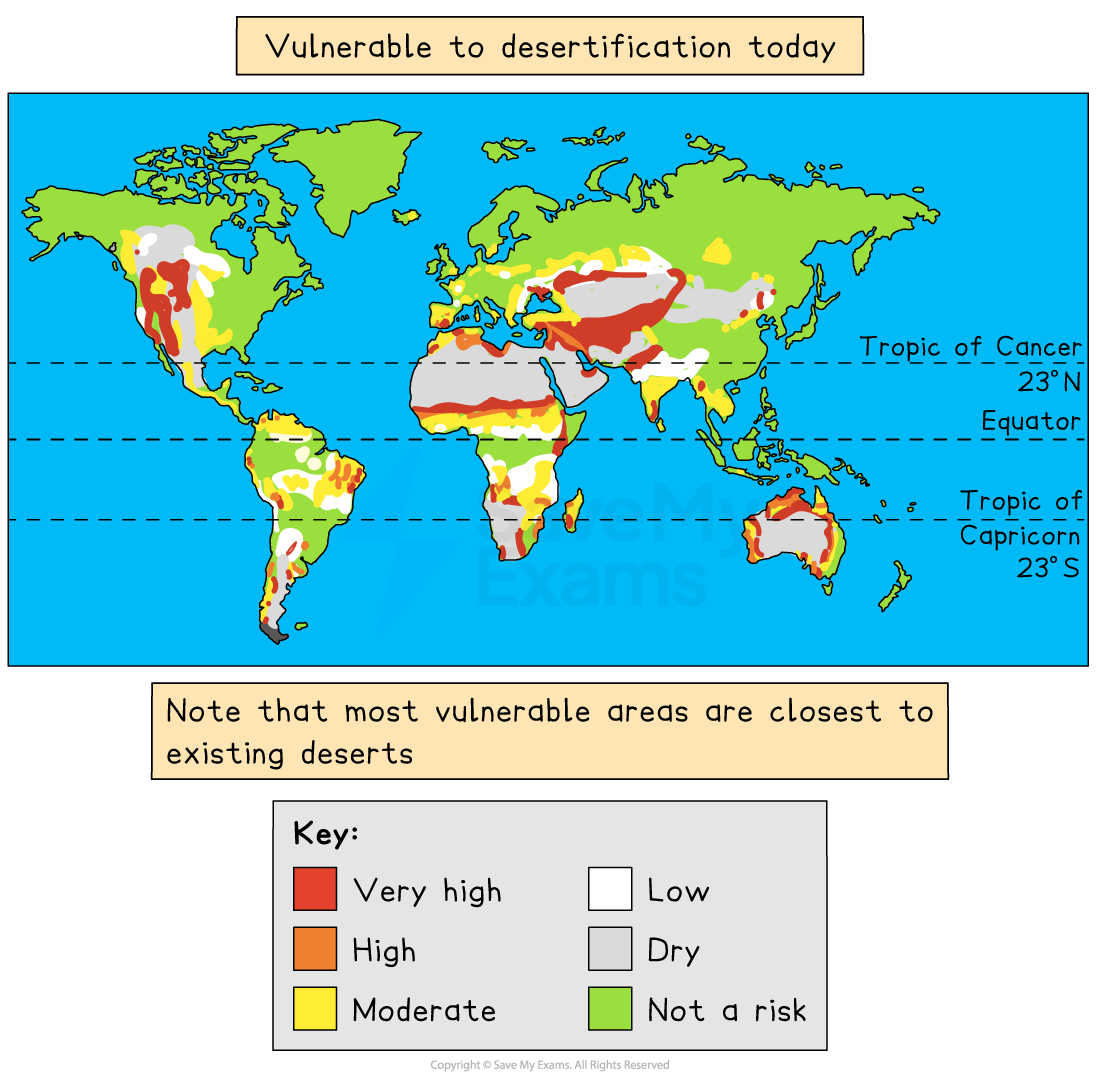
Changing location of semi-arid areas
Changing climates have changed the extent and distribution of semi-arid areas
A large percentage of the world was wetter after the last ice age, and this reduced the amount of semi-arid land
Until about 5000 years ago, there were only narrow strips of hot deserts to be found on the west coasts of South America and Africa
Gradually, these semi-arid areas increased in size, and new hot deserts began to form
The Sahara region was not always a desert
Between 11000 and 5000 years ago, the area was known as the Green Sahara with lakes, lush vegetation and animals of the savanna biome such as elephants and lions
These are natural climatic variations forming hot deserts; however, human activity has also influenced the extent and distribution of these drylands through desertification
Global circulation and hot semi-arid regions
Aridity is affected by the global circulation of air
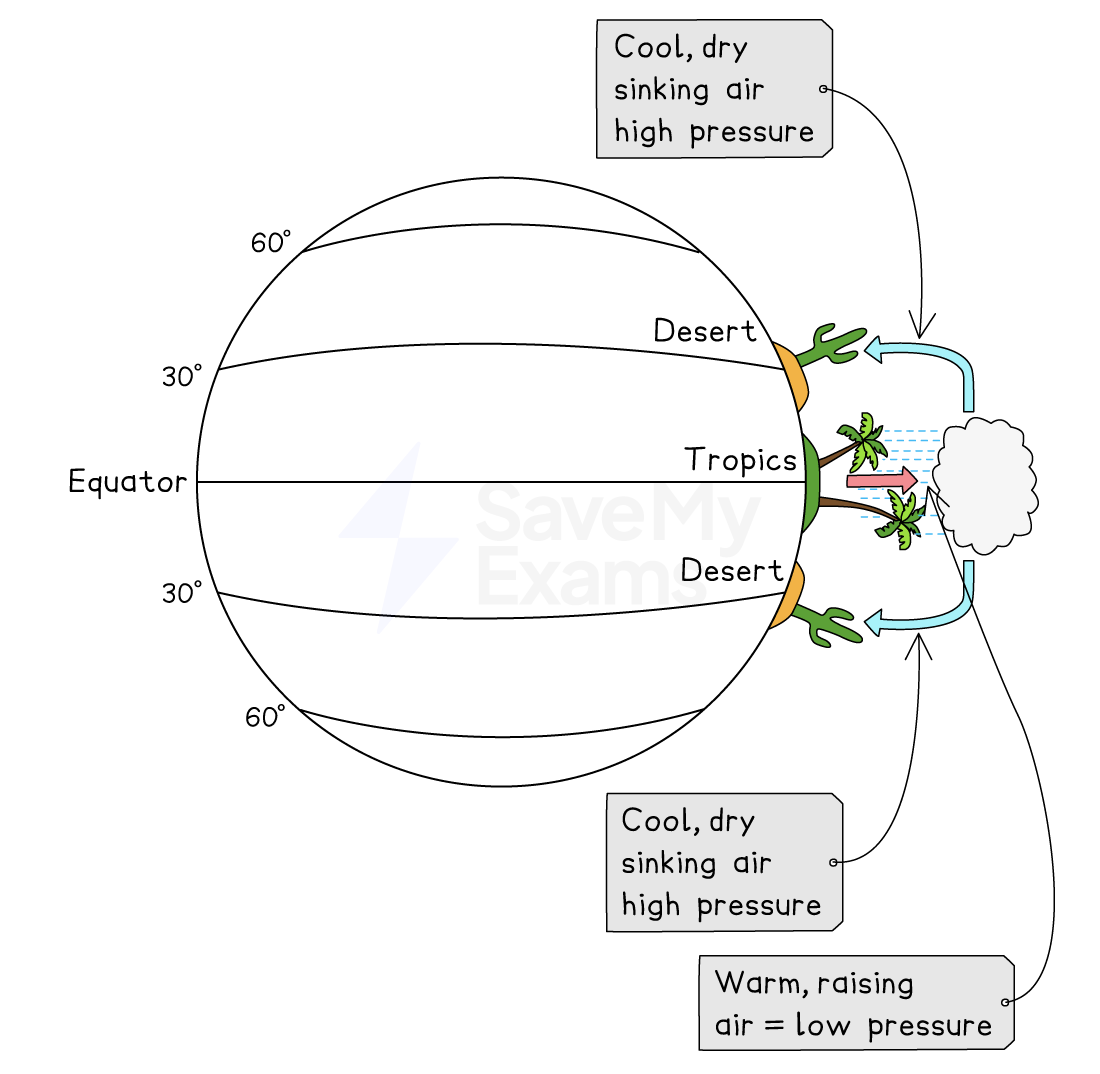
Semi-arid deserts are found in the tropics and subtropics due to two large convective cells called Hadley Cells
These atmospheric cells control the air circulating between the equator and the tropics in the northern and southern hemispheres
The area where the dry air descends is a zone of high pressure known as the subtropical high
Note that as the cool, dense, dry air descends, it is being warmed by high levels of insolation
Changing climatic patterns
Areas which are vulnerable to desertification have experienced changing climatic patterns over recent decades
These changing climatic patterns have increased the risk of desertification
The main climate changes include:
Unreliable rainfall patterns
Higher rates of evapotranspiration
Climate change leads to less reliable precipitation, resulting in both droughts and intense rain events
Droughts cause vegetation to die off due to a lack of water, leaving the soil exposed
Intense rain events on bare, baked soil lead to increased surface runoff rather than infiltration
This leads to soil erosion, washing away nutrient-rich topsoil
Higher average temperatures lead to increased rates of evapotranspiration
Higher temperatures increase the rate at which water evaporates from the land surface and transpires from plants.
This rapid moisture loss means plants struggle to hold on to water and the soil dries out quickly, losing its moisture content and structure
Small-scale climatic patterns
Desertification and the removal of vegetation lead to small-scale climatic patterns
Shade
The tree canopy shades the ground beneath it
This lowers ground temperature, affecting the local micro-climate and the types of plants that can grow beneath it
If the vegetation is removed, the lack of shade leads to increased temperatures
Evapotranspiration
Plants absorb water through their roots and release it as water vapour through their leaves
This process:
Cools the surrounding air
Increases humidity
Can lead to cloud formation
This process creates a microclimate around the vegetation
Wind reduction
Vegetation acts as a natural windbreak, reducing wind speed in the immediate area
This creates a more sheltered, warmer, and less humid environment directly behind the vegetation
Removal of the vegetation increases soil erosion by wind

Unlock more, it's free!
Join the 100,000+ Students that ❤️ Save My Exams
the (exam) results speak for themselves:

Was this revision note helpful?