Management of vulnerable environments (WJEC Eduqas GCSE Geography B): Revision Note
Exam code: C112

Specification Link
The notes on this page cover part 3.4.3 of the WJEC Eduqas GCSE B Geography.
3.4.3 How can environments vulnerable to desertification be managed?
A range of strategies employed by Non-Government Organisations (NGOs), working at a local level with communities, to include drip irrigation, magic stones and use of drought-tolerant crops.
International strategies aimed at reducing the spread of areas experiencing desertification.
NGO strategies to manage desertification
Halting and reversing desertification means tackling the causes
There are a variety of political and social responses
Non-Government Organisations (NGOs) such as Oxfam, Eden Foundation and the World Wildlife Fund (WWF) are often involved in working with local communities to implement management strategies
Education
Education including:
Sustainable farming methods, including agroforestry and crop rotation, help to keep the soil healthy
Family planning to reduce population growth
Drip irrigation
Standard irrigation leads to a lot of wasted water due to evaporation
Drip irrigation delivers water directly to plant roots, reducing evaporation and salt buildup
Agriculture
Focus on livestock breeds which are better adapted to drier conditions
Reduced herd size
Use high-yielding varieties (HYV)
Crop rotation
Drought-tolerant crops
Drought-tolerant crops can:
Increase the yield
Other High-Yield Varieties (HYV) and Genetically Modified (GM) crops may also be:
Drought resistant
Pest resistant
Magic stones and terraces
These help to reduce soil erosion by:
Preventing the soil from being blown or washed away
Increasing infiltration of water and reducing overland flow
Ensuring that dead organic matter stays in one place and can decompose, adding nutrients to the soil
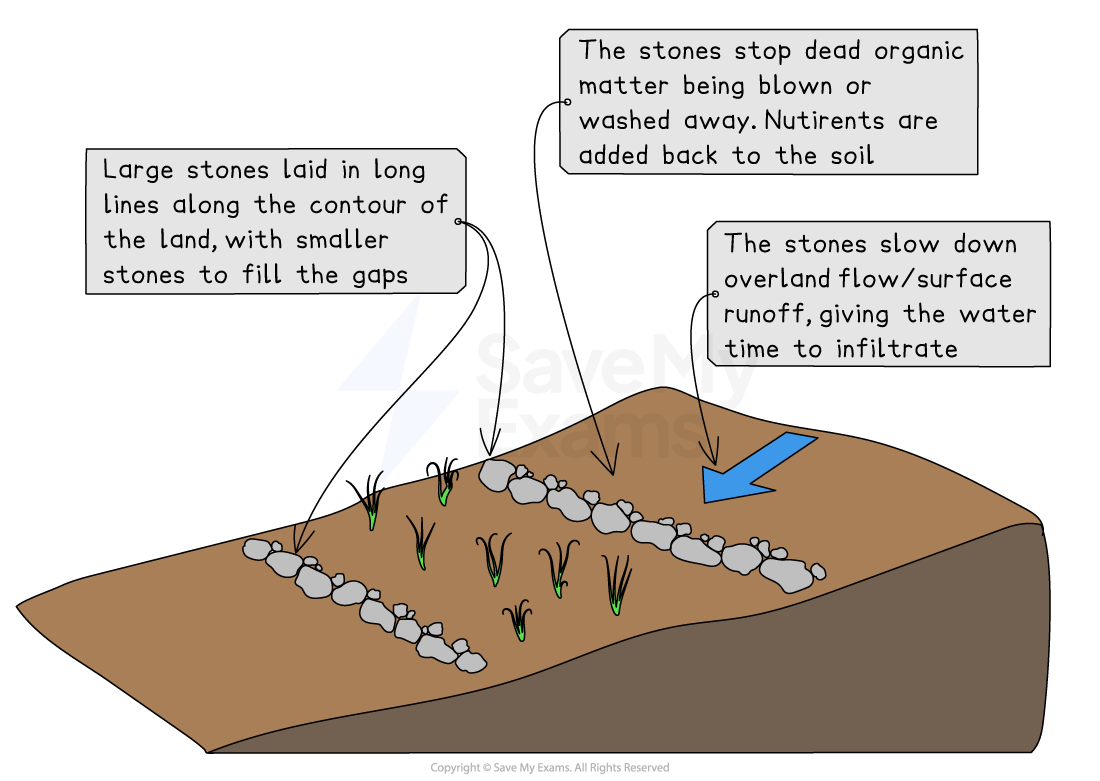
Many projects combine different strategies
The Eden Project is based around agroforestry but also includes education
Based in Niger
Trees and shrubs, which are sources of food, are grown
The trees also provide a wind break, reducing soil erosion and increasing crop yields
The project educates farmers about sustainable farming methods
International strategies to manage desertification
Afforestation
Tree planting, such as the Great Green Wall across the Sahel, helps to reverse desertification in several ways:
The roots help to bind the soil together, reducing soil erosion
The canopy offers shade, helping to prevent the soil from drying out and also reducing soil erosion from rainfall landing directly on the soil
Nutrients in the soil are replaced by falling leaves and branches
The trees increase animal and insect activity, which helps improve soil quality
International agreements
United Nations Convention to Combat Desertification (UNCCD)
Provides advice for countries and regions experiencing serious drought and desertification, particularly in Africa

Unlock more, it's free!
Join the 100,000+ Students that ❤️ Save My Exams
the (exam) results speak for themselves:

Was this revision note helpful?