Ecosystems: Hot Semi-Arid Grasslands (WJEC Eduqas GCSE Geography B): Revision Note
Exam code: C112

Specification Link
This page covers part of 3.2.2 and 3.2.3 of the WJEC Eduqas GCSE B specification
3.2.2 - How are ecosystems damaged by human activity?
How hot semi-arid grasslands have been damaged by human activity.
How processes within the ecosystem have been affected
The effects of the damage at the local scale, to include the effect on biodiversity, and at the global scale
3.2.3 - Why and how are ecosystems managed in a sustainable way?
The reasons for conservation and management.
The ways in which hot semi-arid grasslands have been managed
Strategies for sustainable management.
Case Study: Human activity in the hot semi-arid grasslands
How human activity has damaged hot semi-arid grasslands
Hot semi-arid grasslands provide water, grazing, food and fuel for millions of people
The unique biodiversity of this biome encourages and supports wildlife tourism
Human impacts are widespread
The main threats are:
Land use change
Landscape fragmentation, which disrupts herbivore communities
Climate change and rising atmospheric CO2
Unsustainable water use and irrigation methods
Land clearance reduces grazing for animals such as giraffes and zebras
The clearance fragments the landscape, reducing movement between communities
Large fires destroy plants - especially those which are not fire-resistant
Fires can also kill insects and small animals, providing food for predators
Woody plants are killed by cattle eating their foliage, allowing thorny, animal-repellent trees to become dominant
Poor agricultural practice can lead to soil degradation and desertification
Overgrazing further exposes the grasslands to erosion
Tourism involves the use of transport, which:
Damages vegetation
Disturbs wildlife
Affects breeding grounds
Tourism also increases the amount of rubbish, which can harm animals
Conservation in national parks is variable
Some parks attract illegal trophy hunting
The value of products such as ivory and rhino horn, where the animal is killed just for their tusks, also increases poaching
Hunters target large males, leading to an imbalance in the population
Animals can become emboldened and attack people
Demand for illegal bushmeat also increases poaching, adding pressure to the hot semi-arid ecosystem
Plants are overharvested due to their commercial value - baobab tree fruit, African Blackwood for carving, Gum Arabic for chewing gum, etc.
The Gum Arabic tree is an important plant in Sudan, as it supplies 80% of the world's export of gum
Gum Arabic is used extensively in pharmaceuticals, food production, and traditional medicine
The impact of human activity on ecosystem processes
Nutrient cycle
Overgrazing and intensive agriculture are unsustainable
They often lead to soil erosion due to a lack of roots binding the soil together
Desertification is increasing due to poor management of these activities
Poor soil conditions make it hard for vegetation to regrow, creating patches of desert-like conditions
These activities lead to the disruption of the nutrient cycle
The lack of vegetation means less litter to biodegrade and add nutrients to the soil
Soil erosion removes the top layer of soil, which contains most of the nutrients
Water cycle
Deforestation removes the trees and leads to a decrease in transpiration
Lower levels of transpiration lead to reduced precipitation
The problem is expected to worsen as climate change alters rainfall patterns
Uncontrolled fires can occur, which decimate habitats and lead to an imbalance in the ecosystem
Water is scarce during the dry season, so it requires careful management in its usage (irrigation, domestic use, etc).
Food webs are disrupted as habitats are destroyed and biodiversity is reduced
The impact of human activity on biodiversity
Human activity is reducing hot semi-arid grassland biodiversity by destroying habitats and killing wildlife
Changing land use is also causing fragmentation, which affects grazing animals and predators that need large areas to roam
The presence of livestock, such as goats, reduces the amount of vegetation and available water for wild grazing animals
Domestic species are replacing wild species in the ecosystem
Native hot semi-arid grassland species are also threatened by invasive species, e.g. cane toads were introduced in the Australian grasslands as a form of crop pest control, but their population rapidly expanded, putting native species under threat through eating their food and secreting poison when threatened
Conservation and management
Game reserves have been created in many areas, these:
Prohibit local settlements, grazing and farming
Strictly control hunting
This can increase sustainability by allowing the ecosystem to operate without human interference
Management of hot semi-arid grasslands
Conservation and management of the hot semi-arid grasslands is essential to:
Reduce desertification
Protect habitats and biodiversity
Reduce rural-urban migration
Preserve ecosystem processes
How are hot semi-arid grasslands being managed?
Education
Education including:
Sustainable farming methods, including agroforestry and crop rotation, which help to keep the soil healthy
Family planning to reduce population growth
Agriculture
Focus on livestock breeds which are better adapted to drier conditions
Reduced herd size
Use high-yielding varieties (HYV)
Crop rotation
Afforestation
Tree planting, such as the Great Green Wall across the Sahel, helps to reverse desertification in several ways:
The roots help to bind the soil together, reducing soil erosion
The canopy offers shade, helping to prevent the soil from drying out and also reducing soil erosion from rainfall landing directly on the soil
Nutrients in the soil are replaced by falling leaves and branches
The trees increase animal and insect activity, which helps improve soil quality
Fertilisers, high-yield varieties (HYV) and genetically modified (GM) crops
Fertilisers, HYV and GM crops can:
Increase the yield
Reduce the amount of land cultivated
HYV and GM crops may also be:
Drought resistant
Pest resistant
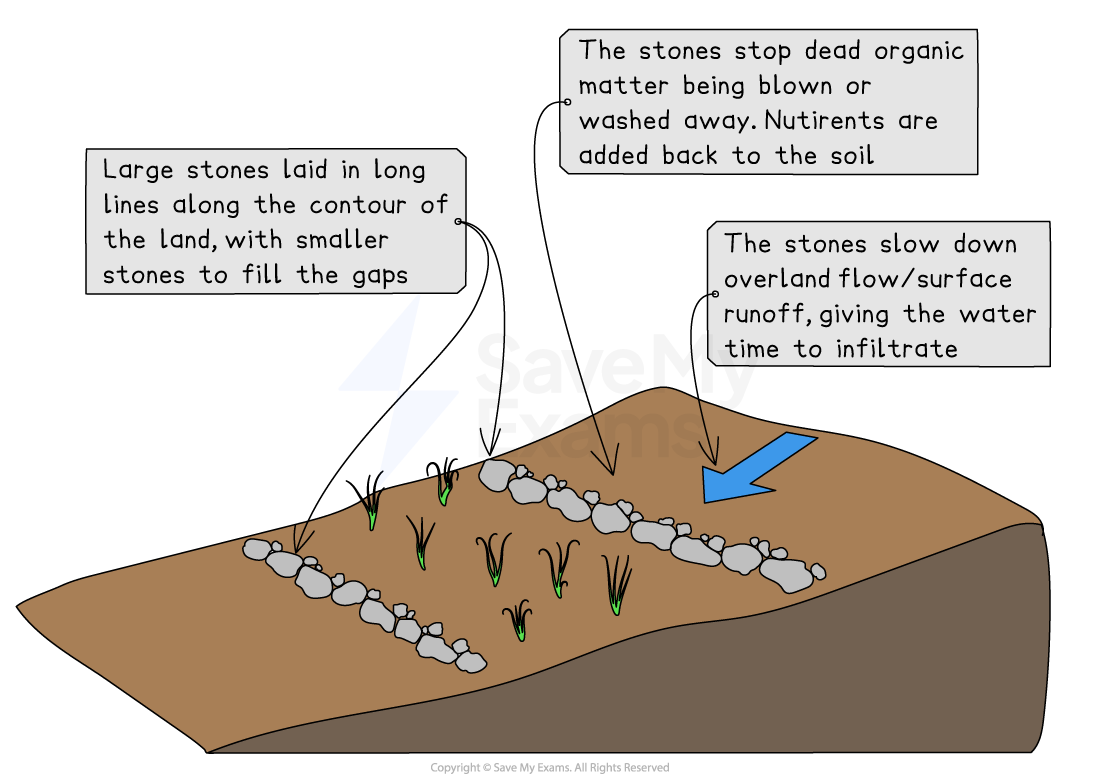
Magic stones and terraces
These help to reduce soil erosion by:
Preventing the soil from being blown or washed away
Increasing infiltration of water and reducing overland flow
Ensuring that dead organic matter stays in one place and can decompose, adding nutrients to the soil

Unlock more, it's free!
Join the 100,000+ Students that ❤️ Save My Exams
the (exam) results speak for themselves:

Was this revision note helpful?