Relationship between climate & biomes (WJEC Eduqas GCSE Geography B): Revision Note
Exam code: C112

Specification Link
The notes on this page cover part 3.1.1 of the WJEC Eduqas GCSE B Geography.
3.1.1 - What is the relationship between climate and biomes at a global scale?
The location and distribution of biomes at a global scale and their relationship to climate zones
The location and distribution of global biomes
There are 11 biomes in Earth's biosphere
A biome is a group of ecosystems around the world with similar climate and vegetation characteristics
Biome distribution
The factors which affect biome distribution include:
Latitude: with distance from the equator, temperatures and sunshine hours decrease
Precipitation: overall areas of high pressure experience low rainfall, and areas of low pressure experience high rainfall
Altitude: an increase in altitude leads to a decrease in temperature
Continentality: locations further inland heat up more quickly in the summer and cool more quickly in the winter
Ocean currents: warm and cold currents circulate in the oceans, either warming or cooling the adjacent land
Climate is the most significant factor affecting biome distribution
The global biomes match the distribution of climates

Worked Example
Describe the distribution of hot semi-arid grasslands shown in Figure 1.
[3 marks]
IMAGE
When describing the distribution, the answer needs to include more than simply a list of continents. The answer below also refers to the tropics to help describe the distribution.
Answer
The greatest amount of semi-arid grassland is in Africa [1] between the Tropic of Cancer and the Tropic of Capricorn. [1] There is also some in Australasia. [1]
Examiner Tips and Tricks
When writing a description of distribution, it is important to use geographical terms such as 'east' and 'west' rather than 'left' or 'right'.
What is an ecosystem?
An Ecosystem is a community of living organisms (plants and animals) and their non-living environment
They function most efficiently when they are in balance:
The living (biotic) and non-living components (abiotic) are linked and interact with each other to try to maintain this balance
Ecosystems vary in size and scale
A small ecosystem could be a garden pond
A large-scale ecosystem could be all tropical rainforests – this is a biome
All ecosystems have inputs, stores, transfers and outputs
Inputs: solar radiation and precipitation
Stores: biomass and soil
Transfers: energy is transferred through food chains and webs
Outputs: gases, dead matter
Interdependence in ecosystems
Within an ecosystem, the different biotic components depend on each other, and the abiotic components for survival (food, water and shelter)
This is known as interdependence
It means that changes in one component can have significant impacts on other parts of the ecosystem
One of the main interactions between biotic components is feeding
These interactions can be shown as food chains and food webs
Examiner Tips and Tricks
Within the exam, you can gain easy marks by learning key term definitions. For example, in this section, you should ensure that you know the definitions for the following terms:
Biome
Ecosystem
Biotic
Abiotic
Food chains and webs
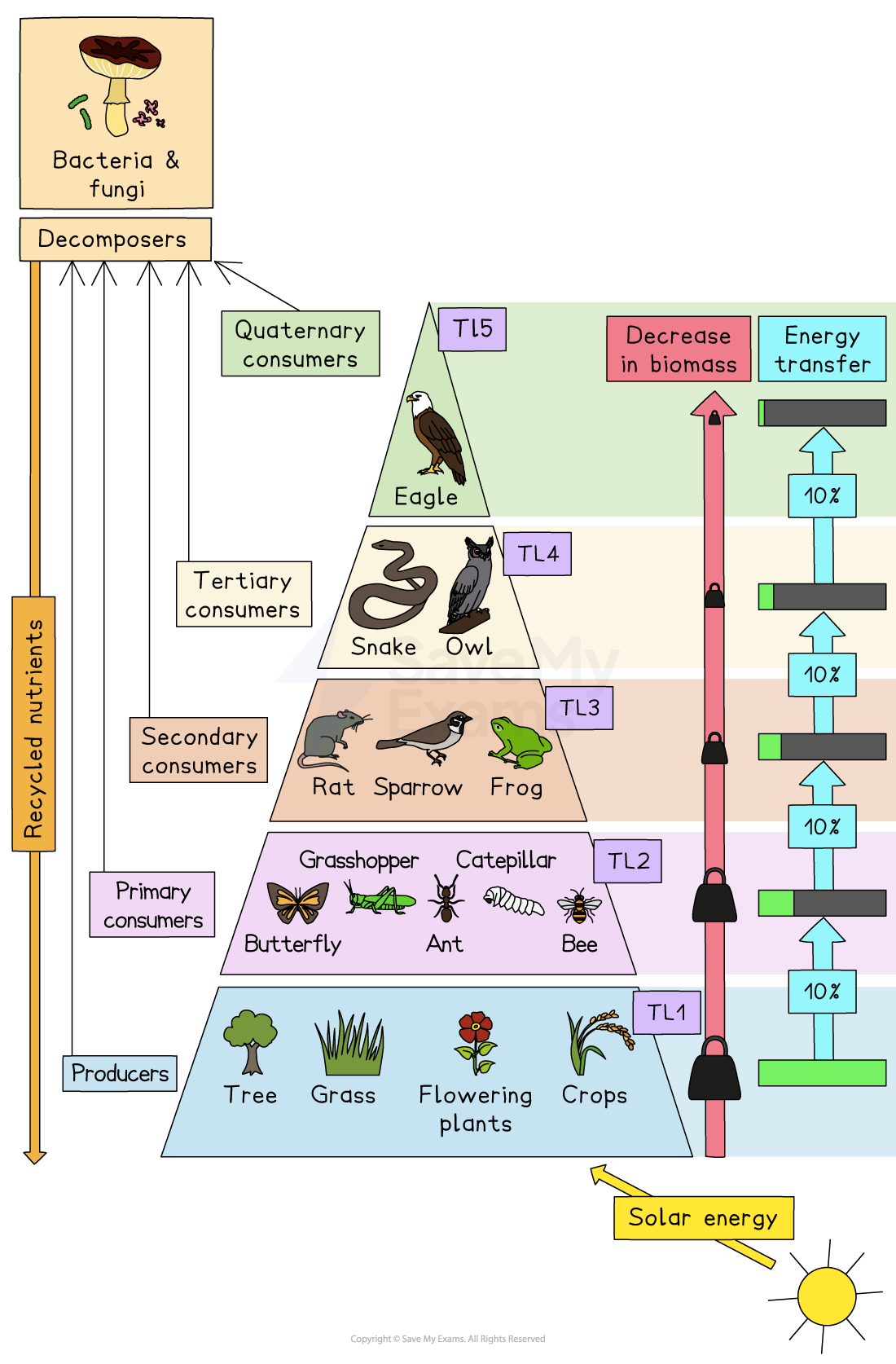
Within all food chains and food webs, there are examples of:
Producers: Food chains always start with a producer
Primary consumers: Producers are eaten by primary consumers (herbivores/omnivores)
Secondary consumer: Primary consumers are eaten by secondary consumers (carnivores/omnivores)
Tertiary consumer: Secondary consumers are eaten by tertiary consumers (carnivores/omnivores)
There are also decomposers.
These are fungi and bacteria, and they:
Help to return energy/nutrients back to the soil
Break down dead organic matter, plant/animal waste
Release energy from organic matter so it can be recycled
Food chains
A food chain shows the feeding interactions and transfer of energy from one organism to the next
As each plant or animal is eaten, energy is passed on to the consumer
The source of energy in a food chain is light energy from the sun
Food webs
The links between the biotic components can also be shown as a food web
These show the complex variety of plants and animals which feed on each other
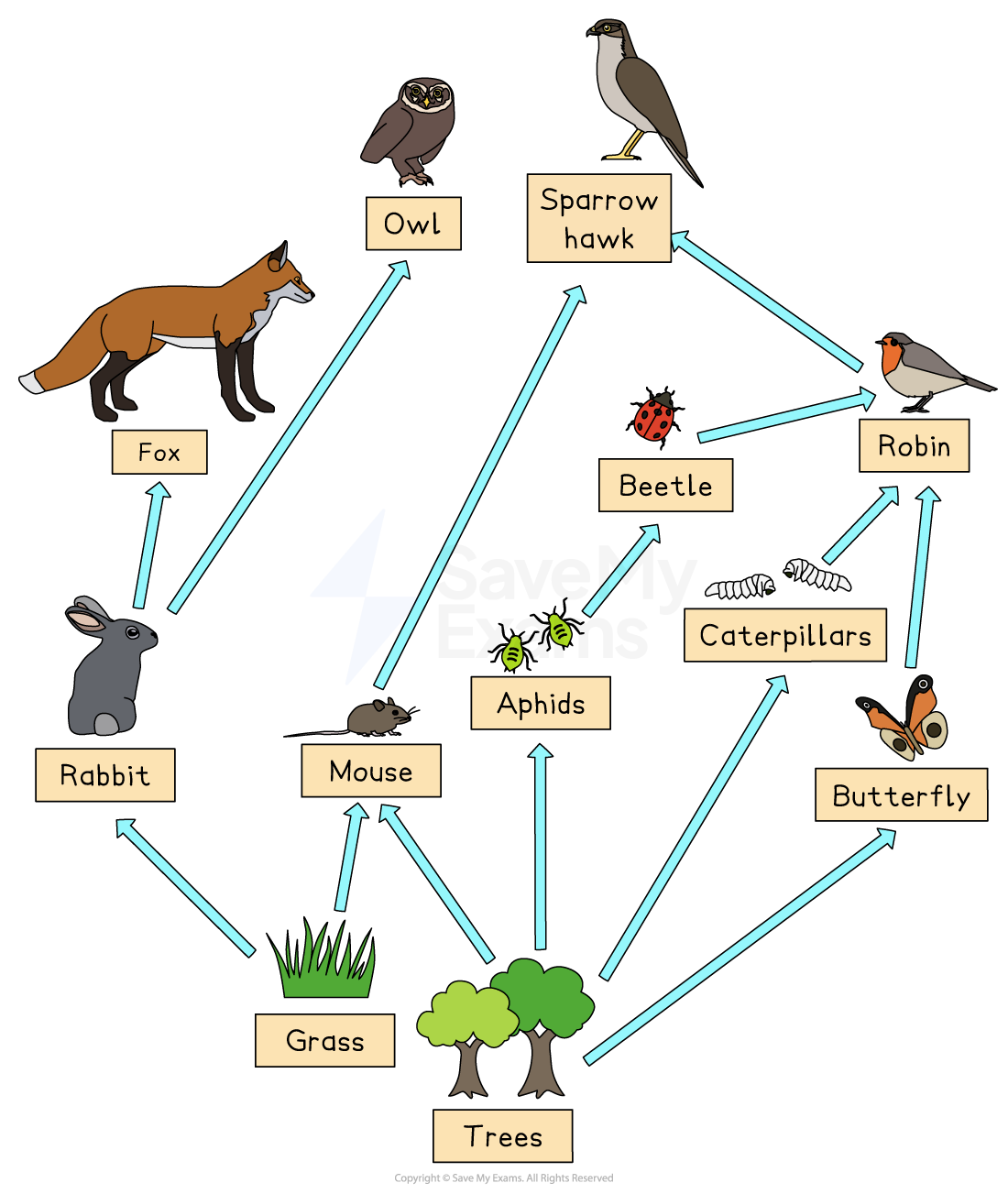
For example, in the food web above, if the population of mice decreased:
The population of grass plants would increase, as there are now fewer species feeding on them
The populations of sparrow hawks would decrease, as mice are a main part of their food
The population of small birds may decrease as more of these are eaten by the sparrow hawks due to the lack of mice
Examiner Tips and Tricks
For the exam, you need to ensure that you are able to identify examples of producers as well as primary, secondary and tertiary consumers.
Water, nutrient and carbon cycles in ecosystems
How do ecosystems regulate water supply?
Every ecosystem forms part of the water cycle
This means that it has stores and flows (transfers) of water
Ecosystems store fresh water in:
Ice/snow
Rivers, streams and lakes
Plants
Soil
Water is transferred through ecosystems by:
Stemflow – which is water running down branches and trunks
Drip flow - water running off leaves
Evaporation from water stores
Transpiration from the leaves of plants
The amount of water stored and transferred depends on the type of ecosystem
In a tropical rainforest, the trees and plants intercept much of the precipitation
It is then returned to the atmosphere via evaporation off the leaves and branches, or runs slowly to the ground through drip flow and stem flow
The water then gradually reaches the streams and rivers
When areas of forest are cleared, this cycle is broken
More precipitation reaches the soil surface, leading to soil erosion and flooding
Less water is intercepted or taken up by the trees and plants, so rates of transpiration and evaporation decrease
This leads to lower rates of precipitation due to less water in the atmosphere
Nutrient cycles
Nutrients and minerals are essential for plant growth
These can be found in rocks, the atmosphere and water
Soil (abiotic) is formed from minerals and particles from weathered rock (abiotic), dead plants, and animals (biotic)
Soil, water and solar energy (abiotic) then provide nutrients and moisture for plants (biotic) to grow
As part of photosynthesis, plants take in CO₂ and release oxygen, balancing gases in the atmosphere
The plants (biotic) are then eaten by animals (biotic), who also eat each other
When the plants and animals die, the nutrients are then returned to the soil (abiotic) through decomposition
If one component of this cycle is changed, for example, by vegetation being cut down, all the other components will be affected
This leads to:
Fewer nutrients are added to the soil through decomposition
There will be less food and fewer habitats, so the number of animal species will decrease
The soil is exposed to erosion from the sun and rain
CO₂ levels will increase
Plants will transpire less, resulting in less precipitation
Carbon store
Ecosystems store carbon
The carbon is stored in:
Animals
Plants
Soil
Dead organic matter
This storage forms part of the carbon cycle
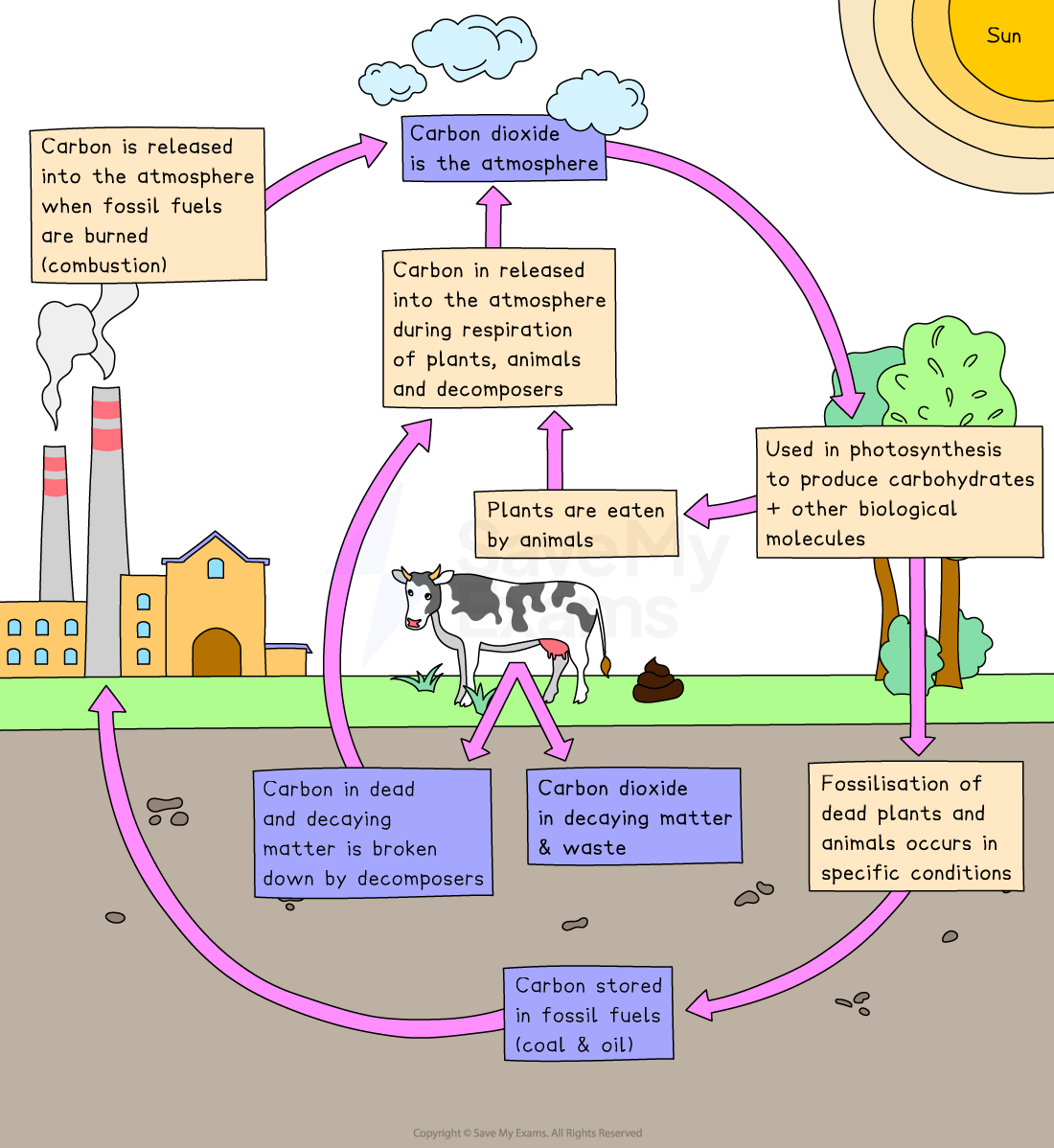
The amount of carbon stored in each depends on the climate
In tropical rainforests, large amounts of carbon are stored in the trees and vegetation (biomass)
In tundra areas, very little carbon is stored above ground due to the lack of vegetation
Instead, it is stored in the peat soil, which forms through slow decomposition due to the cold conditions

Unlock more, it's free!
Join the 100,000+ Students that ❤️ Save My Exams
the (exam) results speak for themselves:

Was this revision note helpful?