Elizabeth I & the War with Spain (OCR GCSE History B (Schools History Project)): Revision Note
Exam code: J411

Summary
The bad relations between Protestant England and Catholic Spain broke out into open warfare when Spain tried to invade England in 1588.
The failure of the Spanish Armada was due to a combination of poor planning, English tactics, and storms at sea. The war between England and Spain continued after the Armada's defeat and only ended after Elizabeth's death.
Why was there conflict between England & Spain?
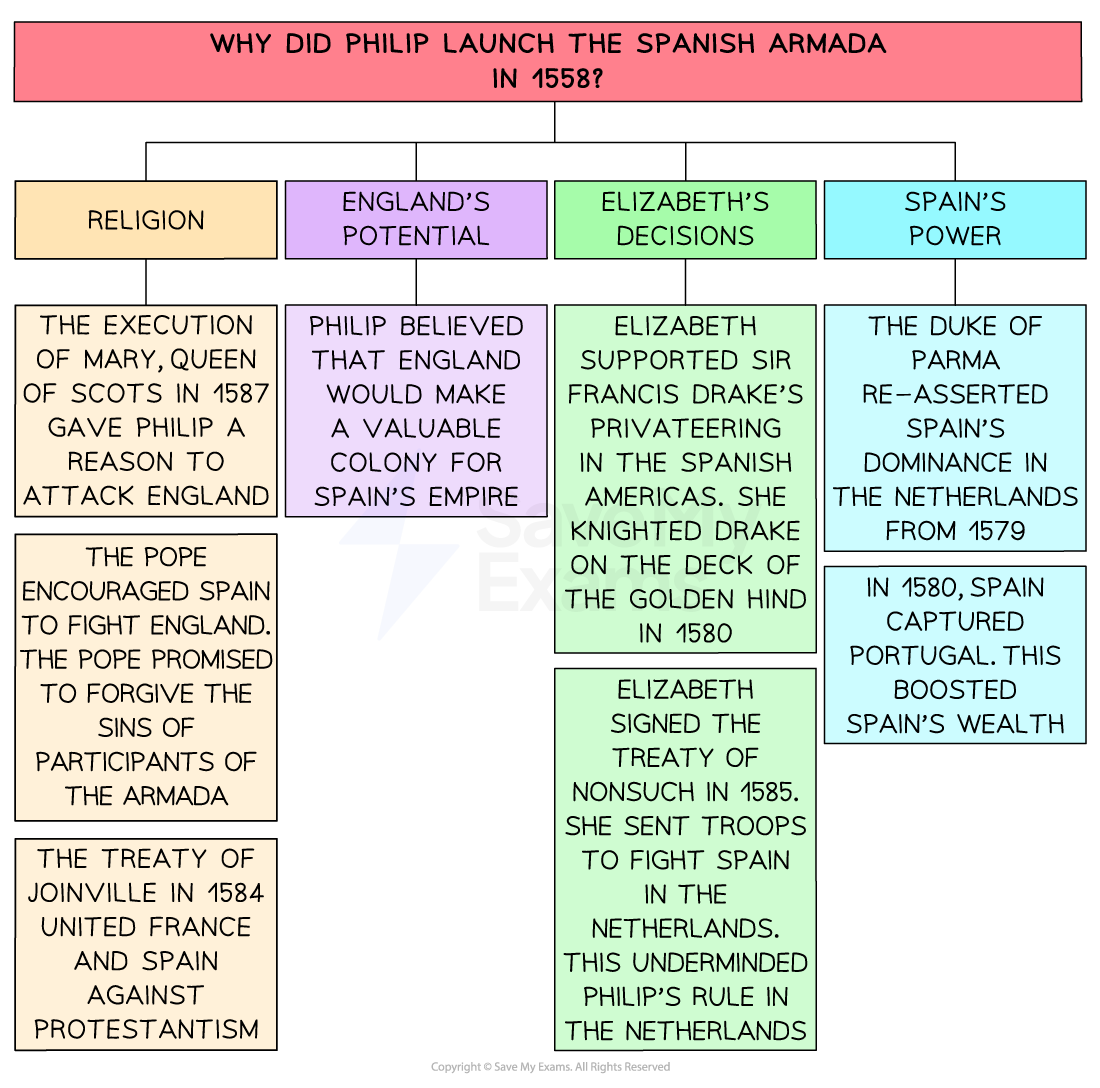
The war between Spain and England broke out in 1558 for several reasons
Elizabeth's refusal to marry Phillip II at the start of her reign
The transformation of England into a Protestant country through Elizabeth's 'middle way' (opens in a new tab)
Spain was Europe's most powerful country in the 1500s and had built an enormous empire in South America
Spain gained huge wealth from its empire
Elizabeth encouraged English sailors like Francis Drake to act like pirates and steal Spanish gold
Elizabeth also sent troops to help Protestants fight against the Spanish in the Netherlands
The execution of the Catholic Mary, Queen of Scots, greatly angered Phillip and Catholics across Europe
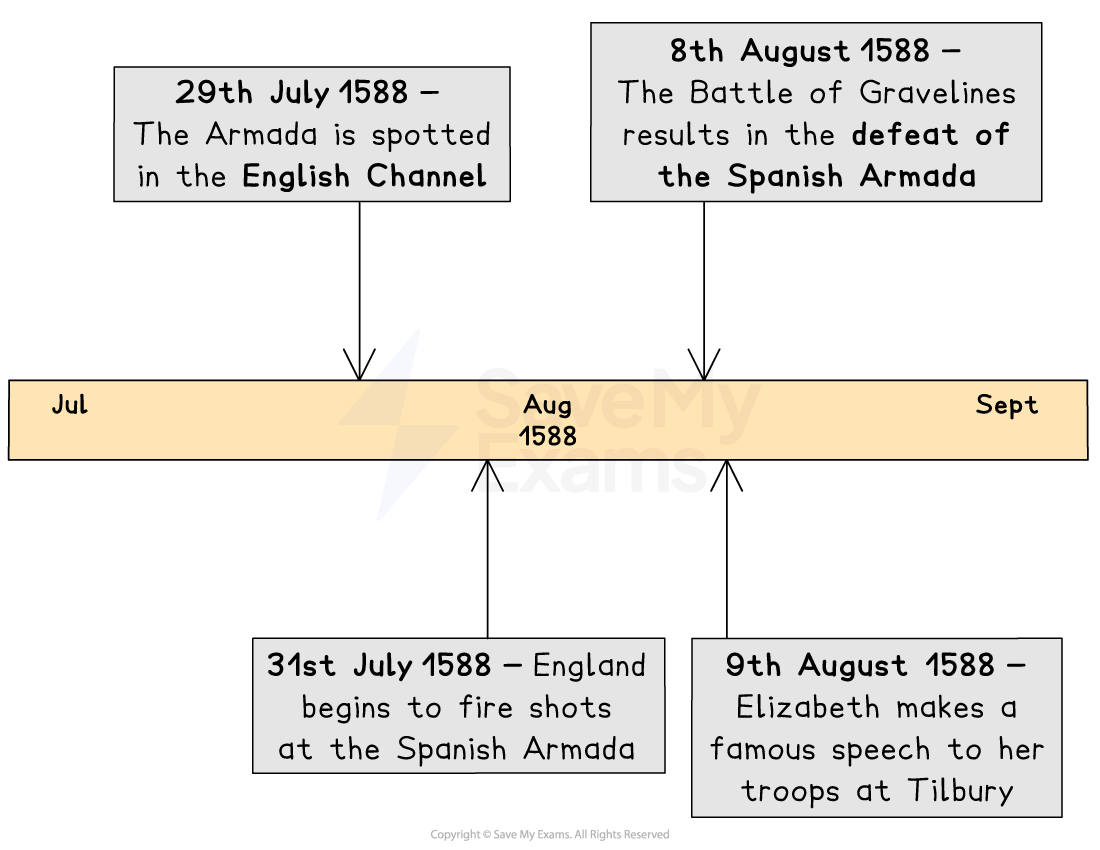
The events of the Spanish Armada
Philip's Plan
Philip assembled an Armada of 130 ships containing 30,000 men
The Armada was to sail from Lisbon to Calais through the English Channel
It would then meet with the Duke of Parma, who would march his army of 20,000 soldiers from the Netherlands to Calais
The Armada would protect and transport Parma's army to Kent, England
The arrival of the Spanish army in England would trigger an uprising from English Catholics
The Spanish army, along with the English Catholics, would depose Elizabeth and restore Catholicism in England
What Actually Happened to the Armada
Philip II launched the Armada on 28th May 1588 from Lisbon
Arriving in Corunna, Spain, on June 19th
On July 21st, the Armada leaves Corunna and sets sail for England
The Armada is spotted off the coast of Cornwall on July 29th
Between the 31st of July and the 4th of August, the Armada is attacked by English ships in the English Channel
By August 6th, the Armada landed in Calais
They waited for the Duke of Parma to arrive with more Spanish Soldiers from the Netherlands
The Duke of Parma was tired of waiting for the Armada, which was seven days late
He sent his troops inland to mend canals, and they were not there when the Armada arrived
On the 7th August, Sir Francis Drake sent eight fireships into the anchored Spanish ships
In a panic, they cut their anchors and left Calais
Their crescent formation was broken as they headed into the North Sea
The Battle of Gravelines began on August 8th in the North Sea
English ships attacked the Spanish
Many ships were damaged, but none were sunk
The Spanish were poorly prepared
The Duke of Medina-Sidonia attempted to flee back to Spain
The English continued to attack with cannon fire
On August 9th, the Armada sailed north around Scotland and Ireland, as they were forced to retreat
As the Armada sailed past Scotland and Ireland, many of the ships were destroyed as
They used inaccurate maps of the coastline, causing ships to sail into dangerous waters and crash
Bad weather created dangerous storms, resulting in several shipwrecks
Only 65 out of 151 ships returned to Spain
How did England defeat the Spanish Armada?
Historians have come to different conclusions and have different interpretations of why the Armada failed
Some historians argue that the defeat of the Armada was due to England's actions:
England's Actions | How did this help to defeat the Spanish Armada? |
|---|---|
The galleon ship design | Elizabeth was advised to build more galleons years before the Armada. The galleons moved more quickly than the Spanish warships. The sailors found them easier to turn around to attack the enemy. The galleon's cannon design allowed for faster reloads |
English tactics | The English ships had smaller cannons with a longer range. The English hit the Spanish Armada from a distance. The Armada was unable to get close enough to the English ships to use their more powerful cannon. The deployment of fireships scattered the Armada from its crescent formation |
Some historians argue that Spain failed to invade England because Philip and his commanders made mistakes
Spain's Actions | How did this lead to the Spanish Armada being unsuccessful? |
|---|---|
Spain did not prepare the Armada effectively | Francis Drake led a raid on Cadiz, which destroyed the barrels that Spain needed to store provisions. Spain rushed to make new barrels for the Armada. Bad weather delayed Spain's fleet from reaching England. By the time Spain reached the English Channel, the Armada had been at sea for 10 weeks. These delays and the poor-quality barrels caused Spain's food provisions to rot. Spain also did not have enough cannonballs to fight the English ships |
A lack of communication between Medina-Sidonia and the Duke of Parma | The Duke of Parma and the man leading the Armada, Medina-Sidonia, communicated by sea. Their messages would take a week to reach their destination. Parma received Medina-Sidonia's message that the Armada had reached the English Channel too late. The Armada became vulnerable to attack as it waited for Parma's forces to arrive |
Philip II's leadership | Philip did not listen to his commanders' advice and concerns. He gave very restrictive instructions to Medina-Sidonia that did not allow him to take the initiative in the battles. Medina-Sidonia had little naval experience. The order for the Armada to anchor in Calais made the fleet an easy target for the English navy |
The consequences of the Spanish Armada
The defeat of the Armada ended the immediate threat of invasion
It did not end England's war with Spain
England continued to launch raids against Spanish ports in Spain, Portugal and the Americas
Spain launched two more Armadas in 1596 and 1597
Both failed due to the weather
Spain landed an Army in Ireland in 1601, hoping to start a Catholic rebellion against English rule
The Spanish army was defeated and the Irish uprising never took place
The war between England and Spain finally came to an end in 1604, a year after Elizabeth's death

Unlock more, it's free!
Join the 100,000+ Students that ❤️ Save My Exams
the (exam) results speak for themselves:

Was this revision note helpful?
