Elizabeth I's Religious Settlement (OCR GCSE History B (Schools History Project)): Revision Note
Exam code: J411

Summary
Elizabeth's father, Henry VIII, split from the Catholic Church in Rome during the Reformation. He made England a Protestant country. When Elizabeth's sister Mary came to the Throne, she returned England to the Catholic faith. Elizabeth had been raised a Protestant but the country was divided. Whichever faith she chose as England's religion was going to leave many people angry and upset.
To minimise the anger, Elizabeth created the Religious Settlement in 1559. It aimed to find a ‘middle way’ between Catholicism and Protestantism. She wanted to create a Protestant Church that most Catholics could accept. She established a Church that looked Catholic but conducted Protestant services. She hoped this would avoid any Catholic uprisings against her.
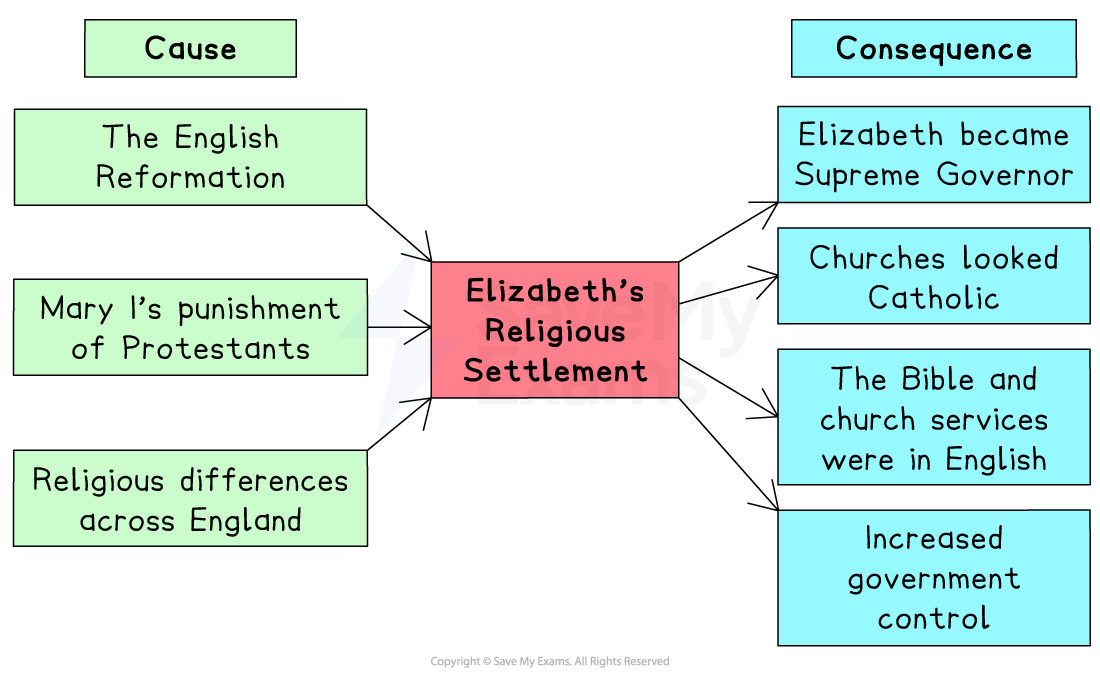
This satisfied most Elizabethans but both the devout Catholics and extreme Protestants (Puritans) were greatly angered.
To enforce her Religious Settlement, Elizabeth issued the Royal Injunctions, which required priests to have a licence and ensured they followed the Queen's instructions
What was the Religious Settlement?
There were two main parts to Elizabeth's Religious Settlement
The Act of Supremacy
Key aspects of the Act of Supremacy | Impact |
|---|---|
Elizabeth named herself Supreme Governor of the Church of England. This was different to her father, Henry VIII, who gave himself the title Head of the Church | Many people did not believe a woman could be the Head of the Church. Some Catholics accepted this phrasing as they could still believe the Pope was the Head of the Church |
All government officials and clergy had to take an oath accepting Elizabeth’s authority as Supreme Governor | Only one of Mary’s Catholic bishops agreed to take the oath |
The Act created an Ecclesiastical High Commission. They ensured that churches were following Elizabeth's Religious Settlement | The Catholic clergy could lose their jobs or be imprisoned for breaking the terms of the settlement |
The Act of Uniformity
Key aspects of the Act of Uniformity | Impact |
|---|---|
Churches were allowed to have decorations and the congregation could sing hymns | Many people welcomed keeping the familiar look of the churches, especially Catholics. Puritans complained that churches looked too Catholic |
The Bible and church services were conducted in English. Churches had to use the new Protestant prayer book | The wording of the prayer book was deliberately unclear, especially for Mass. This meant that Catholics and Protestants could interpret it in their own way. However, refusing to use the new prayer book resulted in punishment |
Priests had to wear special vestments and could marry if they chose to | Many priests accepted these changes. The Puritans, however, did not believe in wearing special vestments |
Everyone had to attend church on Sundays and on holy days. Recusants received a one-shilling fine for every absence | Most wealthy Catholics chose to pay the one-shilling fine rather than attend a Church of England service. Most Catholics could not afford the fine and were forced to attend church services |
How was the Religious Settlement enforced?
The Religious Settlement was enforced through a series of measures known as the Royal Injunctions
The Royal Injunctions
Key aspects of the Royal Injunctions | Impact |
|---|---|
It was a requirement for the clergy to teach that the Queen was in charge of the Church | This was widely accepted by the clergy |
The Privy Council received information about anyone who refused to attend church | Many Catholics decided to publicly show loyalty to the Church of England. Elizabeth’s government did not mind Catholics conducting religious services in private |
Priests needed a license to preach. They had to perform services at least once a month | The clergy accepted the government monitoring their practices. They received visitations once every three to four years to check. The clergy had to present their licences to officials |
The banning of pilgrimages and the worship of ‘fake miracles’ | The use of the word 'fake' allowed Catholics to interpret this to mean that there were real miracles. Puritans strongly disapproved of pilgrimages and of worshipping idols. The Bible stated it was a sin to pray to images of God or other religious symbols |

Unlock more, it's free!
Join the 100,000+ Students that ❤️ Save My Exams
the (exam) results speak for themselves:

Was this revision note helpful?
