Colonisation in Elizabethan Times (OCR GCSE History B (Schools History Project)): Revision Note
Exam code: J411

Summary
In the 1580s, England decided to copy Spain and Portugal by building an empire of colonies abroad. The first attempt was led by Walter Raleigh, and the colony was located on the North American island of Roanoke.
It ended in complete failure and the colonists who did not die returned to England. However, valuable lessons were learned and successful English colonies were built all across the East Coast of America in the 1600s.
Where was Roanoke?
In 1584, Sir Walter Raleigh sent an expedition to North America
The aim was to find a suitable place to establish a colony
The expedition believed it had found an ideal location on an island off the east coast of North America called Roanoke
Captain Arthur Barlowe called the wider area 'Virginia' in his report back to England
The name 'Virginia' was important as it symbolised the region was for the 'Virgin' Queen Elizabeth
It also represented how other European colonists had not touched the region
The expedition sent back positive reports of Virginia
The English explorers encountered the Algonquians, an indigenous community
The Algonquians had an organised system of government
The explorers met Chief Wingina, the ruler of several settlements on Roanoke Island
The English understood that they needed to work with the indigenous people in America
Raleigh was sponsored by private investors and Queen Elizabeth to colonise Virginia
In August 1585, 107 colonists landed on Roanoke Island
Reasons for building a colony on Roanoke
The motivating factors behind the colonisation of Virginia included:
Reducing Spain's power
Improving the economy
Taking power away from Spain
England could attack Spain's American colonies from Virginia
England wanted to rival Spain's supremacy in the Americas
An English colony in the Americas would increase England's trade and influence with the indigenous people
England wanted to create an empire as powerful as Spain's
Elizabethan attempts to colonise the Americas in the 16th century led to Britain possessing the most powerful empire by the 19th century
Boosting the economy
Merchants wanted new groups to trade with
The conflict with Spain prevented English merchants from trading wool in the Netherlands
In the Americas, England would gain access to valuable, rare raw materials
Tobacco and sugar were growing in popularity in England
The failure of the Virginia colony
The attempt to build an English colony in Roanoke was a disaster
The colonists who survived arrived back in England in 1586
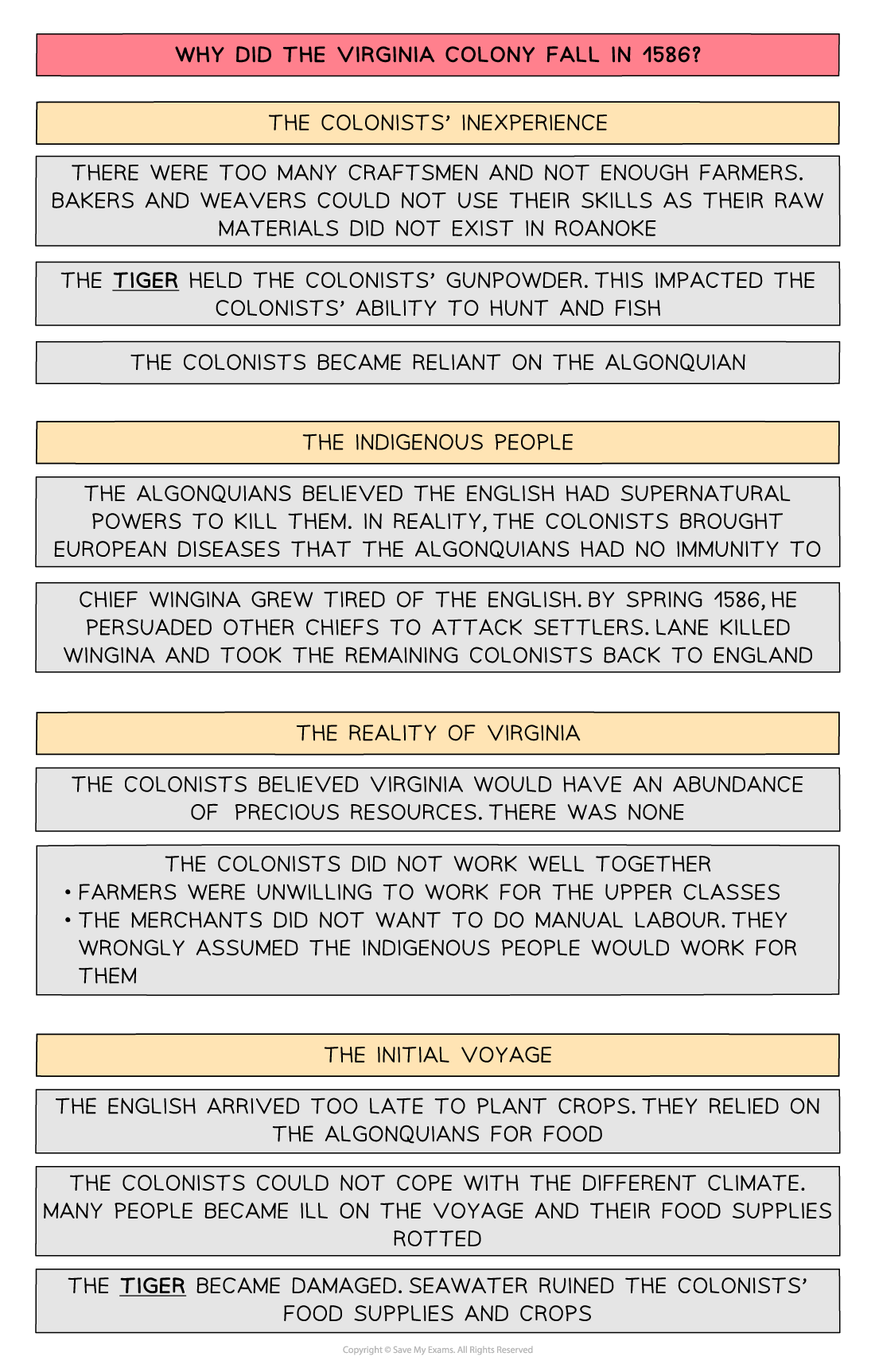
Raleigh's attempted colony may have failed, but lessons were learned from the experience
These lessons helped the colonists establish Jamestown in 1607 - the first successful English colony in America
Examiner Tips and Tricks
Question 8/9 on this paper is worth 20 marks and you should devote around 30 minutes of your exam time to answering it.
Remember to factor in time for carefully reading and annotating the interpretations too.

Unlock more, it's free!
Join the 100,000+ Students that ❤️ Save My Exams
the (exam) results speak for themselves:

Was this revision note helpful?
