Reform, Resistance & the End of Indigenous Peoples' Independence (OCR GCSE History B (Schools History Project)): Revision Note
Exam code: J411

Summary
In the 1880s, there were several different views within American society over what the US Government should do about the indigenous peoples.
Some people believed that the Indigenous peoples should assimilate into US society. Other people were scared of Indigenous peoples and wanted them to live in reservations to separate them from the rest of society. Another group of Americans believed that Indigenous peoples should be exterminated to keep the USA safe. The US government had to navigate these varying opinions in their treatment of Indigenous peoples.
By the late 1880s, the situation between the US government and the Indigenous peoples had changed. The US policy of reservations had destroyed the Indigenous way of life. They also insisted on educating Indigenous children to be Christian and reject their culture. Indigenous peoples relied on government support, despite incentives to become self-sufficient through farming.
The government decided to adopt a new approach. They understood that the reservation system was too damaging to Indigenous peoples. They also understood that the tribal structure still existed, with people relying on each other to survive. The government wanted the Indigenous peoples to live more independently, like US citizens.
Citizenship, land loss & assimilation
The Dawes Act, 1887
The Dawes Act aimed to break up the power of tribes
Some chiefs still influenced Indigenous peoples in reservations
The US government wanted Indigenous peoples to live as individuals
Indigenous peoples would no longer rely on the tribe or annuity, reducing government costs
The government encouraged Indigenous peoples to assimilate
The US government wanted Indigenous peoples to farm
Assimilation would open up more land for settlers
Terms of the Dawes Act
Indigenous families could apply for homesteads of 160 acres
Single Indigenous persons could apply for 80 acres
Orphans could apply for 40 acres
Anyone who claimed a plot would automatically become a US citizen
The US Congress passed the Dawes Act due to a clause that stated that leftover reservation land could be sold to Euro-American settlers and railroad companies
Consequences of the Dawes Act
By 1890, Indigenous peoples had lost over half the land that they held in 1887
Indigenous people who took up plots struggled to farm the land
The soil on their homesteads was of poor quality
The plots were too small
Many Indigenous people sold their plots on or were cheated out of the land by Euro-American farmers
Some Indigenous people turned to lawlessness
When Indigenous people died, they often divided their homesteads amongst their children
This led to much smaller plots that were even more difficult to farm and make successful
The Dawes Act freed up a significant amount of land for Euro-American colonists and railroad companies
Examiner Tips and Tricks
A useful way to think about the Dawes Act is to remember that it was essentially a Homestead Act for Indigenous peoples.
Ensure that you know the details of the Homestead Act so you can use this knowledge for the Dawes Act, for example, the size of the plot being 160 acres.
The Ghost Dance Movement
One result of the widespread destruction of the Indigenous ways of life was the Ghost Dance movement
A man named Wovoka of the Paiute tribe began to preach that if people prayed whilst dancing, it would trigger a great flood that would remove all the Euro-Americans from the land
At the same time, the great herds of bison would return
The Ghost Dance spread quickly through the reservations
This unsettled Euro-Americans who lived near reservations and they asked for help
President Harrison ordered the US Army into the reservations to take control
Chief Sitting Bull was shot in the head as the army believed he was about to start a dance
Sitting Bull’s followers fled and joined another tribal leader's band called Big Foot
This led to the massacre at Wounded Knee
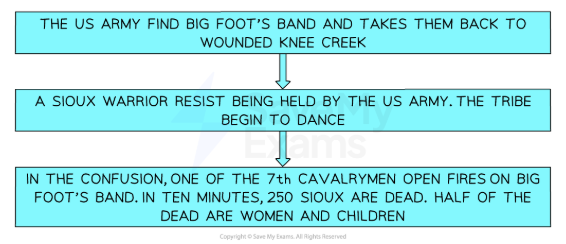
Consequences of the Wounded Knee Massacre
Despite the death and bloodshed, the US public supported the Army's actions at Wounded Knee Creek
Many people were relieved that the Ghost Dance was over
A large number of Euro-Americans believed Indigenous peoples were too wild and hostile
They either had to be assimilated or killed
There was also a desire for the US Army to get revenge for its losses at Little Bighorn
Worked Example
Name one consequence of the Dawes Act of 1887.
[1 mark]
Answer
One consequence of the Dawes Act of 1887 was that indigenous peoples had lost over half their land by 1890.

Unlock more, it's free!
Join the 100,000+ Students that ❤️ Save My Exams
the (exam) results speak for themselves:

Was this revision note helpful?
