Indigenous People of East America (OCR GCSE History B (Schools History Project)): Revision Note
Exam code: J411

Summary
The victory of the United States over Britain in the American War of Independence had significant consequences for the Indigenous peoples in North America. Although British colonists had taken land from the indigenous tribes and nations on the East Coast, they had no intention of expanding west beyond the Appalachian Mountains.
The leaders of the United States did want to expand west and American colonists began to occupy land to the west of the Appalachians during the 1780s. This led to violent conflicts. The Indian Removal Act of 1830 led to Indigenous peoples being moved to an area named "Indian Territory" by the US government.
The Indigenous People in the East
The North American continent is often, wrongly, portrayed as being largely unpopulated when European colonists first arrived
There were large groups or nations of Indigenous peoples with rich and varied cultures and ways of life
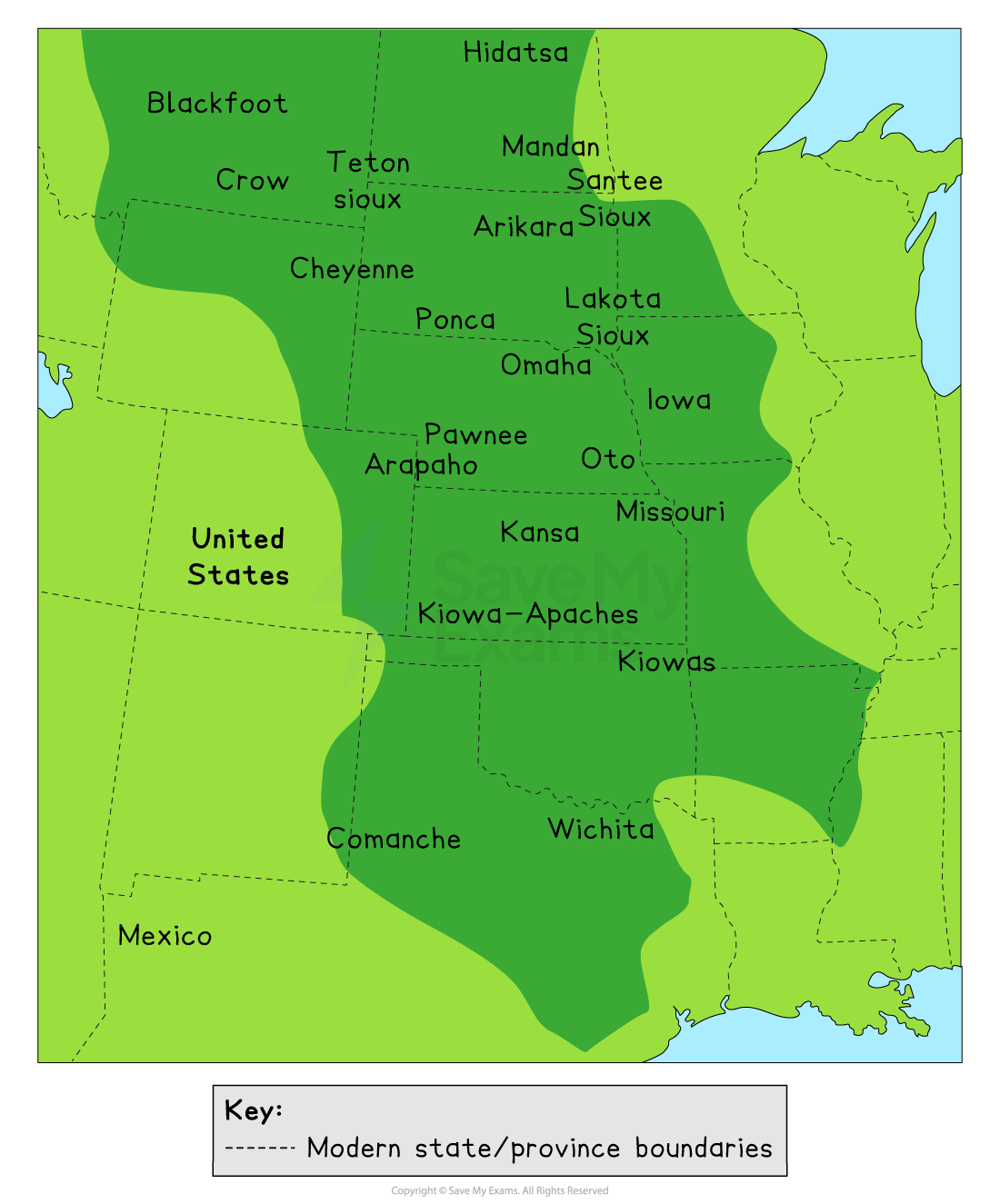
Indigenous Americans had been displaced and removed from their lands since the arrival of the first British colonists in the early 1600s
Many of these people had moved to lands west of the Appalachian Mountains, which Britain had no ambition to colonise
When the United States defeated Britain in the American War of Independence in 1783, these lands came under the control of the USA
The newly-acquired lands were divided into the Northwest Territory and the Southwest Territory and they were soon opened for 'settlement' or colonisation by the United States government
Examiner Tips and Tricks
Question 1 on this paper is actually three questions - each worth one mark. The questions will test your factual knowledge by asking you to name something or give a specific example of something. Flashcards are a great way to revise facts such as dates and people.
The removal of the Indigenous People from the East
In 1787, the Northwest Territory was opened by the US government for 'settlement' or colonisation by Euro-Americans
The land of this territory would become the states of Michigan, Ohio, Indiana and Illinois
The arrival of large numbers of Euro-Americans led many Indigenous people to leave and move further west
In 1790, the Southwest Territory was opened
Euro-Americans were encouraged by the US government to occupy and farm the land
The land of this territory became Alabama, Tennessee and Kentucky
It was more difficult for indigenous people in the Southwest territory to move further west, as much of the land there had already been occupied by Euro-Americans
The response of the Creeks and Seminoles was to fight the Euro-Americans who were coming to occupy the land of the Southwest territory
This was not successful and the Creeks were defeated in 1814 by an army led by Andrew Jackson (a future American president)
The Creeks were forced to give up 23 million acres of land
Rather than fighting, some Indigenous people tried to adopt the ways of life of the people of the United States
The Cherokee, the Creeks, the Chickasaws, the Seminoles and the Choctaws all began trading in farmed goods with the United States and even opened schools, churches and newspapers
These nations soon became known as the "Five Civilised Tribes" by people in the United States
The Indian Removal Act, 1830
The assimilation of the 'Five Civilised Tribes' did not prevent their forced removal from their lands
Like many others, President Andrew Jackson and others referred to it as the "Indian Problem"
He decided that the way to end this problem was to remove all Indigenous people from the lands in the east
In 1830, Congress passed the Indian Removal Act
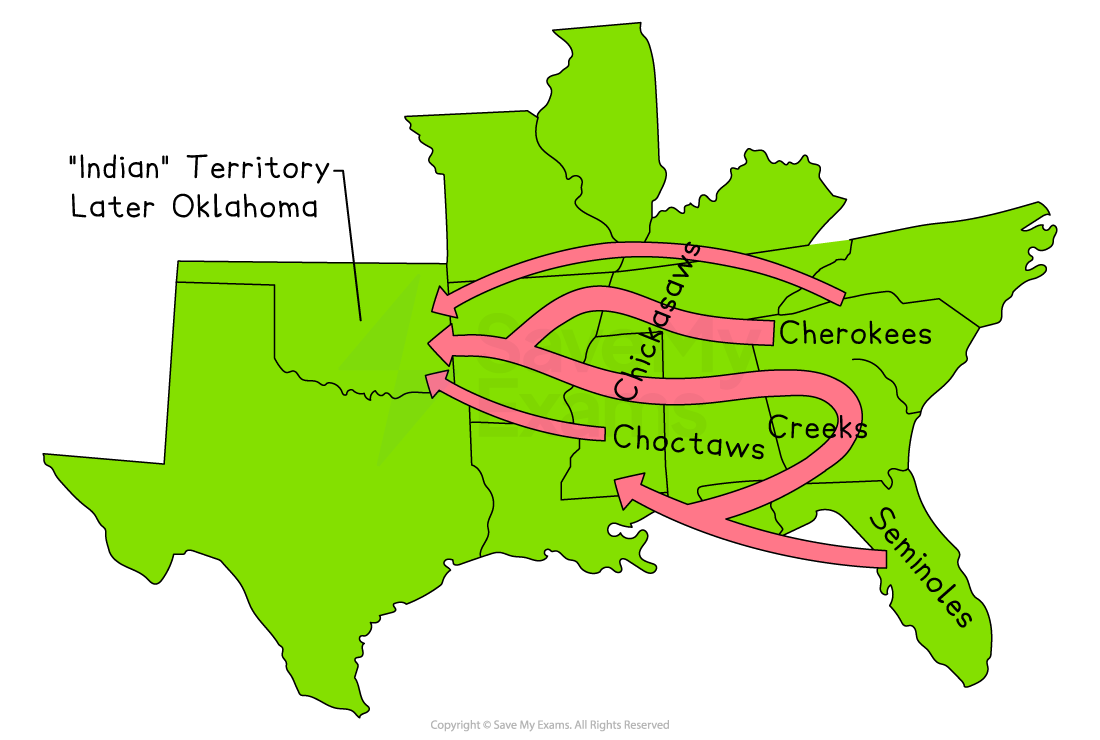
This forced all Indigenous people in the East of the USA to:
Give up their lands
Move to an area in the Midwest of America that was unwanted by Euro-American plantation owners
This area was named "Indian Territory" by the US government
It was later to become the state of Oklahoma
Cherokee court action
The Cherokee Nation took legal action to try to stop its eviction from its land
The case went to the Supreme Court, the highest court in the land
The Cherokee argued they were an independent nation from the United States
This, argued the Cherokee, meant that US laws and acts did not apply to them
The judge agreed and ruled that the Cherokee were 'a distinct political society'
The judge also ruled that the Cherokee relied on the US government for their safety and welfare,
This meant the US government should be able to do what it thought was best for the Cherokee
The ruling infuriated President Andrew Jackson, who decided to ignore it and continue to force the Cherokee from their lands
The Second Seminole War, 1835-42
Some Seminole leaders signed a treaty with the US government and moved to Indian Territory
However, many Seminole leaders refused to acknowledge the treaty
They claimed it had been signed without their knowledge
Their refusal to stick to the terms of the Treaty led to war
The Seminole were joined in their fight by African Americans who had escaped enslavement
The war lasted 7 years and cost the US government over $50 million
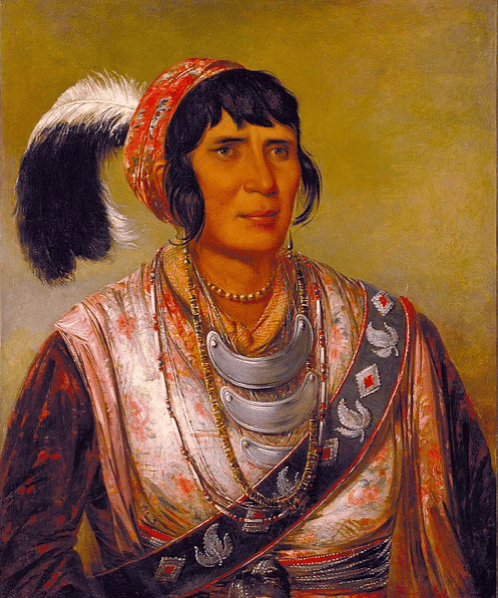
When the US government opened negotiations with the Seminole chief and war general, Osceola
The government captured and imprisoned Osceola
Osceola died in prison
His death was a turning point in the war
Many Seminoles decided to head west
A minority of Seminoles remained in Florida
The United States fought another war with the Seminoles between 1855 and 1858
The Creek in Alabama
The Creeks signed a treaty in 1832
The treaty gave much of the Creek's land in Alabama to the Alabama government
This was in exchange for a promise that they could keep the remaining land
However, US citizens kept moving onto Creek land and illegally occupying it
The Creek complained to the Alabama government, but they refused to act
The Creeks started to take violent action against the occupiers, which involved arson and murder
In 1836, the Alabama government called on the US Government for help
The Secretary of War sent in troops and ordered the removal of all Creeks from Alabama
Over 15,000 Creeks were moved to the Indian Territory by 1837
The Trail of Tears
In 1835, several Cherokee leaders signed a treaty with the US government
In the treaty, they agreed to move to "Indian Territory"
However, the majority of the Cherokee did not agree with the treaty
Over 15,000 of them signed a petition that claimed the treaty did not represent them
Despite the petition, in 1838, the US government sent 7,000 troops to force 18,000 Cherokee to march for three months to Indian Territory
The terrible journey became known as the 'Trail of Tears'
It is estimated that around 5,000 Cherokee died of disease, exposure and starvation before they reached Indian Territory
The Consequences of President Jackson's Actions
Around 46,000 indigenous people were removed from their lands as a result of the Indian Removal Act
This meant 25 million acres of land were then available for Euro-Americans to occupy and build plantations
These plantations were worked by enslaved people
Worked Example
Name one of the so called "Civilised Tribes" that adopted many of the ways of life of people from the United States.
[1 mark]
Answer
One of the so called 'Civilised Tribes' who adopted many of the ways of life of people from the United States was the Chickasaw.

Unlock more, it's free!
Join the 100,000+ Students that ❤️ Save My Exams
the (exam) results speak for themselves:

Was this revision note helpful?
