Conflict on the Plains (OCR GCSE History B (Schools History Project)): Revision Note
Exam code: J411

Summary
The increase in homesteaders and ranchers arriving on the plains led to more conflict between the US and the Indigenous tribes. Both colonising Euro-Americans and the Indigenous tribes competed for the same land and resources. Widespread gun ownership amongst all people on the plains meant disagreements often led to deadly violence.
When the homesteaders, ranchers and gold prospectors asked the government for help against the indigenous tribes, it often led to war. These wars did not end well for the Indigenous tribes on the plains.
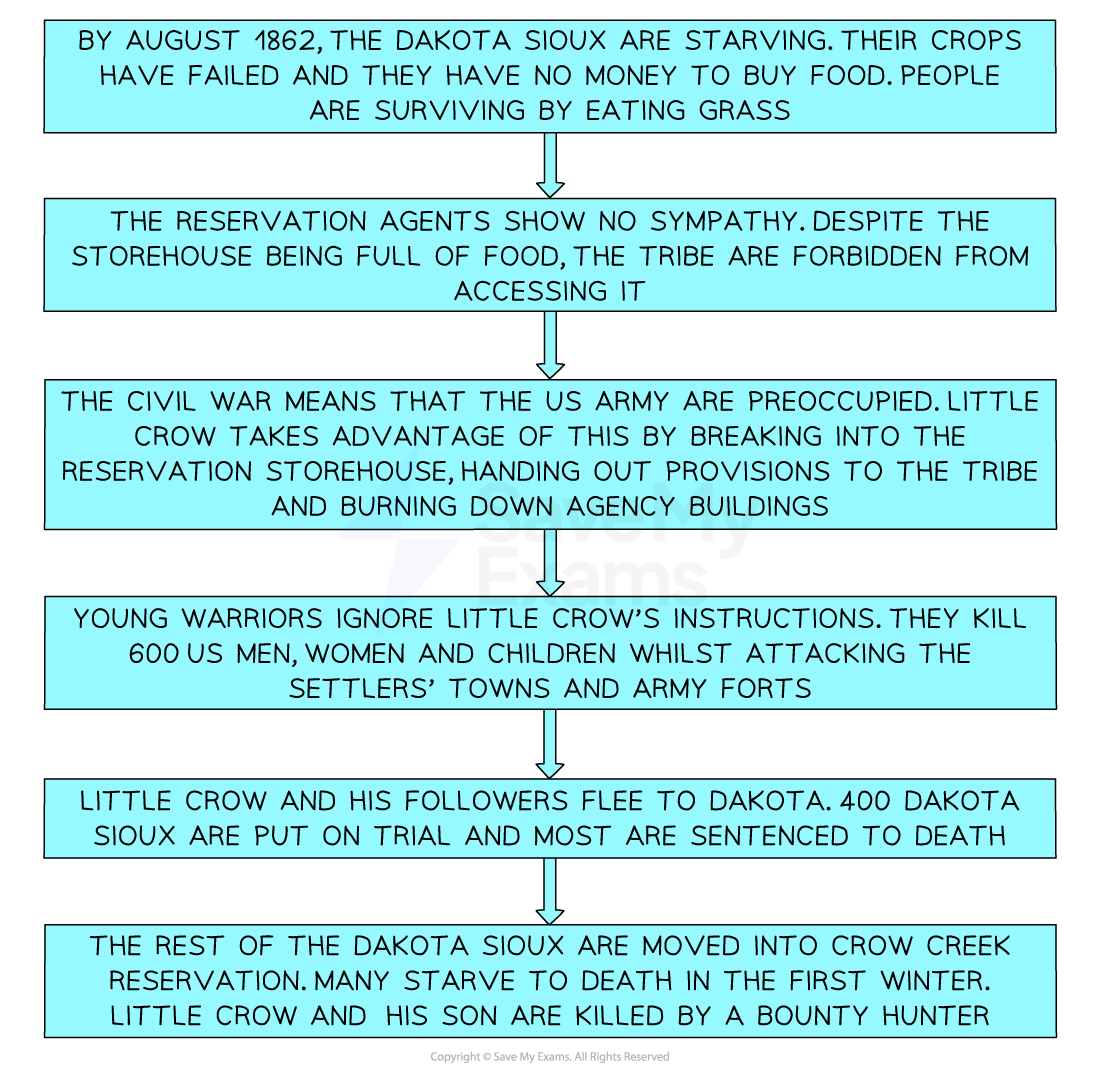
Little Crow's War, 1862
In 1851, the Dakota Sioux signed a treaty with the US government
They gave up 24 million acres of land in Minnesota in return for a $1.4 million annuity
The number of Euro-Americans occupying land in Minnesota increased rapidly
They even took the fertile farming land within the Dakota Sioux's reservation
The remaining area of the reservation could not produce enough food for the Dakota Sioux to survive over the winter
This was made worse because corrupt agents from the Bureau of Indian Affairs ran the Dakota Sioux's reservation
The agents stole the annuity that was meant to be given to the Dakota Sioux
They also held on to supplies until the Dakota Sioux were desperate and starving
This meant they would pay higher prices for the supplies
The supplies they gave the Dakota Sioux were often spoiled and rotten
To prevent starvation, the Dakota Sioux ran up large debts with traders
In 1858, the government forced the Dakota Sioux to give away half of their reservation land in exchange for money to pay off their debts
A band chief of the Dakota Sioux named Little Crow wanted to take action
He felt the government had broken their promise not to take away land
The reservation was already too small to sustain the tribe
Examiner Tips and Tricks
Many Europeans and Americans called the Indigenous peoples of America 'Indians.' This is no longer an accepted term. Do not use 'Indians' to refer to Indigenous peoples in your exam answers. However, in this section, you will have to use the official name for the government policies towards Indigenous peoples. Many of the policies use the term 'Indian'. You should write the full title of these acts in your exam answers to show specific own knowledge.
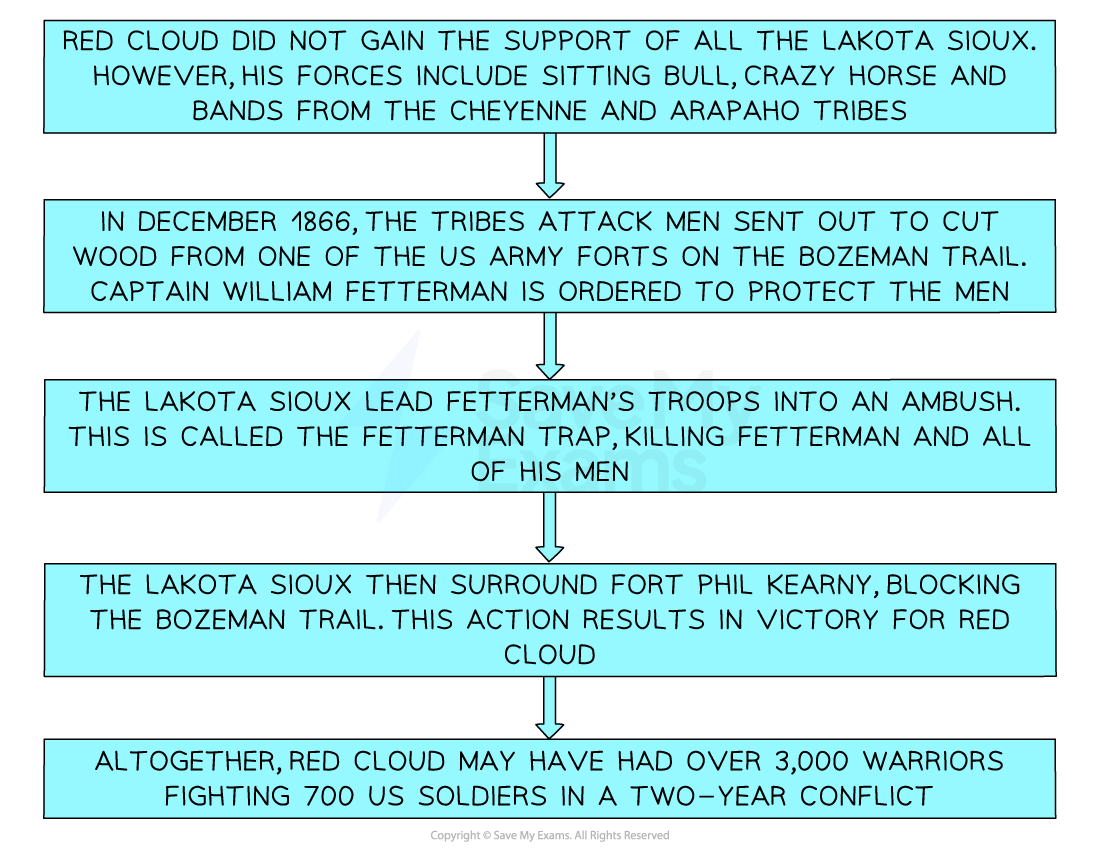
Red Cloud's War, 1865-1868
In 1862, gold was discovered in Montana
To reach the gold fields, many prospectors travelled down a path known as the Bozeman Trail
The Bozeman Trail crossed through land that had been promised to the Lakota Sioux as part of the Fort Laramie Treaty
By 1865, 2,000 prospectors had travelled down the Bozeman Trail
This angered a respected war chief of the Lakota Sioux named Red Cloud
Red Cloud entered talks with the US government, but discovered that the US Army had started building forts along the Bozeman Trail
Red Cloud decided the only response was war
The Great Sioux War, 1876-1877
Gold prospectors used the Sioux hunting grounds called the Black Hills in Dakota
This went against the 1868 Fort Laramie Treaty
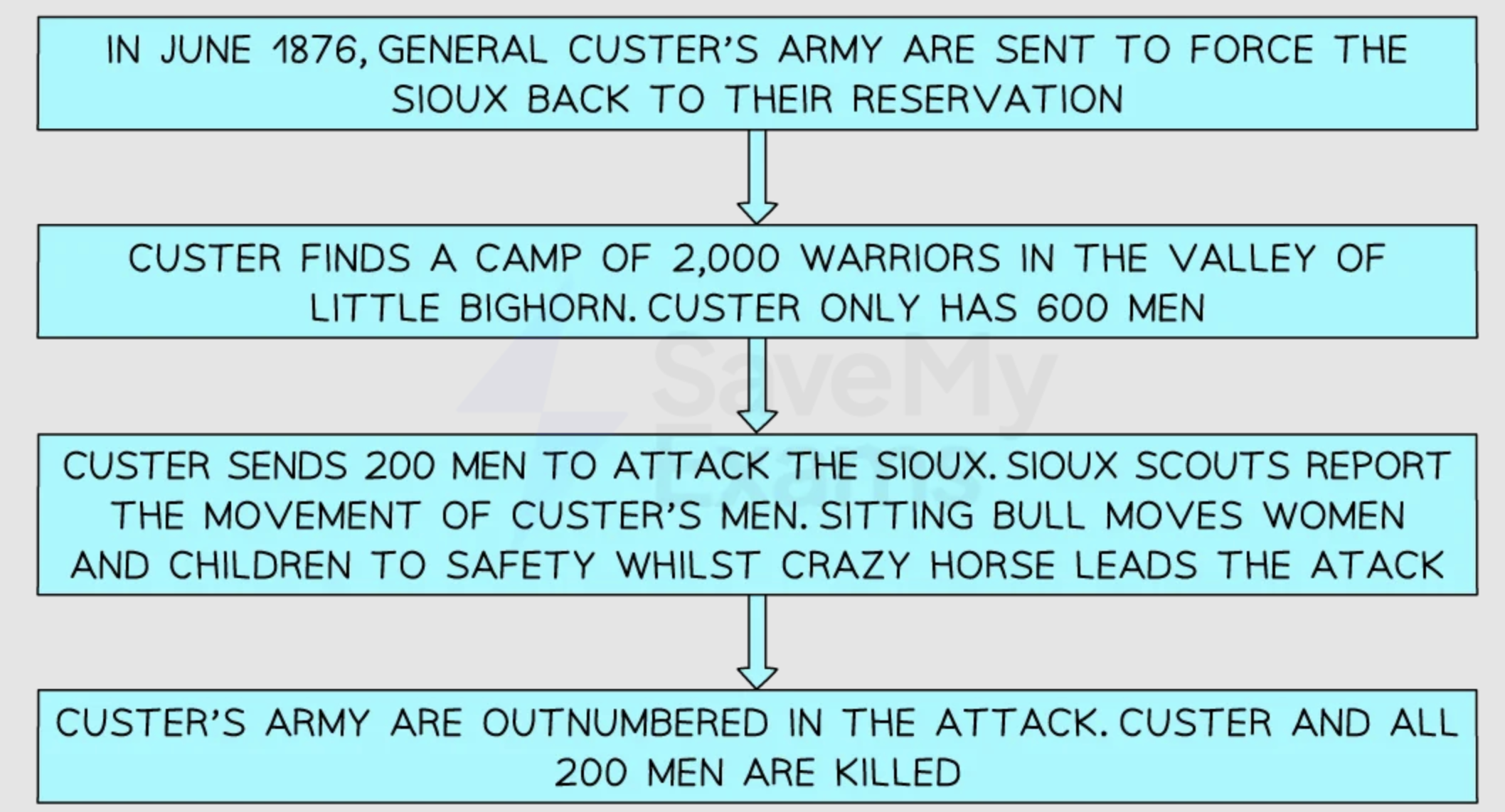
George Custer and his 7th Cavalry were meant to protect railroad builders
However, Custer was also searching for gold
The Sioux rejected a new treaty
They continued to attack prospectors
Thousands of Sioux warriors left their reservation to join leaders Sitting Bull and Crazy Horse
The warriors were given 60 days to return to their reservation by President Grant, or else they would be attacked
Deep snow made it impossible for the warriors to return. 7,000 Sioux were outside their reservation
This led to the Battle of the Little Bighorn
Consequences of the Sioux victory at the Battle of the Little Bighorn
The Sioux had hoped for a truce after their victory at the Little Bighorn
Instead, the US Army relentlessly pursued and hunted them down
The government stopped all rations being given to the Sioux, which forced them to sell land from their reservation
Sitting Bull escaped to Canada, but Crazy Horse was arrested and murdered
In 1877, the Sioux surrendered and the US Government took illegal ownership of the Black Hills
They also seized another 40 million acres of land that had been designated an "Indian" reservation
Worked Example
Name one example of a conflict that occurred on the plains between 1862 and 1877.
[1 mark]
Answer
One example of a conflict that occurred on the plains between 1862 and 1877 was Red Cloud's War.

Unlock more, it's free!
Join the 100,000+ Students that ❤️ Save My Exams
the (exam) results speak for themselves:

Was this revision note helpful?
