The Building of the Railroads (OCR GCSE History B (Schools History Project)): Revision Note
Exam code: J411

Summary
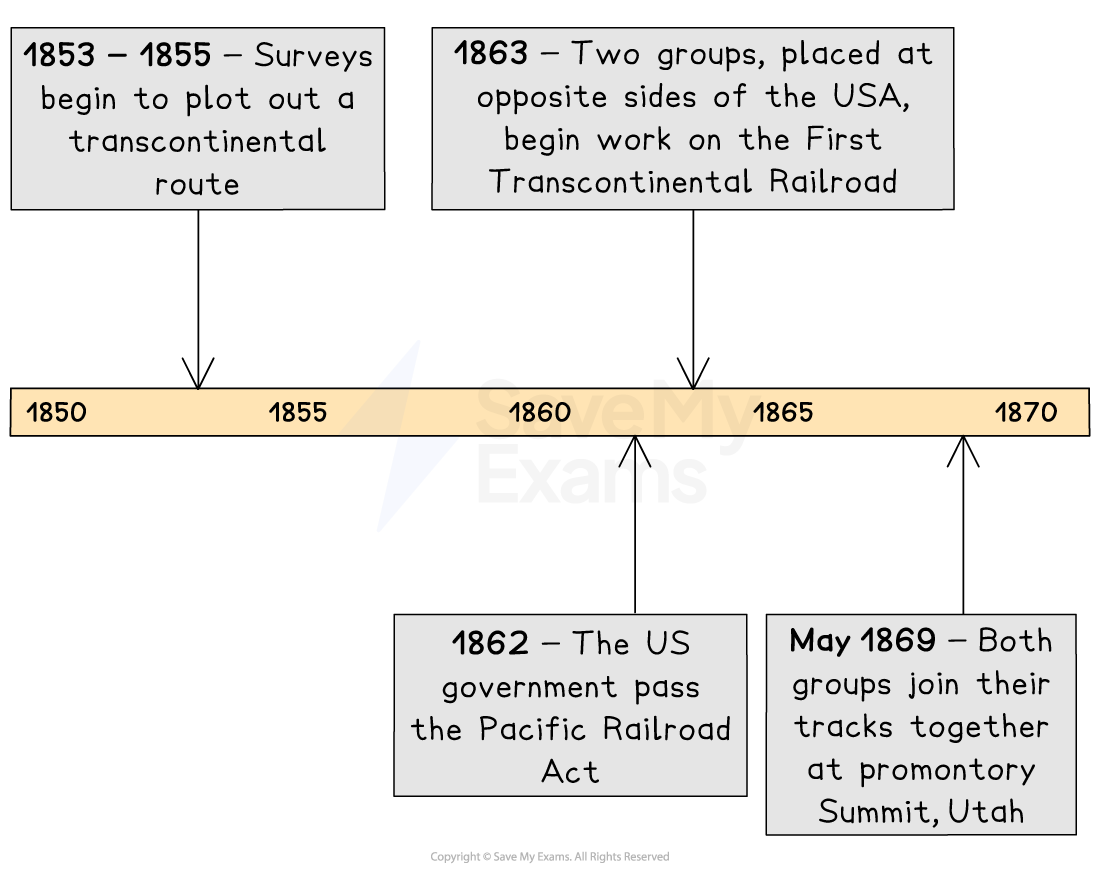
Building a railroad that stretched right across the North American continent was an enormous task. For many years, it was too big for any private company to take on. The passing of the Pacific Railroad Act in 1862 meant that government money finally made it possible.
Two companies set about building the 3077km of railroad that stretched from Omaha, Nebraska, in the east to Sacramento, California, in the west. The Central Pacific Railroad Company started building in Sacramento and the Union Pacific Railroad Company started building in Omaha. They both met at Promontory Summit, Utah in 1869
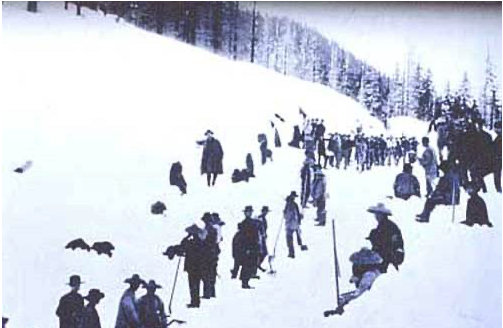
The construction of the railroad was dangerous and required thousands of workers to live and work outdoors in all weathers, all year round. Many workers lost their lives in the construction of the railroad.
As part of the deal, huge areas of land in the West became the property of the railroad companies. They used marketing campaigns to encourage thousands of people - both from within the US and from Europe - to move to the west and build farms.
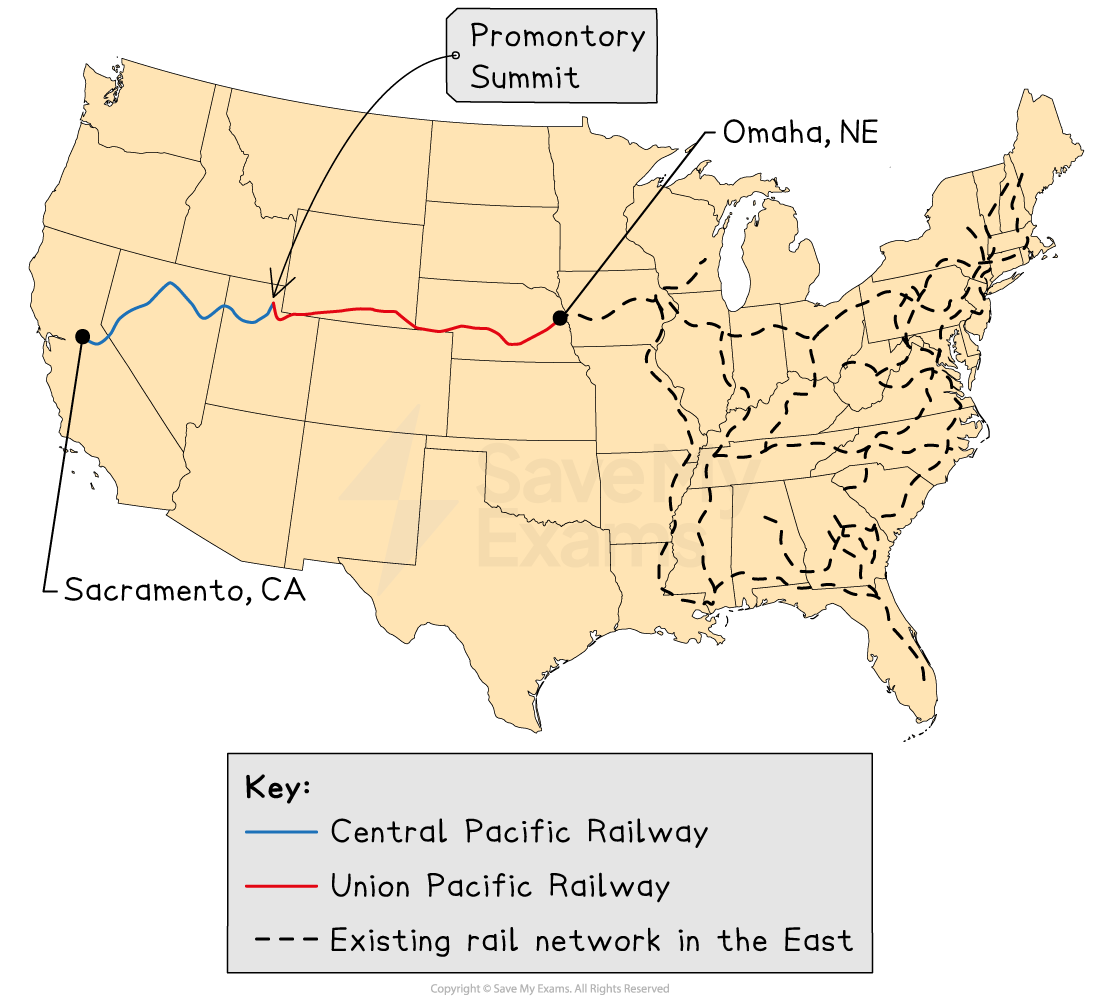
Central Pacific and Union Pacific
The national government began conducting surveys to build a transcontinental railroad in 1853
Building a railroad of that scale meant that no private company could afford to do it
However, the terms of the Pacific Railroad Act, passed by Abraham Lincoln in 1862, meant that building such an enormous railway would be profitable for companies
The Central Pacific Railroad Company won the contract to build the railroad, starting at Sacramento, California and heading east
The Union Pacific Railroad Company won the contract to build the railroad starting at Omaha, Nebraska and heading west
Government subsidies and land grants
The reason building the railroad became attractive to private companies was because of the subsidies, loans and land they were given by the government
Each company was given $16,000 for every mile of track they laid
They received $48,000 for every mile laid in the mountains
They were also given 6,400 acres of land for every mile laid
By the time the railroad was completed in 1869, the two railroad companies owned land that was greater in size than the state of Texas
This was sold on to investors and farmers for enormous profits
Despite this, the enormous costs involved in building railroads through such challenging terrain and over such distances meant that both companies almost went bankrupt
The exploitation of workers
Constructing the railroad was done without modern machinery
It was difficult and dangerous
The workers were housed in tents and moved with the railroad
Health and safety regulations were nonexistent,
Deaths and injuries due to accidents were common
Thousands of men lived and worked in places without proper sanitation facilities
This caused illness and disease to spread
The construction of tunnels through the Rocky and Sierra Nevada mountains was particularly dangerous
It required dynamite to blast through the rock
The Central Pacific Company employed 12,000 Chinese workers from Kwantung Province to do this
Completion of the transcontinental railroad
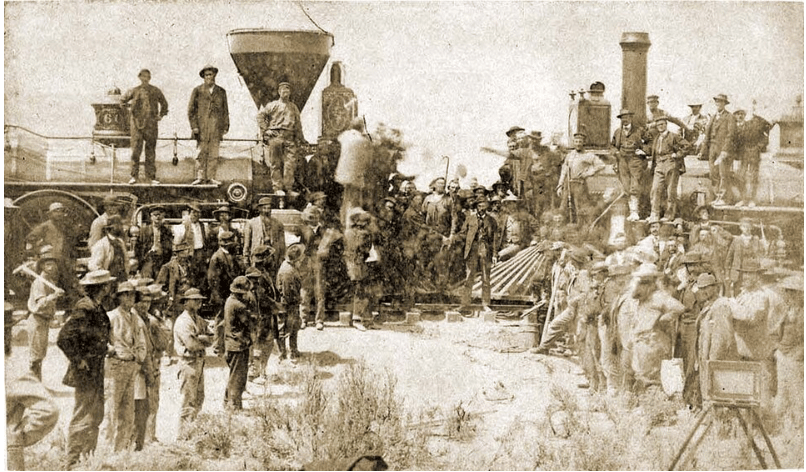
The completion of the transcontinental railroad is seen as one of the key moments in American national history
The two lines met at Promontory Summit in Utah on 10th May 1869
To mark the completion, the final nail driven in to hold the track to the sleeper was made of solid gold
The gold nail was removed as soon as the ceremony was over
Examiner Tips and Tricks
History is not about remembering lots of dates, but you do need to have a solid chronological understanding of a period. This is particularly important for question 2, which requires you to write a clear and organised summary of an event.
The role of the railroads and the Plains settlements
By the time the railroads were complete, the railroad companies owned enormous areas of land, but also had vast debts
They quickly set about attracting people to move to the west and buy the land from them
Railroad companies did what they could to make migration easier
They organised trips, using the experience of existing settlers, to see the attractions of the area
They gave out loans to help people buy land
They also attracted people from Europe to move to the west
Each company had a Bureau of Immigration to persuade people to travel to the USA
By 1880, over 200 million acres of land sold by the railway companies were being farmed
Worked Example
Name one of the companies that built the transcontinental railroad, which was completed in 1869.
[1 mark]
One of the companies that built the transcontinental railroad was the Central Pacific Railroad Company

Unlock more, it's free!
Join the 100,000+ Students that ❤️ Save My Exams
the (exam) results speak for themselves:

Was this revision note helpful?
