Reconstruction & African American Liberty (OCR GCSE History B (Schools History Project)): Revision Note
Exam code: J411

Summary
Abraham Lincoln was killed before the Reconstruction of the USA could get underway after the Civil War. His successor, Andrew Johnson, quickly went about readmitting the Confederate states to the Union and pardoning almost all those who had fought against the Union.
This caused great anger amongst many people in Congress. They introduced a Radical Reconstruction programme that saw the ex-Confederacy states occupied by Union soldiers and all those who fought against the Union being banned from voting. The ex-Confederacy states were not readmitted to the Union until they met certain conditions, such as accepting the 13th and 14th Amendments to the US Constitution.
When President Johnson stood for reelection in 1868, he lost and was voted out of office.
However, many people in the south were strongly against the changes introduced by the Radical Reconstruction and attempted to reverse them. They were helped by Supreme Court rulings that stated state laws did not have to treat all people equally. This led to segregation in many states in the south where African Americans were forced to attend separate schools, parks, etc.
A campaign of violence was also launched against the African Americans in the south by the Ku Klux Klan and the White League. The system of sharecropping also kept African Americans poor and under the control of Euro-American landowners.
Reconstruction and Andrew Johnson
By the end of the American Civil War on 9 April 1865,
Approximately 800,000 Americans had been killed, about 2 per cent of the entire population
It had cost a total of $8.3 billion in 1860s dollars - the equivalent of several trillion dollars today
Enormous damage had been caused, particularly in the southern states where railroads, cities and plantations had been severely damaged or destroyed
It also resulted in 4 million enslaved people becoming emancipated
It directly led to Congress passing the 13th Amendment of the US Constitution in January 1865, which states:
"Neither slavery nor involuntary servitude shall exist within the United States or any place subject to its jurisdiction."
US Constitution
Almost the entire first term of Abraham Lincoln's Presidency had been spent fighting the Civil War
He began his second term in March 1865, just over a month before the end of the war
The focus was now on rebuilding the United States and healing the deep wounds it had caused
This task became known as Reconstruction
The death of Abraham Lincoln
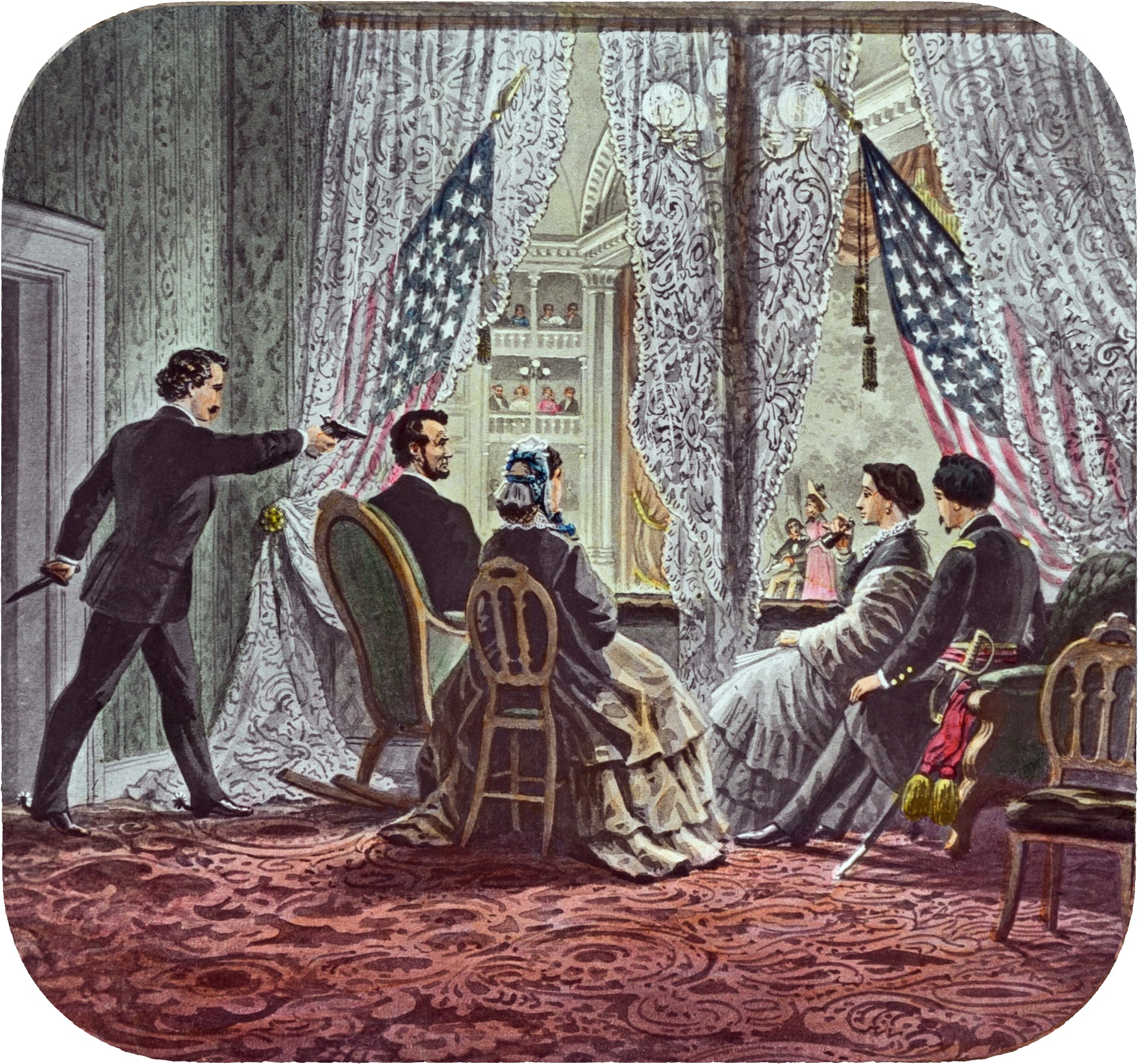
Less than one week after accepting the surrender of the Confederacy, Lincoln was shot in the back of the head as he sat at the theatre in Washington with his wife
Lincoln's killer was John Wilkes Booth
He was motivated by trying to stop African Americans from gaining full citizenship
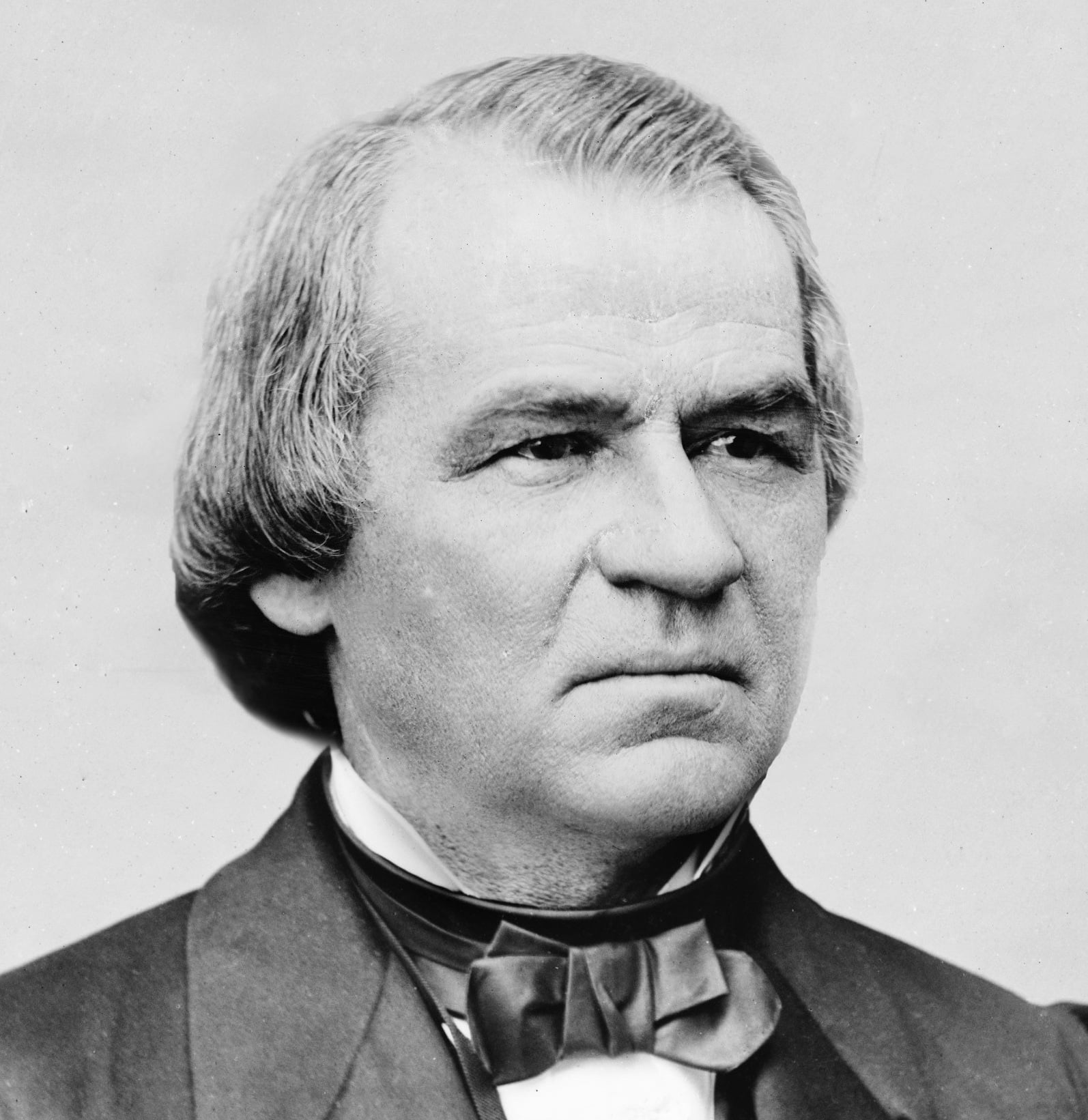
President Andrew Johnson
Andrew Johnson was Lincoln's vice president
He took over as president after Lincoln's death
The actions of President Johnson caused shock and surprise amongst many people in the north, including those in the president's own Republican Party
Johnson's reconstruction
President Johnson's main priority was to reunite the country
He only planned to punish the most powerful generals and plantation owners from the Confederacy
All others who fought in the Confederate Army were pardoned
The Confederate states were allowed to reapply and were admitted back into the Union almost immediately
Some of these southern states were still governed by plantation owners
'Black Codes' in the southern states
The 13th Amendment to the Constitution meant the southern states could not reintroduce slavery
Instead, they introduced laws that treated African Americans differently
These laws:
Kept African Americans powerless and impoverished
Became known as the 'Black Codes'
Were slightly different in each state
Some laws banned African Americans from:
Giving evidence in trials
Owning weapons
Serving on juries in court cases
In Louisiana, African Americans had to work for the same employer for a year and were not allowed to leave the land during that time
This meant they were essentially living the same lives as they were when they were enslaved
In Mississippi, African Americans were banned from even renting farmland
Despite these restrictions on African Americans, just months after becoming President, Johnson declared that Reconstruction was over in December 1865
Radical Reconstruction, 1866-70
Much of Johnson's Reconstruction had taken place while Congress had not been sitting
When Congress finally met in December 1865, Johnson had declared that Reconstruction was over
Many anti-slavery members of Congress believed Johnson's actions had been a betrayal of all the sacrifices and deaths that had taken place during the Civil War
They believed that:
The former Confederate States should be occupied by the Army to protect African Americans
The southern states should be governed by Congress rather than by the plantation owners who had gone to war with the Union
The members of Congress started to undo Johnson's Reconstruction and protect the lives and rights of African Americans in the southern states
These changes to Reconstruction became known as Radical Reconstruction
Readmitting the ex-Confederate States
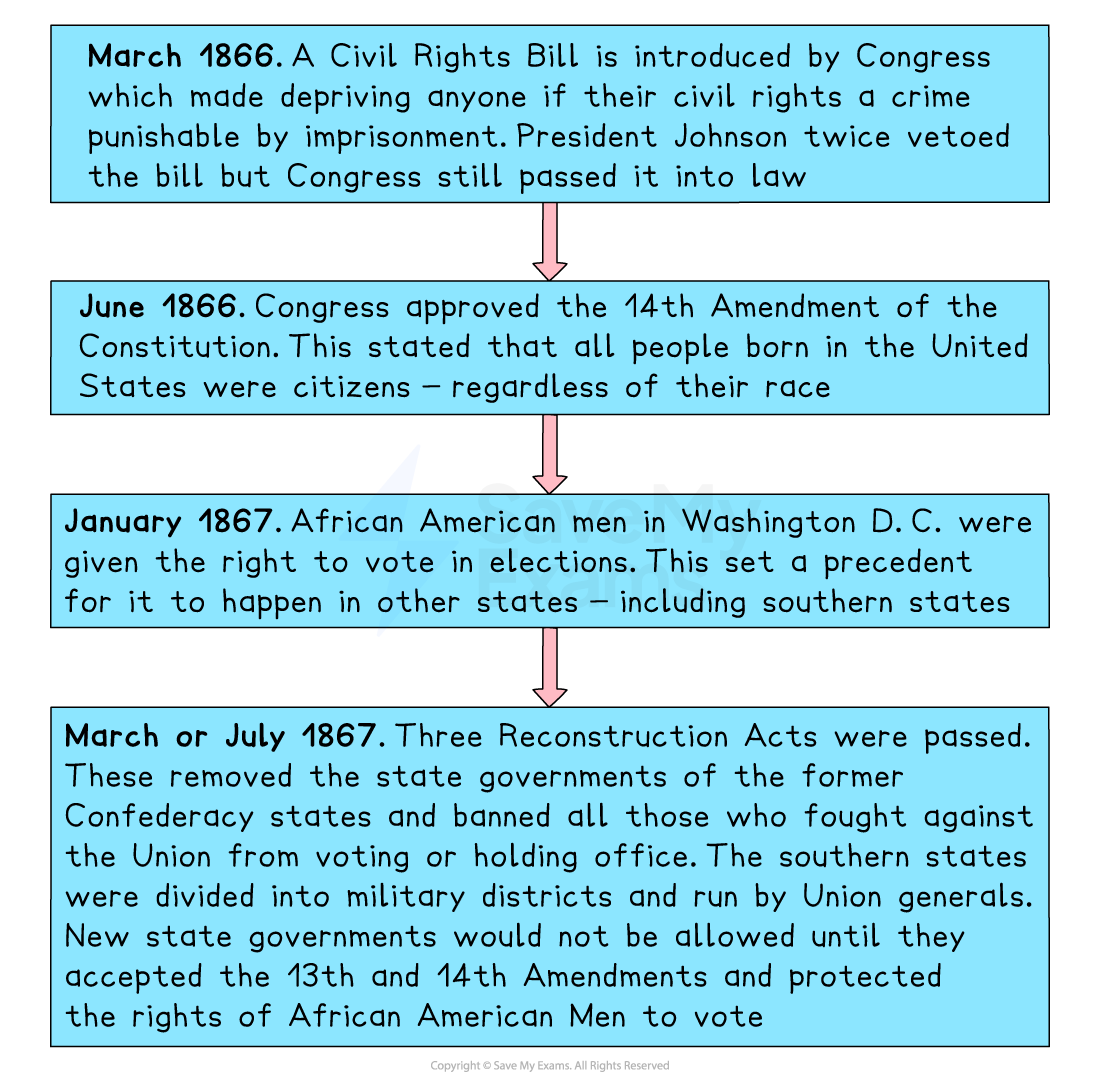
In July 1868, the 14th Amendment to the US Constitution became law
All Americans who were descended from enslaved Africans were legally citizens of the United States and had rights protected by law
This overturned a Supreme Court ruling of 1857, which had judged that African Americans could not be citizens of the United States
By the end of 1868, the ex-Confederacy states of Texas, Virginia, Mississippi, North and South Carolina, Florida, Arkansas, Alabama, Louisiana and Georgia had met the conditions set out by Congress
They were then re-admitted to the Union
Further proof of people's anger with Andrew Johnson for his handling of Reconstruction came in the Presidential election in November 1868
Johnson lost that election and was voted out of office after a single term
Examiner Tips and Tricks
It is important not to confuse the 'Black Codes' with the segregation and prejudice that took place after 1870.
The 'Black Codes' took place before Congress introduced Radical Reconstruction and the segregation took place after the Supreme Court ruling of 1873.
Sharecropping & segregation in the South
After 1870, the pace of change in the southern states, because of Reconstruction, slowed
Many of the members of Congress who were responsible for the Radical Reconstruction died
Many people in the southern states were increasingly angry about Reconstruction
They believed widespread corruption was taking place and people from the north were robbing the south of its wealth
There was also fear amongst the Euro-Americans in the southern states
In many southern states, Euro-Americans were outnumbered by African Americans
Many southern Euro-Americans believed that, by giving African Americans the right to vote, the lives of southern Euro-Americans would be ruined
The Ku Klux Klan and the White League
Some Euro-American southerners turned to violence and intimidation to prevent African Americans from achieving equality
The Ku Klux Klan was a secret white supremacist group formed in Tennessee in the late 1860s
The Ku Klux Klan used violence against African Americans; they:
attacked schools and churches
murdered community leaders
launched night raids on African American communities
wore hoods that covered their faces to hide their identities
NOTE: Please insert KKK night raid picture here
The White League was formed in Louisiana in 1874
It was not a secret organisation
Its members openly called for the return of slavery
The White League used violence and intimidation to prevent African Americans from:
Voting
Becoming involved in politics
In September 1874, thousands of White League members seized control of the city government buildings in New Orleans
It became known as the Battle of Liberty Place
Between 30 and 50 people were killed before government troops took back control of the buildings
Supreme Court Rulings
In 1873, the Supreme Court ruled that:
The US Constitution stated that all citizens had to be treated equally by the national government on national issues, regardless of their race
It also ruled that the US Constitution did not state that people of different races had to be treated equally by state laws
Southern governments began to legally reintroduce segregation
This meant separate schools, parks, public toilets, etc., for Euro-Americans and African Americans
In 1875, the Supreme Court ruled that the national government had no right to intervene if state governments were preventing African Americans from voting
This meant the majority of voters remained Euro-Americans
The majority of these voted for Euro-American politicians who introduced racist and discriminatory state laws
Sharecropping
Many African Americans lived on and farmed land owned by Euro-Americans
The terms involved handing over two-thirds of the crops grown every year to the landowner as rent
This was known as sharecropping
It kept the African American farmers very poor
Landowners became rich
It also meant landowners were very powerful
They could evict any tenants who did not act as they wished
As voting was done in public, most sharecroppers would not vote for candidates their landowners did not approve of
Many sharecroppers were bullied into not voting at all
Worked Example
Name Abraham Lincoln's vice-president.
[1 mark]
Abraham Lincoln's vice president was Andrew Johnson.

Unlock more, it's free!
Join the 100,000+ Students that ❤️ Save My Exams
the (exam) results speak for themselves:

Was this revision note helpful?
