Migrant Journeys to the West (OCR GCSE History B (Schools History Project)): Revision Note
Exam code: J411

Summary
From the 1830s, people travelled to the West of America because of economic, social and religious factors.
Many settlers were motivated to move westward for land and opportunity. The concept of 'Manifest Destiny' was very important. The white Americans believed that it was their mission to spread Christianity and populate the West. As a result, the US government established policies and schemes to encourage migration.
The desire for religious freedom motivated some groups to migrate to the West. Religious groups like the Mormons sought to create communities where they could practice their beliefs freely. They had faced severe persecution within the USA.
Westward migration had significant consequences for America. It led to the establishment of societies and states for the US government. There were also many negative impacts on the existing Indigenous tribes in these areas. Settlers disrespected tribal boundaries and monopolised resources. This also caused issues with law and order in newly established towns.
Migration to California & Oregon
In 1837, there was a significant drop in the Eastern and Southern US economy
This crash lasted until the mid-1840s
The impact of the crash was:
Loss of people's savings
The closing of multiple banks
The failure of businesses
An increase in unemployment by 25%
A reduction in wages by 40%
Poorer and unemployed settlers wanted a chance at a new life
They had heard stories of the riches in West America
Many people were unable to afford to stay in the East of America
Farmland in Oregon, 1830s
Settlers heard from traders about rich farmland on the West Coast and in Oregon
Traders had travelled along the Pacific Coast of America for many years by sea
The sea route took a year
The route went around South America
It would have been quicker and less expensive to travel by land
The sea route to Oregon cost $300
An average farm labourer earned $11 a month
Migrants could take all their possessions by wagon if there was a land route
The Rocky Mountains formed a huge barrier to migrating to the West
Travellers needed a way through the mountains to reach Oregon
Why did farmland in Oregon increase western migration?
Farmers could earn more in Oregon
They could grow more crops
There was less competition for farmland than in the East of America
The problems with the economy in the East made Oregon more attractive to settlers
The Oregon Trail
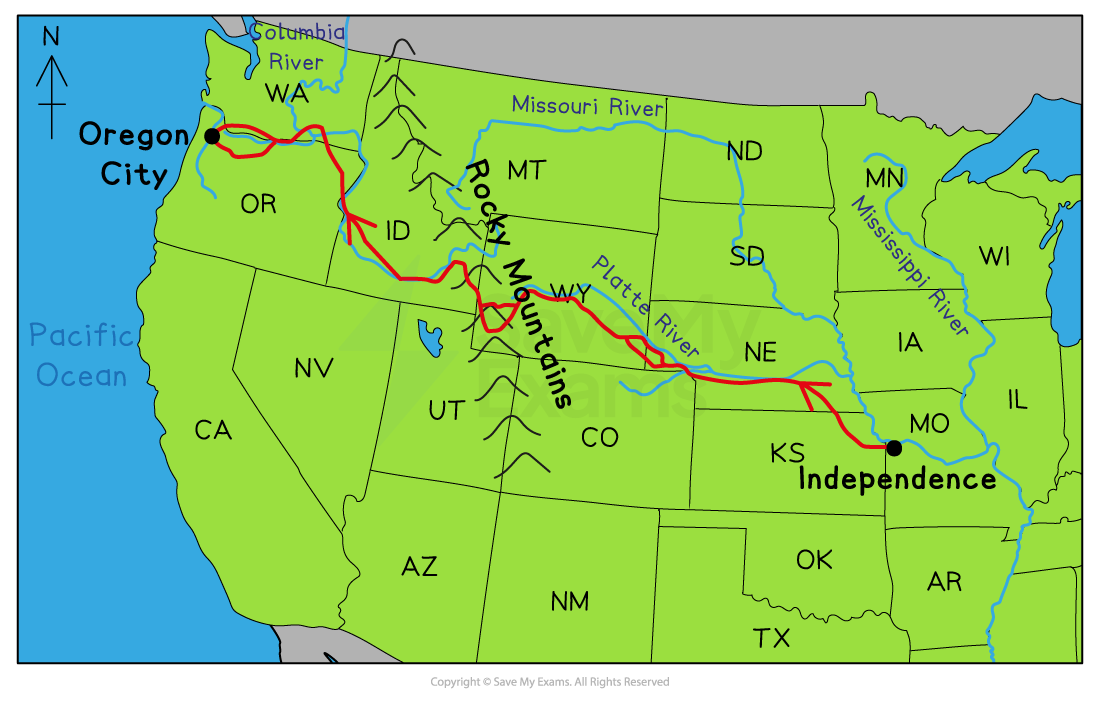
The Oregon Trail was the only practical land route to the West
The South Pass, a key section of the route, was found and advertised by Jedidiah Smith in 1825
Fur trappers began to clear this route
The Oregon Trail became important
By 1836, the Oregon Trail was used for the first time with covered wagons
By the 1840s, groups as large as 900 people completed the trip
By 1869, 400,000 people had used the Oregon Trail to settle in the West
Why did the Oregon Trail increase western migration?
The Oregon Trail made western migration easier
Many missionaries took the Oregon Trail
They wanted to travel to Oregon to convert Indigenous people to Christianity
The US government encouraged settlers to use the Oregon Trail
In 1841, the government gave $30,000 for an expedition to map and publish the best way to get to Oregon
John Fremont led the expedition
Many migrants used Fremont's guidebook
The guidebook made the route sound exciting and achievable
The belief in "Manifest Destiny"
"Manifest Destiny" was the belief that it was God's will for white, Christian settlers to control the whole of America
The intention was to spread Christianity across the country
Euro-American settlers believed they should "civilise" the Indigenous population
Why did "Manifest Destiny" increase western migration?
The government encouraged the belief in "Manifest Destiny" to increase the number of settlers travelling westward
Guidebooks like John Fremont promoted the value of "Manifest Destiny"
Euro-Americans believed that they had been given a mission by God to travel to the West
This made settlers resilient enough to overcome the problems of migration
Examiner Tips and Tricks
The last question on this paper is worth 18 marks. You will be given a choice of two questions, so make sure you choose which question to answer carefully.
Also, as the questions are numbered, 4 and 5, do not fall into the trap of answering them both! You will not receive any marks for the second answer and you will waste precious time.
The Mormon settlement of Utah
Who were the Mormons?
Mormons are a religious group
They are a sect of Christianity
Joseph Smith founded the Mormon Church in 1830
Smith stated that the Angel Moroni visited him in 1827
Moroni instructed Smith to dig for golden plates and translate them into the Book of Mormon, the third section of the Bible
The Mormon Church gained followers
By 1831, 1,000 people followed the Mormon faith
The Mormons also angered other Christians
The Mormon Church believed in polygamy
Other Christians accused Smith of committing blasphemy and lying about his experience
The Murder of Joseph Smith
The Mormons often moved to avoid persecution
The Mormons had travelled from New York and settled in Kirtland and Missouri
Smith reached Nauvoo, Illinois, in 1839
By 1845, the Mormons were no longer welcome in Illinois
In 1844, an angry mob murdered Joseph Smith
The Mormons' new leader, Brigham Young, wanted to find the 'promised land'
He believed that God had ordered the Mormons to travel west to the Salt Lake Valley
The Salt Lake Valley was not a part of the US
Young hoped that the Mormons could settle there without persecution
Reaching Omaha, 1846
The angry residents of Illinois forced the Mormons to start their migration in February 1846
Young wanted to begin the journey in the spring because:
The grass would have grown to feed their livestock
The weather would be warmer
The first stage of the Mormon migration was slow
The weather was bitterly cold
Families struggled to make the journey
The Mormons reached Omaha in June 1846
Young decided it was too late to begin the next stage of their migration
The Mormons stayed in Omaha until Spring 1847
Reaching the Great Salt Lake, 1847
In April 1847, Young sent a small group to travel to Salt Lake Valley, 2,000km away
Only 150 Mormons were in the group
The group had enough food and supplies for a year
They also had a portable boat to cross rivers
The Mormons left the Oregon Trail at South Pass, in the Rocky Mountains
The Mormons found a suitable route through the terrain
To prepare for future migration, the group:
Planted crops
Located water supplies
Built river crossings
The group reached the Salt Lake Valley in July 1847
A larger group of 1,500 Mormons followed the route and reached Salt Lake Valley in August 1847
From 1847 to 1869, 70,000 people followed the Mormon Trail to the Salt Lake Valley
Establishing Salt Lake City
The Salt Lake Valley was a challenging environment in which to establish a settlement
The lake held saltwater, so this could not serve as drinking water
The land around the lake could not grow crops
Under Young's strict leadership, the Mormons created Salt Lake City
The Mormons believed that Brigham Young was God's prophet
This meant all Mormons followed Young's instructions, and every person worked together
Mormon followers accepted that the Church owned everything
The Mormons built irrigation systems which transported fresh water from streams
This meant the community could grow crops
The responsibility to build, maintain and operate the irrigation systems gave Mormons jobs
Later, the Mormons founded new settlements away from the Salt Lake Valley
Resources from these new settlements were sent to Salt Lake City to help provide for the community
New Mormon settlements had a mix of skilled labourers and a Church leader
Each settlement was productive and shared valuable resources
The Church leader ensured that all settlers followed Mormon principles
Why was Mormon Migration Successful?
Young's leadership
Young created manageable groups
Each group had:
A leader
Mixed skills
Young insisted on strict discipline
Everyone had a specific role
Arguments were not allowed on the journey
Good planning
The Mormons formed circles with their wagons, with the livestock within the circle
This protected them from attack
They planned regular resting places
This helped keep their oxen healthy
Young did extensive research on the Salt Lake region
Worked Example
Name one reason why the Mormon settlement in Salt Lake was successful.
[1 mark]
Answer
One reason why the Mormon settlement in Salt Lake was successful was the widely held belief amongst the migrants that Brigham Young was a prophet from God and that God was on their side.

Unlock more, it's free!
Join the 100,000+ Students that ❤️ Save My Exams
the (exam) results speak for themselves:

Was this revision note helpful?
