The Growth of the Nazi Party, 1919-1933 (OCR GCSE History B (Schools History Project)): Revision Note
Exam code: J411

Summary
Between 1919 and 1932, the Nazi Party (originally the DAP and later the NSDAP) rose from a small Munich-based group to become the largest political party in Germany.
Under the leadership of Adolf Hitler, they tried and failed to violently seize control of Germany during the Munich Putsch of 1923. Hitler was imprisoned for his crimes and decided to change his approach to getting into power. He decided to try to get voted into power and reorganised the NSDAP, or Nazi Party, on a national scale.
Initially, this was not a success, but after the German economy collapsed as teh world entered the Great Depression, more and more Germans began voting for Hitler. By 1932, the Nazis had more seats in the Reichstag than any other political party.
The German Workers' Party (DAP)
IMAGE Needed - DAP timeline
Anton Drexler founded the DAP in February 1919
Drexler was a railway mechanic from Munich
In September 1919, the DAP had 23 members
It was a right-wing party that targeted the working classes
The government hired Hitler to spy on political parties in Munich
The Weimar Republic had struggled to survive threats from extremist parties
They wanted to know the plans of the different political parties
As an ex-soldier, Hitler desperately needed the work
The majority of Germany’s armed forces had been made unemployed after the Treaty of Versailles restricted the German army to 100,000 soldiers
Hitler attended his first meeting of the DAP on 12th September 1919
The ideas discussed at the meeting matched Hitler’s personal beliefs
On 19th September 1919, Hitler signed up as a member
This went against his government assignment
The Nazi Party under Adolf Hitler
By 1920, the DAP had changed its name to the National Socialist German Workers’ Party (the NSDAP or Nazi Party)
Hitler implemented his takeover of the NSDAP in 1921 in five ways:
Changing the party’s policies to the Twenty-Five Point Programme
Using his personal appeal
Developing the party’s organisational structure
Forcing a change of leadership and choosing members for key positions
Creating the NSDAP’s private army, the SA (Sturmabteilung)
The Twenty-Five Point Programme
In January 1920, Hitler and Drexler wrote the Twenty-Five Point Programme, which formalised the aims and beliefs of the DAP
These aims and beliefs included:
Anschluss and the union of all German speakers into one German country
Germany's former overseas colonies should be returned to German control
These would provide extra food and space for the German people
The belief that the Jewish people were not German citizens
The government’s top priority was to provide jobs for German citizens
All citizens should have equal legal rights
The banning of private ownership of land
The implementation of a strong, centralised government
The appeal of Hitler
The DAP experienced a rapid increase in membership in 1920
By June 1920, the DAP had 1,000 members
By the end of the year, this had increased to 3,000
It had also changed its name to the National Socialist German Workers Party (NSDAP) to broaden its appeal
The main cause of this increase in membership was the appeal of Hitler
Hitler's speeches attracted an audience and new members
It was his popularity that enabled Hitler to replace Drexler as leader in 1921
In January 1922, Hitler called a party conference
Hitler established his autocratic control of the party
He spoke for two and a half hours
He persuaded the NSDAP members to surrender their right to elect the leader of the party
This effectively made the NSDAP a dictatorship
The popularity of the NSDAP accelerated in 1923
By November 1923, the NSDAP had 50,000 members
The Weimar government was dealing with the hyperinflation crisis. Many Germans began to look at extremist parties like the NSDAP for solutions
The Munich Putsch
By November 1923, Hitler decided that the NSDAP (Nazi Party) was ready to seize control of Germany
Support for the Nazi Party had increased due to the Weimar government’s failure to deal with the hyperinflation crisis
Many people were looking to extremist parties for economic and political solutions
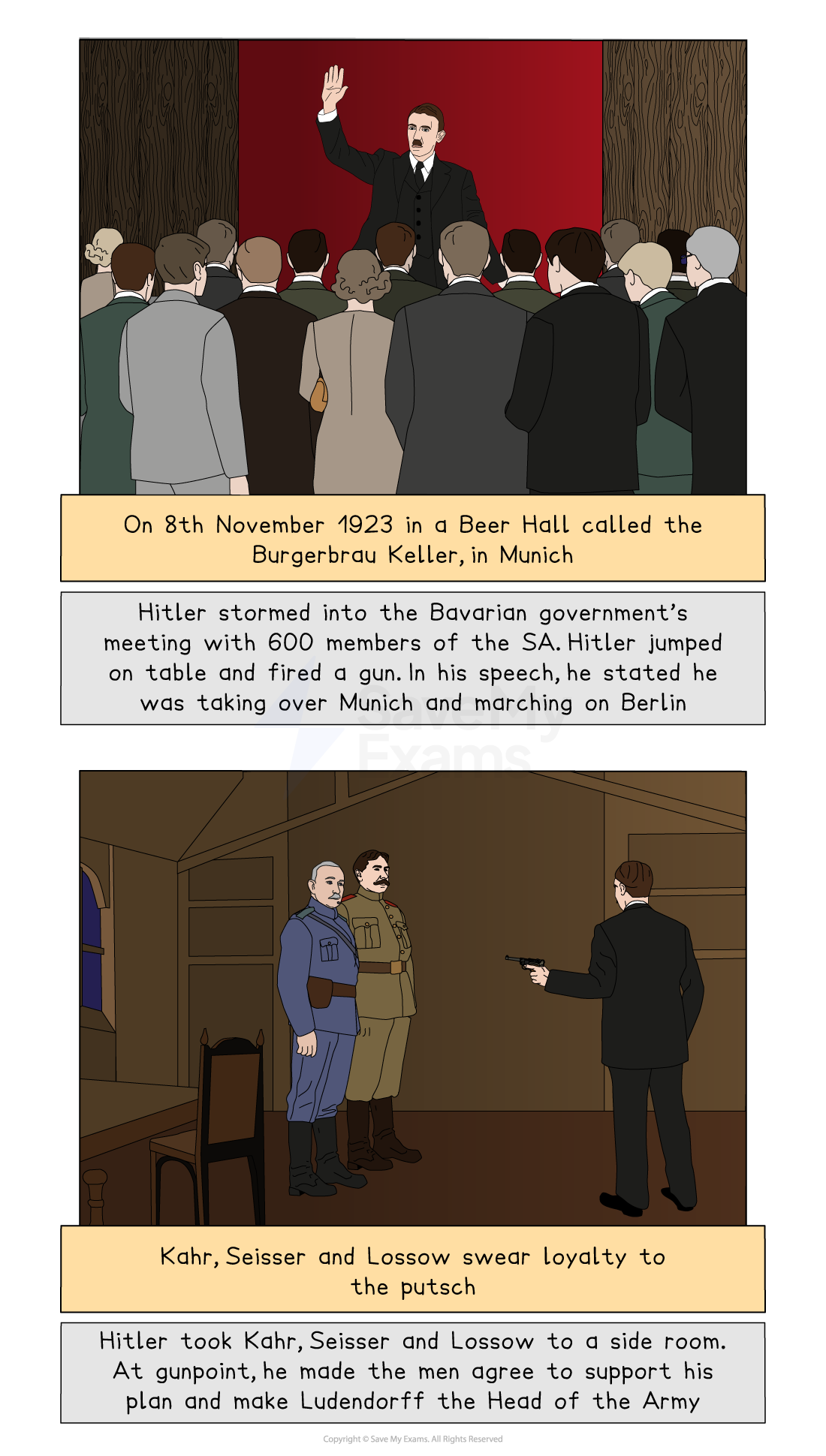
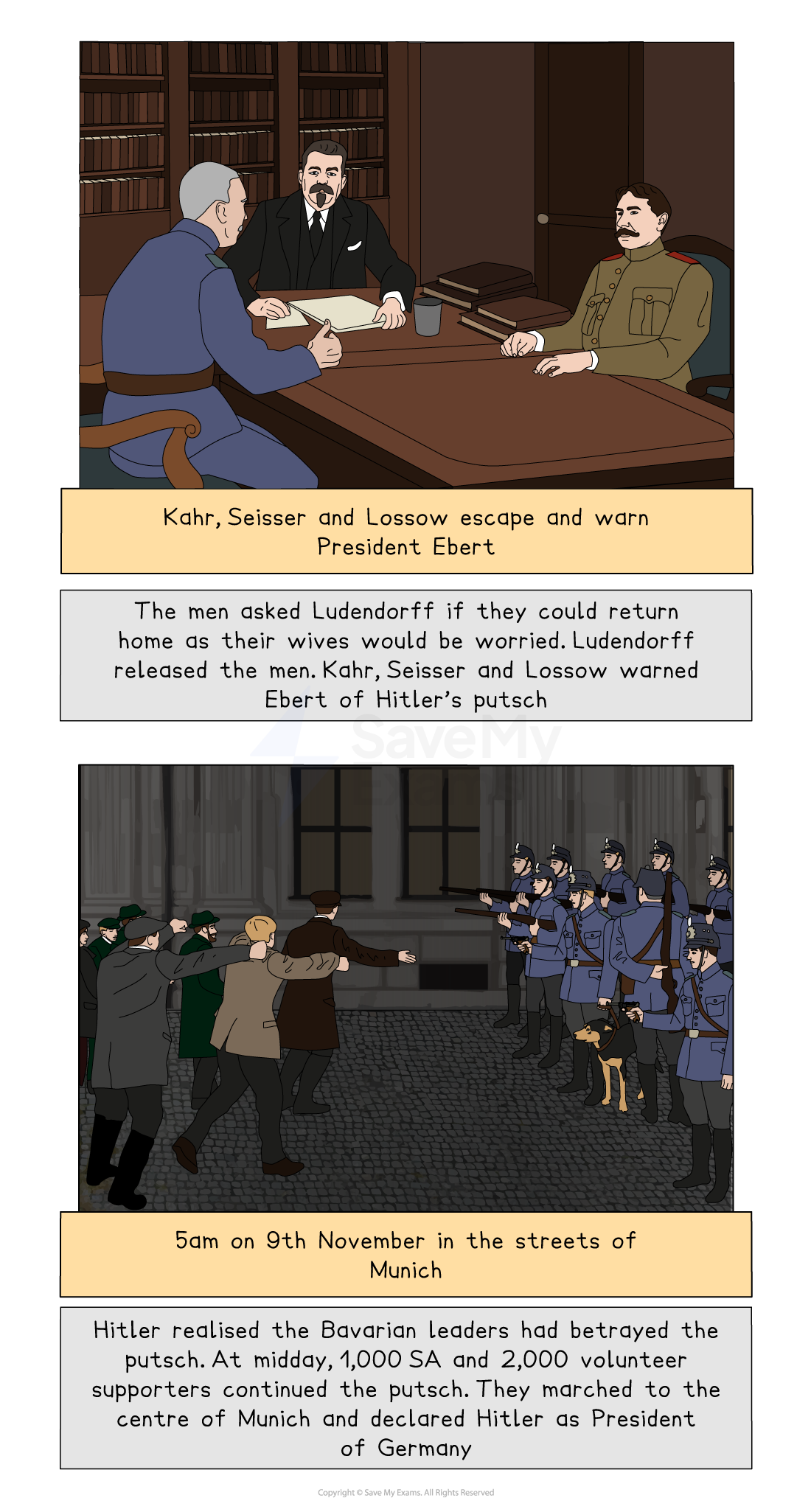
The events of the Munich Putsch
The plan was for Hitler and the SA (led by Ernst Röhm) to seize control of the local Bavarian government
They were to be helped by a World War I general, General Ludendorff
The leaders of the Bavarian government, Gustav von Kahr, Colonel von Seisser and General von Lossow, were to be captured during a meeting at the Burgerbrau Keller in Munich
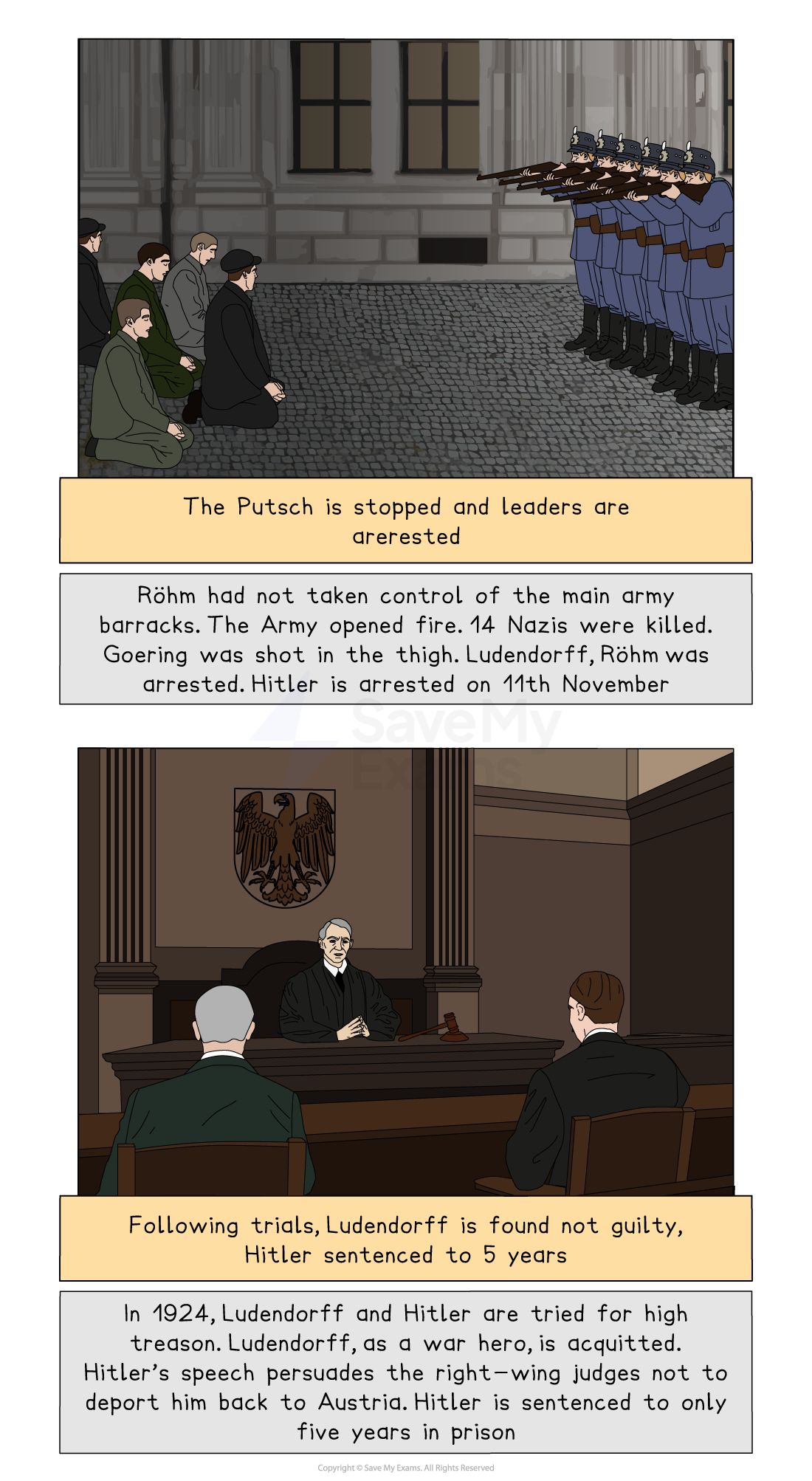
The Munich Putsch failed, and Hitler was arrested for high treason
The NSDAP (Nazi Party) was banned
Although Hitler was sentenced to five years in prison, he only served nine months
The reorganisation of the Nazi Party
Hitler left prison after serving nine months of his five-year sentence
Judges were much more lenient on right-wing offenders
Whilst in prison, Hitler wrote Mein Kampf (‘My Struggle’)
In the book, he considered what the core values of the Nazi Party should be
He dictated the text to Rudolph Hess, who then wrote it
Hess later became a deputy in the party
Hitler published Mein Kampf in July 1925
The government lifted the ban on the NSDAP in February 1925
Hitler relaunched the party on 27th February 1925
The failure of the Munich Putsch made Hitler rethink the organisation of the party
Hitler had learnt that violent putsches did not work.
After being released from prison, he set about trying to get into power by legal means, which meant winning elections
To make the Nazi Party electable, its systems needed to be a lot clearer
Hitler divided Germany into 35 regions (called a Gau)
These corresponded to the constituencies created by the Weimar government
Each Gau (single region) had a local Nazi Party leader called a Gauleiter
Often, Gauleiters were not appointed
Hitler left it to the Nazi members in the Gau to fight over who became the Gauleiter
Hitler strongly believed in the survival of the fittest mentality
Whoever wanted the position more would win it by any means necessary
Strasser became a powerful Gauleiter in North Germany
To fund a national party, Hitler persuaded business owners who shared his nationalist vision for Germany to contribute:
Big corporations such as Thyssen, Krupp and Bosch funded the Nazi Party
The business owners believed Hitler’s influence over the workers would limit the power of trade unions
Business owners feared trade unions because they could make unreasonable demands for increased pay and benefits
Trade unions had strong links to communism
If communism became powerful, business owners would lose their ability to make lots of profit
The Great Depression and the Rise of the Nazi Party
Between 1924 and 1929, life in Germany settled and the economy recovered
This meant few people voted for Hitler
His extreme policies did not appeal in a time of stability
However, in 1929, the American stock exchange on Wall Street crashed
This caused the German economy to collapse
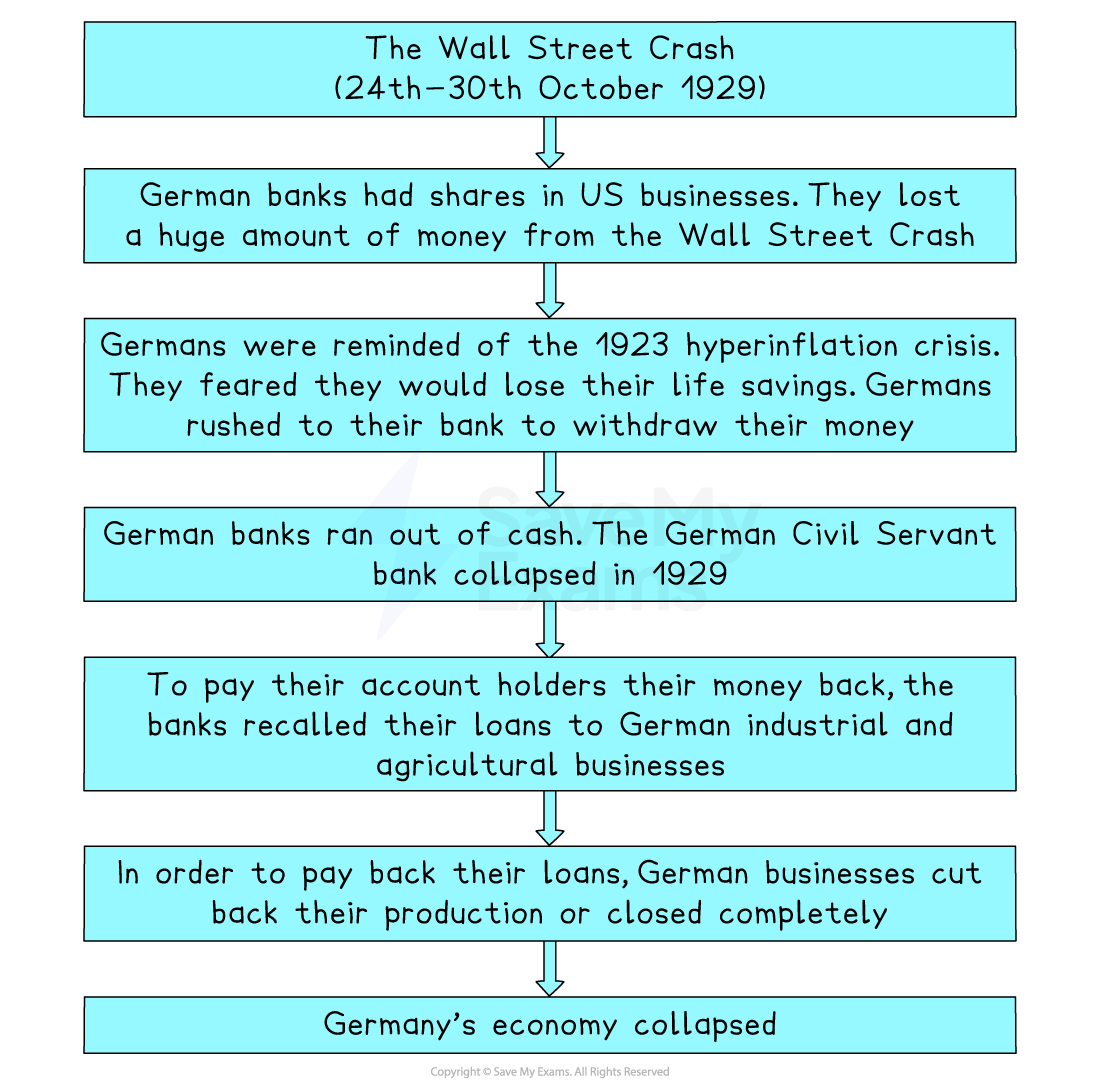
The economic issues triggered an employment crisis
German banks recalled loans, which forced businesses to close and workers to lose their jobs
The USA’s crash affected other countries across the world
Other countries stopped purchasing German goods, which increased unemployment
Unemployed workers did not spend money on goods or services. This resulted in even more companies having to make redundancies
By September 1931, 4.3 million German workers were unemployed
Over 40% were factory workers
Half of all 16 and 30-year-olds did not work
By January 1933, unemployment hit 6.1 million people
Widespread unemployment meant many German people started looking to the extremist parties for solutions
Both the Nazis and the German Communist Party (KPD) started to win more votes in the elections
By 1932, the Nazis had more seats in the Reichstag than any other political party
Examiner Tips and Tricks
Much of this paper relies on your ability to analyse sources and interpretations. Sources are historical evidence that come from the time period you are studying. Interpretations are made by historians after the event by examining a range of historical sources.

Unlock more, it's free!
Join the 100,000+ Students that ❤️ Save My Exams
the (exam) results speak for themselves:

Was this revision note helpful?
