1
1 mark
What term is commonly used by sociologists to describe a family in which a woman holds power and authority?
Matriarchal family
Patriarchal family
Symmetrical family
Traditional family
Was this exam question helpful?
Exam code: 8192
What term is commonly used by sociologists to describe a family in which a woman holds power and authority?
Matriarchal family
Patriarchal family
Symmetrical family
Traditional family
Was this exam question helpful?
Describe what sociologists mean by kinship.
Was this exam question helpful?
Identify and describe one example of how a grandparent can contribute to family life.
Was this exam question helpful?
Describe a dual career family.
Was this exam question helpful?
Identify and describe one factor that may have led to an increase in the number of lone parent families in Britain.
Was this exam question helpful?
Identify one practical issue you would need to consider when using postal questionnaires to investigate role relationships within the family and explain how you would deal with this issue in your investigation.
Was this exam question helpful?
Identify and explain one advantage of using unstructured interviews to research the role of parents in families.
Was this exam question helpful?
Identify and describe one example of how a grandparent can contribute to family life.
Was this exam question helpful?
Item A
Despite concerns over the increase in the number of children in single-parent families, recent research has found that children raised by a single parent are no less happy than those living with two biological parents. Rather, it is the quality of relationships at home which are most strongly linked to a child’s well-being.
Researchers analysed data from the Millennium Cohort Study, which was made up of 12 877 children aged seven, in 2008, from across the UK. The children came from three family types: those living with two biological parents; those living with a step-parent and a biological parent; and those with just a single parent.
The seven-year-olds were asked the question: “How often do you feel happy?” Of the children living with a lone parent, 36 per cent said they were happy “all the time” while the remaining 64 per cent reported being happy “sometimes or never”.
Exactly the same percentages were recorded when the question was put to children from the other family types.
The results were largely unchanged when other factors which could influence a child’s well-being were taken into account, such as their parents’ social class or the affluence of the area in which they live.
Identify and explain one factor that may have led to an increase in the number of children raised in single-parent families referred to as a concern in Item A.
Was this exam question helpful?
Identify and describe one way in which relationships within families in Britain have become more 'child-centred'.
Was this exam question helpful?
Item A
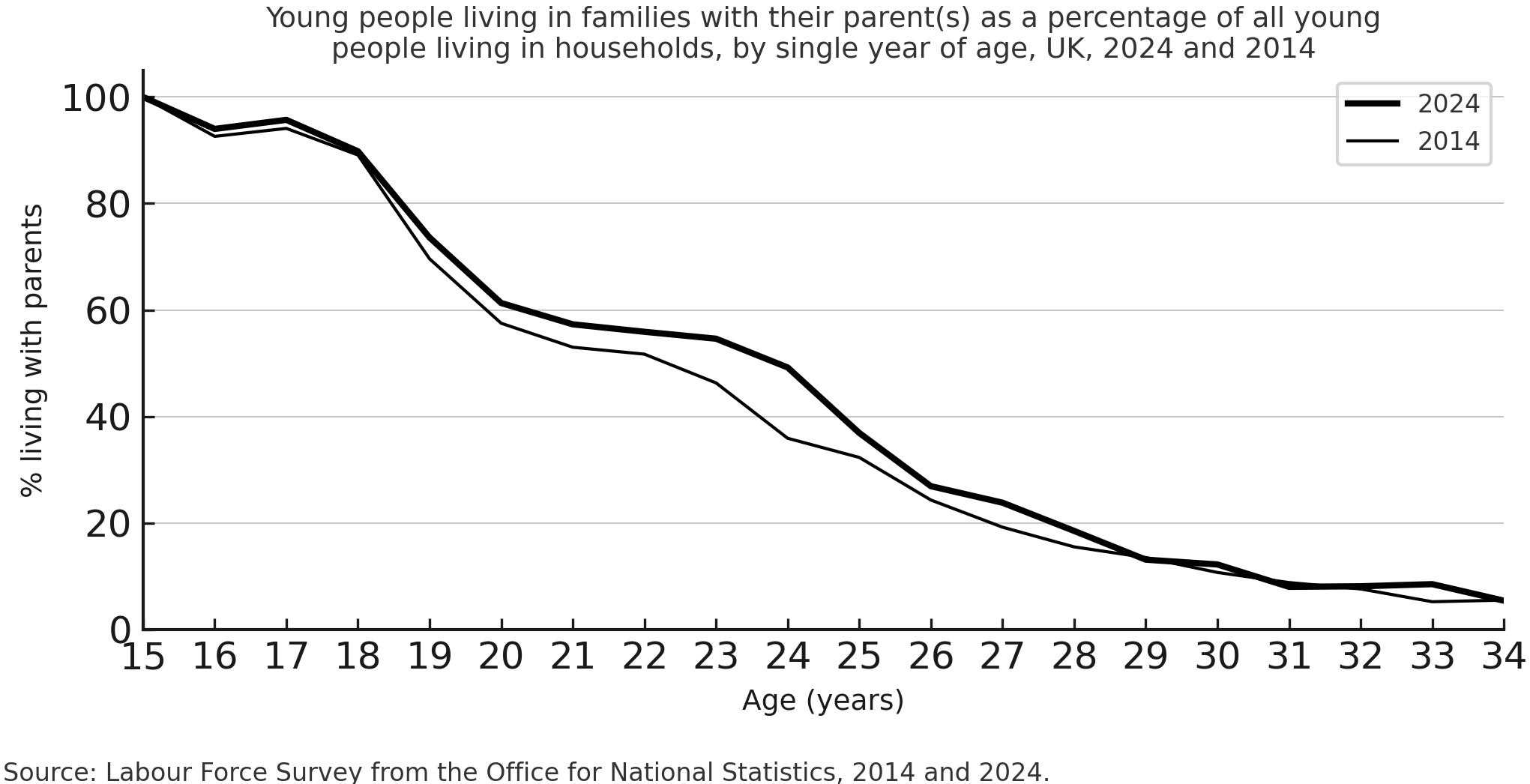
Identify and explain one factor that may have led to a change in the age at which children leave home as shown in Item A.
Was this exam question helpful?
Identify and explain one disadvantage of using postal questionnaires to investigate the care of the disabled or elderly within the family.
Was this exam question helpful?