1
3 marks
Identify and describe one consequence of divorce for family members.
Was this exam question helpful?
Exam code: 8192
Identify and describe one consequence of divorce for family members.
Was this exam question helpful?
What term is commonly used by sociologists to describe a pattern of divorce and remarriage where an individual marries several times but only to one partner at a time?
Bigamy
Polygamy
Polygyny
Serial monogamy
Was this exam question helpful?
Item A
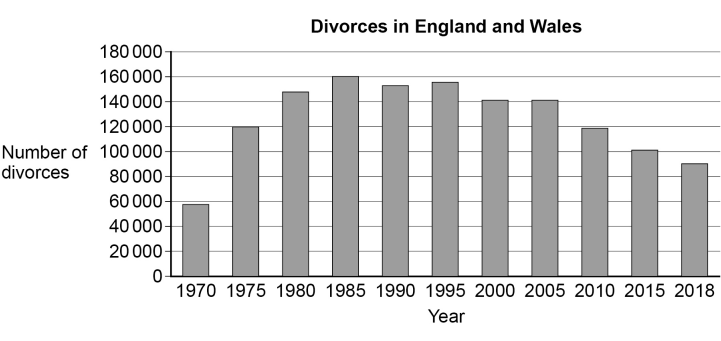 Source: Office for National Statistics |
From Item A, examine one weakness of using statistics to research divorce.
Was this exam question helpful?
Item A
Source: Office for National Statistics |
Describe the type of statistical data shown in Item A. Identify the trend shown by the data and explain one factor which may account for this trend.
Was this exam question helpful?
Identify and explain one disadvantage of using secondary data to investigate attitudes towards marriage.
Was this exam question helpful?
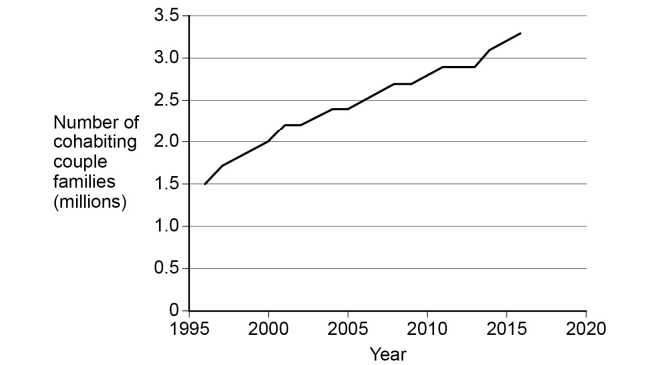 Source: Office for National Statistics |
From Item A, examine one strength of using statistics to research cohabiting couple families.
Was this exam question helpful?
Source: Office for National Statistics |
Describe the type of statistical data shown in Item A. Identify the trend shown by the data and explain one factor which may account for this trend
Was this exam question helpful?
Identify and explain one disadvantage of using postal questionnaires to investigate attitudes towards cohabitation.
Was this exam question helpful?
Item A
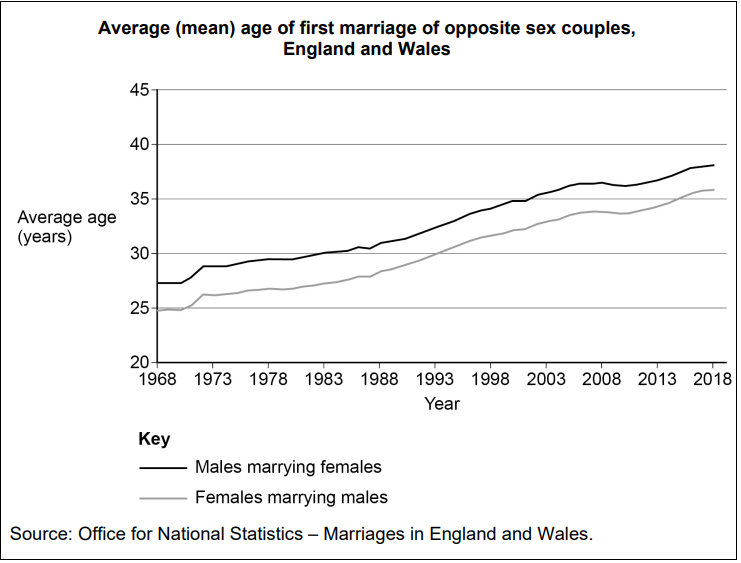
Identify and explain one factor that may have led to a change in the age at which people first marry as shown in Item A.
Was this exam question helpful?
Identify and describe one consequence of divorce for family members.
Was this exam question helpful?
Item B
Writing in 1976, Eli Zaretsky argued that the nuclear family had an economic function that served the interests of capitalism. He believed the family to be a key unit of consumption; in other words families bought and consumed the products of the capitalist economy.
He also believed that it was through the family that each social class reproduced itself over time. Through inheritance, the bourgeois family transmitted its private property from one generation to the next, whilst the proletarian family reproduced the labour force by producing future generations of workers.
Source: Zaretsky, E, Capitalism, the Family and Personal Life
Discuss how far sociologists would agree that changes in the law are the main reason for the pattern of divorce in Britain since 1969.
Was this exam question helpful?
Item B
This table appears in a paper by the sociologists Robert and Rhona Rapoport published in 1982, they have used a variety of sources to identify class based differences in relationships within marriage and child rearing.
Sources: Bott (1971), Goldthorpe (1969), Newson and Newson (1970).
Social class differences | ||
Middle class | Working class | |
Marital relations | More emphasis on sharing, equality, communication. More ‘joint’ division of labour. More planning. | More emphasis on ‘the place’ of women and men, less verbal communication. More ‘segregated’ division of labour. Less planning. |
Child rearing practices | High value placed on reasoning, self-direction, initiative. Emphasis on ambition. Discipline by reasoning and withholding of reward/love. | High value placed on obedience. Emphasis on conforming, obeying authority. Discipline more physical. |
Discuss how far sociologists agree that feminism has changed marriage in modern British society.
Was this exam question helpful?
Discuss how far sociologists would agree that changes in the law are the main reason for the pattern of divorce in Britain since 1969.
Was this exam question helpful?
Discuss how far sociologists would agree that the main reason for the rise in divorce in Britain since 1945 is due to changing social attitudes and values.
Was this exam question helpful?