1
1 mark
What term is commonly used by sociologists to describe the invisible barrier keeping women from achieving senior positions in the workplace?
Alienation
Gender role
Glass ceiling
Social control
Was this exam question helpful?
Exam code: 8192
What term is commonly used by sociologists to describe the invisible barrier keeping women from achieving senior positions in the workplace?
Alienation
Gender role
Glass ceiling
Social control
Was this exam question helpful?
Describe one feature of a meritocracy.
Was this exam question helpful?
Identify and describe one example of age discrimination.
Was this exam question helpful?
Identify and describe one factor that might affect an individual’s life chances.
Was this exam question helpful?
Describe one way society may exploit women.
Was this exam question helpful?
Identify and describe one type of social inequality.
Was this exam question helpful?
Item C
In 2020, Public Health England produced a report into the inequalities faced by ethnic minority women in their experiences of pregnancy and childbirth. Researchers used a range of secondary sources to compile the report, including existing peer-reviewed smaller scale academic research, government research and guidance. The report found that women from Black, Asian and Minority Ethnic backgrounds were up to five times more likely to die during pregnancy than white women. A range of potential issues were considered, such as language barriers, poorer health, concentration in lower social classes and less chance of accessing and engaging with pregnancy services. The report went on to recommend a range of interventions including improved access to maternity services, improved personalised care by the NHS and encouraging healthier lifestyles. Source: Public Health, Reducing the inequality of outcomes for women from Black, Asian and Minority Ethnic communities and their babies, 2020. |
From Item C, examine one weakness of the research.
Was this exam question helpful?
Item C
In 2020, Public Health England produced a report into the inequalities faced by ethnic minority women in their experiences of pregnancy and childbirth. Researchers used a range of secondary sources to compile the report, including existing peer-reviewed smaller scale academic research, government research and guidance. The report found that women from Black, Asian and Minority Ethnic backgrounds were up to five times more likely to die during pregnancy than white women. A range of potential issues were considered, such as language barriers, poorer health, concentration in lower social classes and less chance of accessing and engaging with pregnancy services. The report went on to recommend a range of interventions including improved access to maternity services, improved personalised care by the NHS and encouraging healthier lifestyles. Source: Public Health, Reducing the inequality of outcomes for women from Black, Asian and Minority Ethnic communities and their babies, 2020. |
Describe the type of research in Item C. Identify and explain one factor considered by the report as a possible explanation for the inequality experienced by some women from Black, Asian and Minority Ethnic backgrounds.
Was this exam question helpful?
Identify and explain one advantage of using previously published research to investigate gender inequality in accessing health care.
Was this exam question helpful?
Item C
The Higher Education Statistics Agency (HESA) produced a report on university enrolment by personal characteristics from 2014/15 to 2018/19. This report found that the vast majority of students that attend university are from white backgrounds, although the number of students from minority ethnic backgrounds is increasing year on year. 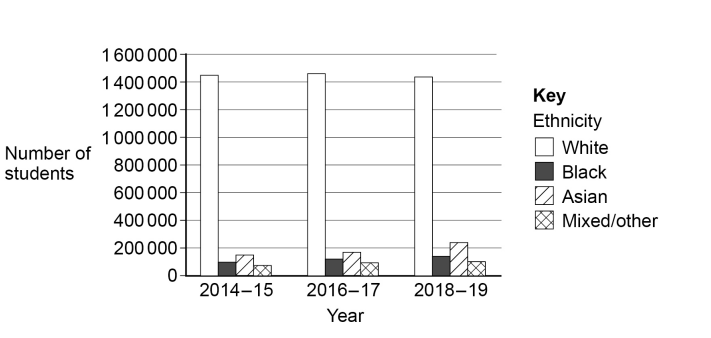 Source: HESA 2020 |
From Item C, examine one strength of the research.
Was this exam question helpful?
Item C
The Higher Education Statistics Agency (HESA) produced a report on university enrolment by personal characteristics from 2014/15 to 2018/19. This report found that the vast majority of students that attend university are from white backgrounds, although the number of students from minority ethnic backgrounds is increasing year on year. Source: HESA 2020 |
Identify and explain one factor which may account for the relatively low numbers of students from some minority ethnic backgrounds attending university, as referred to in Item C.
Was this exam question helpful?
Identify and explain one advantage of using ethnography as a research method to investigate life chances.
Was this exam question helpful?
What term is commonly used by sociologists to describe the adoption of middle class values and attitudes by members of the working class?
Class consciousness
Class identity
Embourgeoisement
Instrumentalism
Was this exam question helpful?
Describe one way in which the glass ceiling may prevent someone from progressing in their career.
Was this exam question helpful?
Item C
Predicted life expectancy at birth for selected regions in England
Region | Male life expectancy | Female life expectancy |
North East | 77.6 | 81.5 |
North West | 77.9 | 81.7 |
East Midlands | 79.2 | 82.7 |
West Midlands | 78.5 | 82.5 |
South East | 80.6 | 84.1 |
South West | 80.3 | 84.1 |
Source: Office for National Statistics, 2021.
Identify and explain one factor that might account for the differences in life expectancy as shown in Item C.
Was this exam question helpful?
Discuss how far sociologists would agree that upward social mobility is possible in modern Britain.
Was this exam question helpful?
Discuss how far sociologists would agree that disability is the most important factor affecting a person’s life chances.
Was this exam question helpful?
What term is commonly used by sociologists to describe the invisible barrier keeping women from achieving senior positions in the workplace?
Alienation
Gender role
Glass ceiling
Social control
Was this exam question helpful?
Describe one feature of a meritocracy.
Was this exam question helpful?
Identify and describe one example of age discrimination.
Was this exam question helpful?
Item C
In 2020, Public Health England produced a report into the inequalities faced by ethnic minority women in their experiences of pregnancy and childbirth.
Researchers used a range of secondary sources to compile the report, including existing peer-reviewed smaller scale academic research, government research and guidance. The report found that women from Black, Asian and Minority Ethnic backgrounds were up to five times more likely to die during pregnancy than white women. A range of potential issues were considered, such as language barriers, poorer health, concentration in lower social classes and less chance of accessing and engaging with pregnancy services.
The report went on to recommend a range of interventions including improved access to maternity services, improved personalised care by the NHS and encouraging healthier lifestyles.
Source: Public Health, Reducing the inequality of outcomes for women from Black, Asian and Minority Ethnic communities and their babies, 2020.
Describe the type of research in Item C. Identify and explain one factor considered by the report as a possible explanation for the inequality experienced by some women from Black, Asian and Minority Ethnic backgrounds.
Was this exam question helpful?
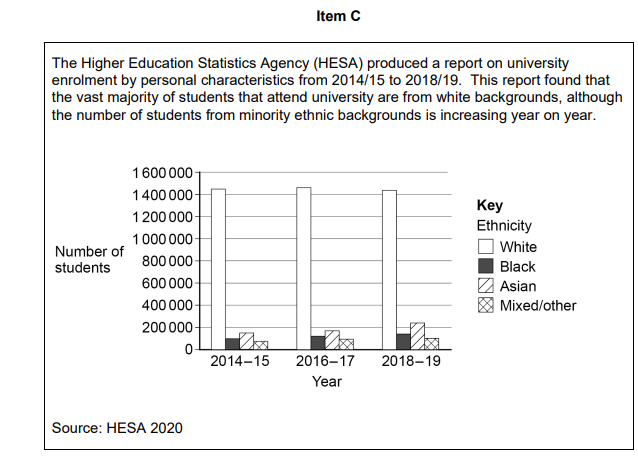
Identify and explain one factor which may account for the relatively low numbers of students from some minority ethnic backgrounds attending university, as referred to in Item C.
Was this exam question helpful?
Identify and explain one way in which social class at birth can influence an individual’s future life chances.
Was this exam question helpful?
What term is commonly used by sociologists to describe an individual’s movement up or down the social scale?
Social class
Social differentiation
Social mobility
Social stratification
Was this exam question helpful?
Identify and describe one example of how the traditional role of women in society may make them more likely to experience poverty
Was this exam question helpful?
Item C
The sociologist Steve Craine studied the lives of 39 unqualified urban school leavers, 19 males and 20 females, over a ten year period between 1980 and 1990. As a youth worker he was familiar with the area in which these young people lived and he used both his own observations and interviews in his research.
Craine looked at how these young people’s lives developed and how they made choices about what to do next. Many of the members of this group failed to secure long-term employment. They experienced regular cycles of unemployment, government schemes and work in the informal economy. Some individuals became involved in criminal activities. Only those who received appropriate support from professionals or family members were able to escape this cycle.
Identify and explain one factor which might limit a young person’s opportunities to find secure long-term employment as experienced by many of the young people referred to in Item C.
Was this exam question helpful?
Discuss how far sociologists agree that social class rather than gender or ethnicity is the most important division in British society.
Was this exam question helpful?
Discuss how far sociologists would agree that Britain today is a meritocracy.
Was this exam question helpful?
Discuss how far sociologists would agree that class is still the most important factor affecting a person’s life chances in modern Britain.
Was this exam question helpful?