Syllabus Edition
First teaching 2025
First exams 2027
Disposal Account (Cambridge (CIE) IGCSE Accounting): Revision Note
Exam code: 0452 & 0985

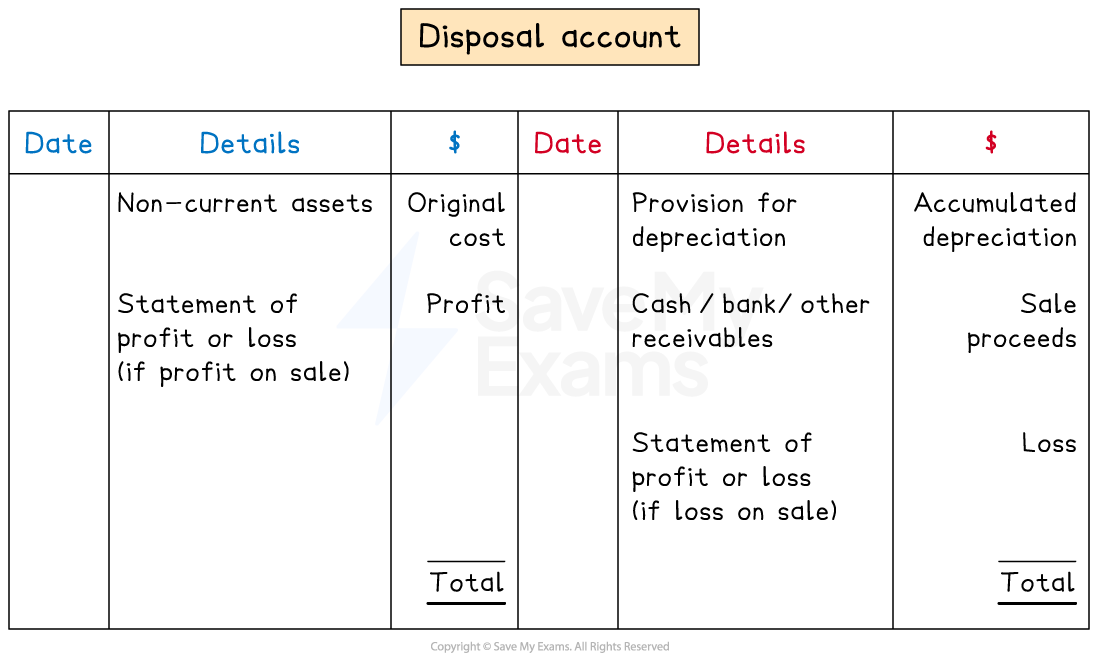
Disposal account
What is a disposal account?
A disposal account is used to show the calculation of the profit or loss on a sale of a non-current asset
The profit or loss is transferred to the statement of profit or loss
The account will then have a zero balance
How do I record the sale of a non-current asset in the ledger accounts?
The book of prime entry is the journal
Deal with each transaction one at a time
STEP 1
Reduce the non-current asset account by the original valueCredit the non-current asset account
Because the value of the assets is decreasing
Debit the disposal account
STEP 2
Reduce the provision of depreciation account by the accumulated depreciation of the non-current assetDebit the provision for depreciation account
Credit the disposal account
STEP 3
Increase the cash, bank or other receivables accountDebit the relevant asset account
Cash, if received
Bank, if money is received by cheque or bank transfer
Other receivables account if it was sold on credit
Credit the disposal account
STEP 4
Include the profit or loss of the saleIf a profit is made, then this is an income for the business
Credit the statement of profit or loss
Debit the disposal account
If a loss is made, then this is an expense to the business
Debit the statement of profit or loss
Credit the disposal account
Examiner Tips and Tricks
The disposals account should balance. If it does not balance, then check for any mistakes. Some students calculate the profit or loss by completing steps 1 to 3 and then finding the amount needed to balance the disposal account. If you use this method, be extra careful that you put the entries on the correct side.
Worked Example
Riz owes an embroidery business and owns machinery. Riz purchased an additional machine on 1 March 2022 for $30 000. Riz depreciates machinery using the straight-line method using the assumption that machinery fully depreciates after five years. Riz charges depreciation at the end of each month. Riz sells this additional machinery on 31 December 2023 and receives a cheque for $17 500. No other non-current assets were sold in the financial year ending 29 February 2024.
Prepare the disposal account for machinery for the year ended 29 February 2024.
Answer:
Calculate the profit or loss on the sale
Calculate the yearly depreciation charge
$30 000 ÷ 5 = $6 000
Calculate the monthly depreciation charge
$6 000 ÷ 12 = $500
Calculate the number of months that Riz owned the machinery
1 March 2022 to 31 December 2023 is 22 months
Calculate the total depreciation of the machinery
22 × $500 = $11 000
Calculate the net book value at 31 December 2023
$30 000 - $11 000 = $19 000
Calculate the loss on the sale
$19 000 - $17 500 = $1 500
The sale proceeds are less than the net book value so it was a loss
Fill in the disposal account
Enter the original cost on the debit side
Enter the total depreciation on the credit side
Enter the sale proceeds on the credit side
Enter the loss on the credit side
Riz
Disposal Account
Date | Details | $ | Date | Details | $ |
2023 Dec 31 |
Machinery |
30 000 | 2023 Dec 31 |
Provision for depreciation |
11 000 |
Dec 31 | Bank | 17 500 | |||
| 2024 Feb 29 |
Statement of profit or loss |
1 500 | ||
30 000 | 30 000 |

Unlock more, it's free!
Join the 100,000+ Students that ❤️ Save My Exams
the (exam) results speak for themselves:

Was this revision note helpful?