Syllabus Edition
First teaching 2025
First exams 2027
Reducing Balance Method of Depreciation (Cambridge (CIE) IGCSE Accounting): Revision Note
Exam code: 0452 & 0985

Reducing balance depreciation
What is the reducing balance method of depreciation?
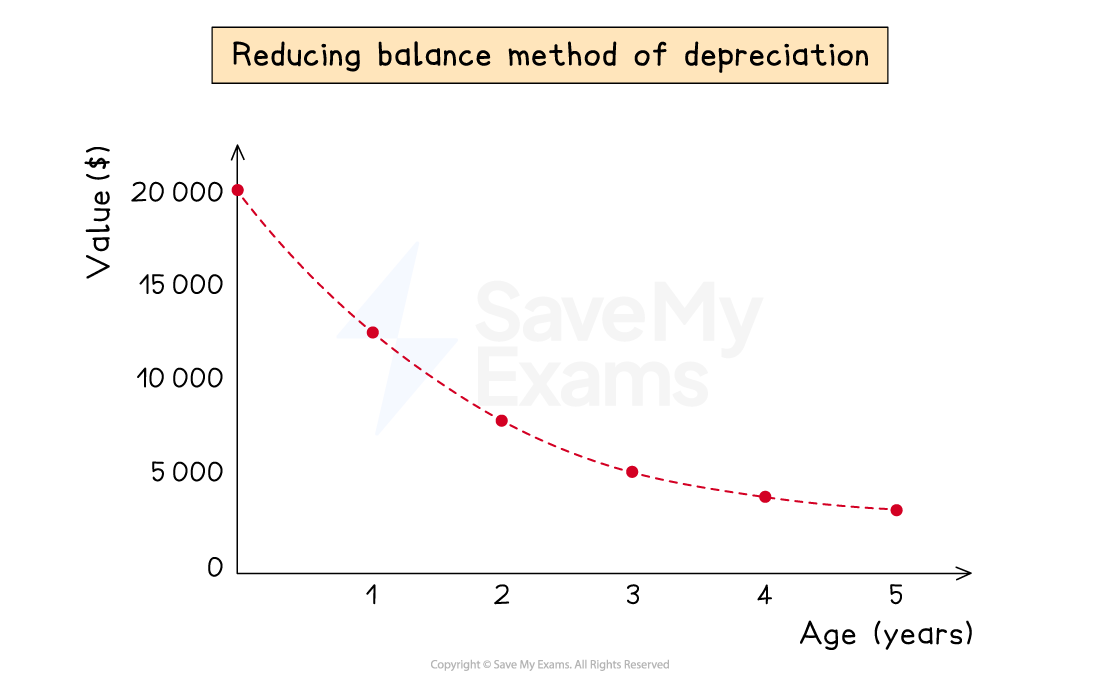
The reducing balance method of depreciation assumes that the non-current asset loses value at a rate proportional to its current value
This means that the expense for its depreciation gets smaller each year as the current value decreases
You will be told the percentage of the current value to use for depreciation
This method is usually used when a non-current asset initially loses value at a fast rate
e.g. vehicles, etc
How do I calculate depreciation using the reducing balance method?
Find the percentage of the current net book value
This will be the depreciation charge for that year
If you need to calculate the depreciation for multiple years, then calculate one year at a time
Find the depreciation charge for one year using the net book value at that start of the year
Subtract this amount from the net book value at the start of the year to find the new net book value
Find the depreciation charge for the next year using the net book value at the start of that year
Continue this process
If you just need to find the current net book value then you can use some maths skills
Subtract the percentage from 100%
Write this as a decimal
Raise this to the power of the number of years
Multiply this by the original value
Examiner Tips and Tricks
The reducing balance method is similar to compound interest calculations used in maths.
Amounts should always be given to the nearest dollar in exams.
Worked Example
Abi purchases a vehicle for $16 000. Machinery is depreciated at 25% per annum using the reducing balance method.
Calculate the net book value of the machinery after 3 years.
Answer:
Method 1: Year-by-year
Find the depreciation charged in each year by finding the percentage of the net book value at that time
Subtract that year’s depreciation from the net book value to find the net book value at the end of the year
End of year | Depreciation charge | Net book value |
0 | - | $16 000 |
1 | 25% × $16 000 = $4 000 | $16 000 - $4 000 = $12 000 |
2 | 25% × $12 000 = $3 000 | $12 000 - $3 000 = $9 000 |
3 | 25% × $9 000 = $2 250 | $9 000 - $2 250 = $6 750 |
Method 2: Compound interest
Subtract the percentage from 100%
100% - 25% = 75%
Write this as a decimal
75% = 0.75
Raise this to the power of the number of years
0.753
Multiply this by the original value
$16 000 × 0.753 = $6 750

Unlock more, it's free!
Join the 100,000+ Students that ❤️ Save My Exams
the (exam) results speak for themselves:

Was this revision note helpful?