Syllabus Edition
First teaching 2025
First exams 2027
Straight-Line Method of Depreciation (Cambridge (CIE) IGCSE Accounting): Revision Note
Exam code: 0452 & 0985

Straight-line depreciation
What is the straight-line method of depreciation?
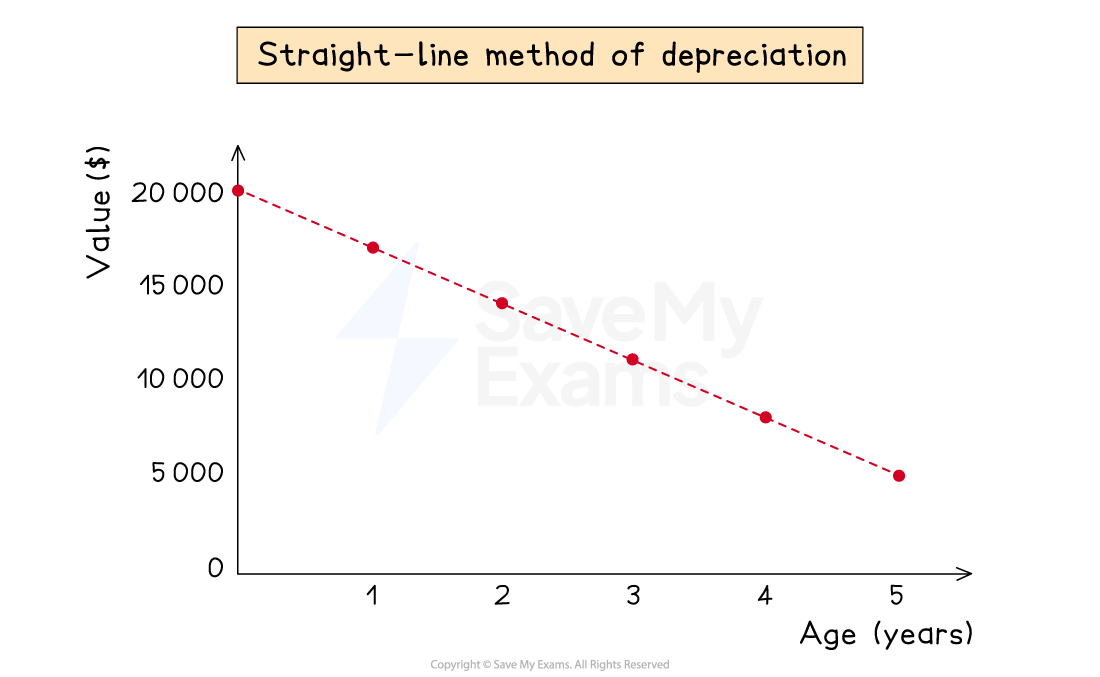
The straight-line method of depreciation assumes that a non-current asset loses value at a constant rate over its useful life
This means that the expense for its depreciation is the same each year
The net book value can reach $0
This is when the asset is fully depreciated
You could be given the depreciation rate as a percentage of its original value
E.g. depreciation could be charged at 20% of its original cost
Or you could be expected to calculate the depreciation using:
The number of years that the non-current asset will be used
The expected value of the non-current asset at the end of its working life
This value could be $0
The expected value is also called the residual value
This method is usually used when the asset will be equally valuable for each year of its use
For example, fixtures and fittings, equipment, etc
How do I calculate depreciation using the straight-line method?
If you are given the percentage for the depreciation
Find the percentage of the original amount
This will be the yearly depreciation charge
If you are not given the percentage
Calculate the expected loss in value during the expected life of the non-current asset
The original value minus the expected value at the end of its life
Divide the loss by the number of years it will be used
This will be the yearly depreciation charge
format('truetype')%3Bfont-weight%3Anormal%3Bfont-style%3Anormal%3B%7D%3C%2Fstyle%3E%3C%2Fdefs%3E%3Ctext%20font-family%3D%22Times%20New%20Roman%22%20font-size%3D%2218%22%20text-anchor%3D%22middle%22%20x%3D%2246.5%22%20y%3D%2230%22%3EDepreciation%3C%2Ftext%3E%3Ctext%20font-family%3D%22math143f4d31b04031e49f5eb18baba%22%20font-size%3D%2216%22%20text-anchor%3D%22middle%22%20x%3D%22101.5%22%20y%3D%2230%22%3E%3D%3C%2Ftext%3E%3Cline%20stroke%3D%22%23000000%22%20stroke-linecap%3D%22square%22%20stroke-width%3D%221%22%20x1%3D%22112.5%22%20x2%3D%22338.5%22%20y1%3D%2223.5%22%20y2%3D%2223.5%22%2F%3E%3Ctext%20font-family%3D%22Times%20New%20Roman%22%20font-size%3D%2218%22%20text-anchor%3D%22middle%22%20x%3D%22142.5%22%20y%3D%2216%22%3Eoriginal%3C%2Ftext%3E%3Ctext%20font-family%3D%22Times%20New%20Roman%22%20font-size%3D%2218%22%20text-anchor%3D%22middle%22%20x%3D%22193.5%22%20y%3D%2216%22%3Evalue%3C%2Ftext%3E%3Ctext%20font-family%3D%22math143f4d31b04031e49f5eb18baba%22%20font-size%3D%2216%22%20text-anchor%3D%22middle%22%20x%3D%22221.5%22%20y%3D%2216%22%3E%26%23x2212%3B%3C%2Ftext%3E%3Ctext%20font-family%3D%22Times%20New%20Roman%22%20font-size%3D%2218%22%20text-anchor%3D%22middle%22%20x%3D%22262.5%22%20y%3D%2216%22%3Eexpected%3C%2Ftext%3E%3Ctext%20font-family%3D%22Times%20New%20Roman%22%20font-size%3D%2218%22%20text-anchor%3D%22middle%22%20x%3D%22317.5%22%20y%3D%2216%22%3Evalue%3C%2Ftext%3E%3Ctext%20font-family%3D%22Times%20New%20Roman%22%20font-size%3D%2218%22%20text-anchor%3D%22middle%22%20x%3D%22195.5%22%20y%3D%2241%22%3Enumber%3C%2Ftext%3E%3Ctext%20font-family%3D%22Times%20New%20Roman%22%20font-size%3D%2218%22%20text-anchor%3D%22middle%22%20x%3D%22234.5%22%20y%3D%2241%22%3Eof%3C%2Ftext%3E%3Ctext%20font-family%3D%22Times%20New%20Roman%22%20font-size%3D%2218%22%20text-anchor%3D%22middle%22%20x%3D%22265.5%22%20y%3D%2241%22%3Eyears%3C%2Ftext%3E%3C%2Fsvg%3E)
Examiner Tips and Tricks
The straight-line method is similar to simple interest calculations used in maths.
Worked Example
Abi purchases machinery for $18 000. Machinery is depreciated at 15% per annum using the straight-line method.
Calculate the net book value of the machinery after 3 years.
Answer:
Calculate the yearly expense due to depreciation
15% × $18 000 = $2 700
Calculate the total depreciation after 3 years
3 × $2 700 = $8 100
Subtract the depreciation from the original value
$18 000 - $8 100 = $9 900
Worked Example
Taiki purchases a vehicle for $30 000. He expects to use the vehicle for 3 years, after which he estimates that it will have a value of $12 000.
Calculate the yearly expense due to the depreciation of the vehicle.
Answer:
Calculate the loss in value over the 3 years
$30 000 - $12 000 = $18 000
Divide this by the number of years
$18 000 ÷ 3 = $6 000

Unlock more, it's free!
Join the 100,000+ Students that ❤️ Save My Exams
the (exam) results speak for themselves:

Was this revision note helpful?