Syllabus Edition
First teaching 2025
First exams 2027
Income Accounts with Accruals & Prepayments (Cambridge (CIE) IGCSE Accounting): Revision Note
Exam code: 0452 & 0985

Income accounts with accruals & prepayments
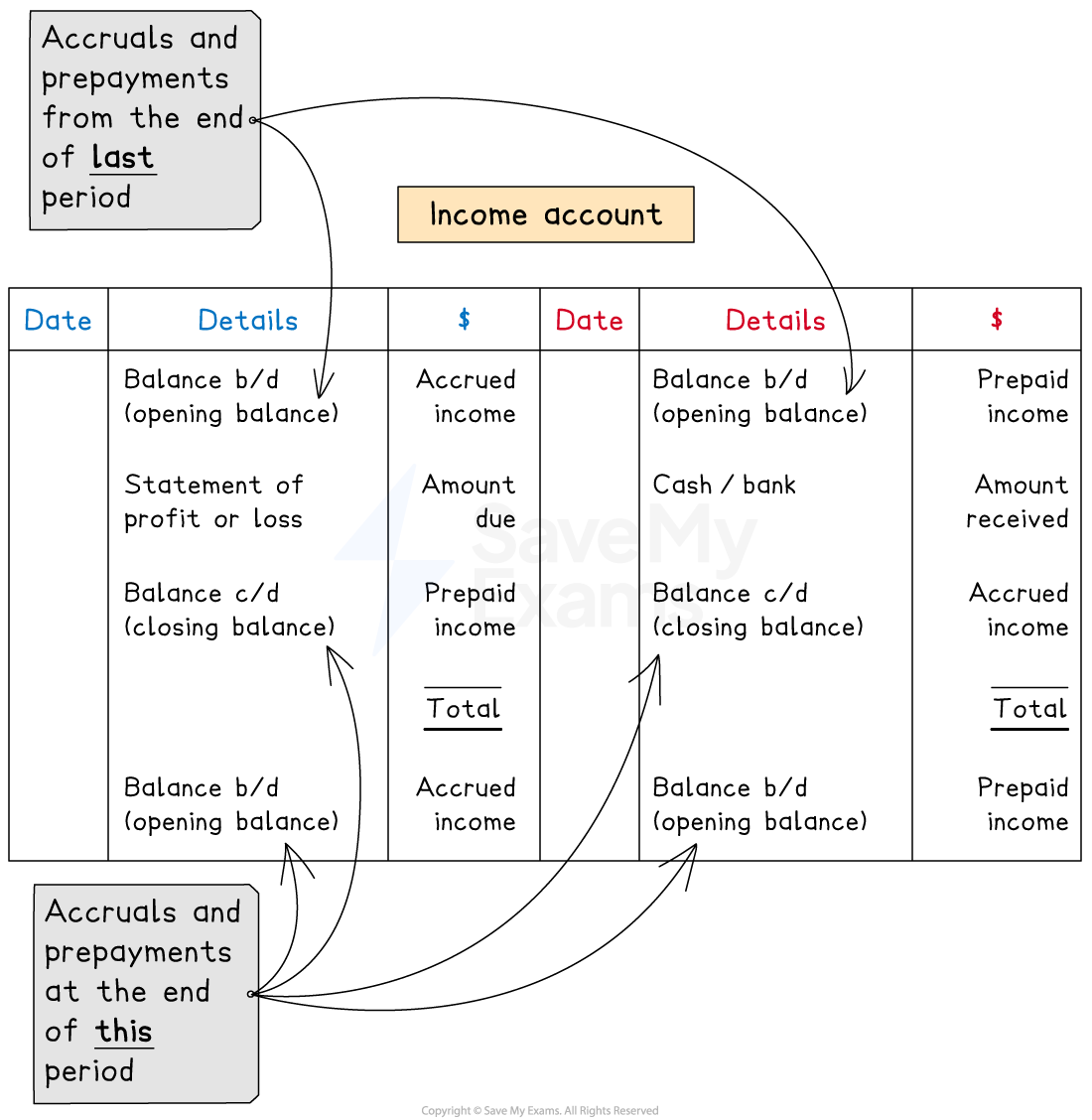
How do I complete an income account?
Put the opening balance on the correct side
Debit side if the amount is an accrual
Credit side if the amount is a prepayment
Put the amount received on the credit side
Label this as cash or bank
Put the amount due on the debit side
Label this as statement of profit or loss
Put the closing balance on the correct side
Credit side if the amount is an accrual
Debit side if the amount is a prepayment
Examiner Tips and Tricks
Students sometimes get confused about where to put the closing balances. A good way to make sure that you put them on the correct side, is to also include the opening balances for the following year. Then the closing balances will be on the opposite side.
How do I calculate a missing value in an income account?
You can use a ledger account to find any missing value
Fill in the amounts that you know on the correct sides
Find the missing value which balances the account
You can use this method to find
the amount received
the amount to transfer to the statement of profit or loss
the amount accrued or prepaid at the end of the year
Worked Example
Hussain receives rent from Sayid.
On 1 January 2023, Sayid owed Hussain three months’ rent.
On 1 March 2023, Hussain receives a cheque from Sayid for $8 400 for 16 months’ rent.
Prepare the rent receivable account in the ledger for Hussain for the financial year ended 31 December 2023. Balance the account and bring down the balances on 1 January 2024. Clearly show the amount that is transferred to the statement or profit or loss.
Answer:
Sayid paid for 16 months:
12 months for the financial year
three months for the arrears at the start
one month prepaid for the next year
Find the accrual at the start of the year.
STEP 1: Divide the payment by 16 to get the monthly rent
$8 400 ÷ 16 = $525
STEP 2: Multiply the monthly rent by 3 to find the accrual at the start of the year
$525 × 3 = $1 575
Find the amount due for the year ended 31 December.
Multiply the monthly rent by 12
$525 × 12 = $6 300
Identify which side of the rent receivable account to post each transaction:
The payment from Sayid will be credited to the rent receivable account
Because it will be debited to the cash book
There is an accrual at the start of the year, which represents an asset
Therefore the opening balance will be on the debit side of the rent receivable account
The amount for the year is credited to the statement or profit or loss
Therefore the rent receivable account will be debited
There is a prepayment at the end of the year, which represents a liability
Therefore there will be an opening balance on the credit side for the next year
Therefore, the closing balance will be on the debit side for this year
Hussain
Rent Receivable Account
Date | Details | $ | Date | Details | $ |
2023 Jan 1 |
Balance b/d |
1 575 | 2023 Jan 1 |
Bank |
8 400 |
Dec 31 | Statement of profit or loss | 6 300 | |||
Dec 31 | Balance c/d | 525 |
| ||
8 400 | 8 400 | ||||
2024 Jan 1 |
Balance b/d |
525 |

Unlock more, it's free!
Join the 100,000+ Students that ❤️ Save My Exams
the (exam) results speak for themselves:

Was this revision note helpful?