Minimum Spanning Trees (Edexcel International A Level (IAL) Maths: Decision 1): Exam Questions

Exam code: YMA01

2 hours12 questions
1a
3 marks

Kruskal’s algorithm finds a minimum spanning tree for a connected graph with n vertices.

Explain the terms

(i) connected graph,

(ii) tree,

(iii) spanning tree.

1b
1 mark

Write down, in terms of n, the number of arcs in the minimum spanning tree.

1c
2 marks

The table below shows the lengths, in km, of a network of roads between seven villages, A, B, C, D, E, F and G.

A

B

C

D

E

F

G

A

-

17

-

19

30

-

-

B

17

-

21

23

-

-

-

C

-

21

-

27

29

31

22

D

19

23

27

-

-

40

-

E

30

-

29

-

-

33

25

F

-

-

31

40

33

-

39

G

-

-

22

-

25

39

-

Complete the drawing of the network on Diagram 1 by adding the necessary arcs from vertex C together with their weights.
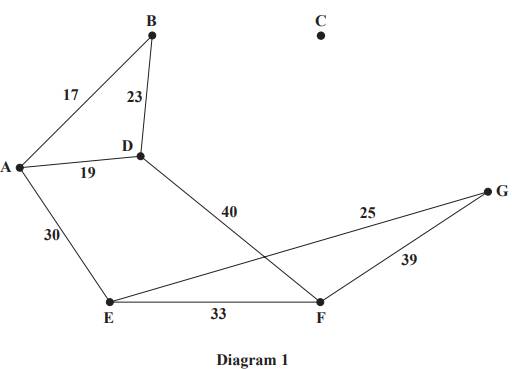
Geometric diagram with points A to G, connected by lines of varying lengths. Distances are marked. Point C is isolated above the main structure. Diagram 1 captioned.
1d
3 marks

Use Kruskal’s algorithm to find a minimum spanning tree for the network. You should list the arcs in the order that you consider them. In each case, state whether you are adding the arc to your minimum spanning tree.

1e
1 mark

State the weight of the minimum spanning tree.

2a
1 mark
Graph with vertices A to H connected by edges: AC (16), AB (17), BH (21), CD (18), DF (24), FG (29), and others, labelled with weights.

Explain why it is impossible to draw a graph with eight vertices in which the vertex orders are 1, 2, 2, 3, 3, 4, 4 and 6

2b
2 marks

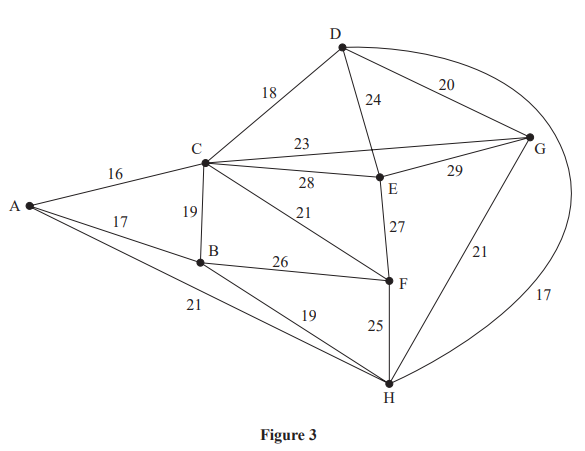
Figure 3 shows the network T. The numbers on the arcs represent the distances, in km, between the eight vertices, A, B, C, D, E, F, G and H.

Determine whether or not A – C – D – E – C – B – F is an example of a path on T. You must justify your answer.

2c
3 marks

Use Prim’s algorithm, starting at A, to find the minimum spanning tree for T. You must clearly state the order in which you select the arcs of the tree.

2d
1 mark

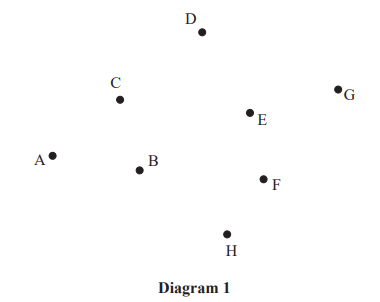
Draw the minimum spanning tree using the vertices given in Diagram 1

Diagram 1 shows eight black dots labelled A to H, scattered randomly across a plain white background.
2e
2 marks

The weight of arc CF is now increased to a value of x. The minimum spanning tree for T is unique and includes the same arcs as those found in (c).
Write down the smallest interval that must contain x.

3a
3 marks
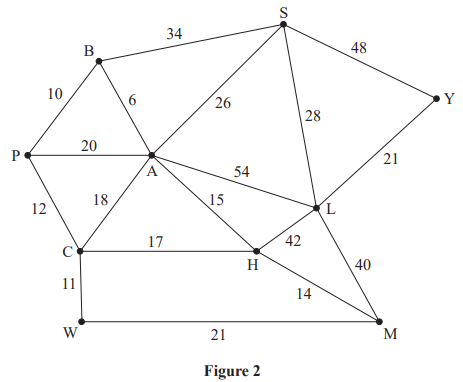
Diagram of interconnected points labelled B, S, Y, M, C, P, W, A, H, L with lines and numbers indicating distances between them; titled Figure 2.

The network in Figure 2 shows the distances, in miles, between ten towns, A, B, C, H, L, M, P, S, W and Y.

Use Kruskal’s algorithm to find a minimum spanning tree for the network. You should list the arcs in the order in which you consider them. In each case, state whether you are adding the arc to your minimum spanning tree.

3b
3 marks

A

B

C

H

L

M

P

S

W

Y

A

-

6

18

15

54

29

16

26

29

74

B

6

-

22

21

60

35

10

32

33

80

C

18

22

-

17

59

31

12

44

11

80

H

15

21

17

-

42

14

29

41

28

63

L

54

60

59

42

-

40

70

28

61

21

M

29

35

31

14

40

-

43

55

21

61

P

16

10

12

29

70

43

-

42

23

90

S

26

32

44

41

28

55

42

-

55

48

W

29

33

11

28

61

21

23

55

-

82

Y

74

80

80

63

21

61

90

48

82

-

Use Prim’s algorithm on the table, starting at A, to find the minimum spanning tree for this network. You must clearly state the order in which you select the arcs of your tree.

3c
1 mark

State the weight of the minimum spanning tree found in (b).

3d
1 mark

Sharon needs to visit all of the towns, starting and finishing in the same town, and wishes to minimise the total distance she travels.

Use your answer to (c) to calculate an initial upper bound for the length of Sharon’s route.

3e
2 marks

Use the nearest neighbour algorithm on the table, starting at W, to find an upper bound for the length of Sharon’s route. Write down the route which gives this upper bound.

3f
1 mark

Using the nearest neighbour algorithm, starting at Y, an upper bound of length 212 miles was found.

State the best upper bound that can be obtained by using this information and your answers from (d) and (e). Give the reason for your answer.

3g
2 marks

By deleting W and all of its arcs, find a lower bound for the length of Sharon’s route.

3h
1 mark

Sharon decides to take the route found in (e).

Interpret this route in terms of the actual towns visited.

4a
1 mark
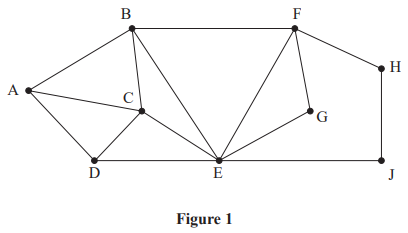
Graph image with labelled vertices A to J; lines connect various points, forming geometric shapes and intersections. Title: Figure 1.

Figure 1 shows a graph, T.

Write down an example of a path from A to J on T.

4b
1 mark

State, with a reason, whether A – B – C – D – E – G – F – H – J is an example of a tour on T.

4c
3 marks
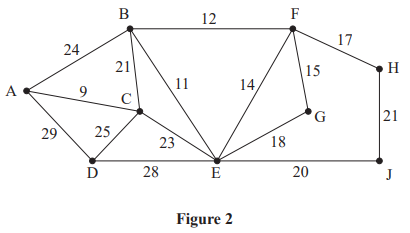
Graph diagram labelled Figure 2 with points A to J, connected by lines marked with numbers, showing a network of interconnected vertices.

The numbers on the 15 arcs in Figure 2 represent the distances, in km, between nine vertices, A, B, C, D, E, F, G, H and J, in a network.

Use Kruskal’s algorithm to find the minimum spanning tree for the network. You should list the arcs in the order in which you consider them. In each case, state whether or not you are adding the arc to the minimum spanning tree.

4d
1 mark

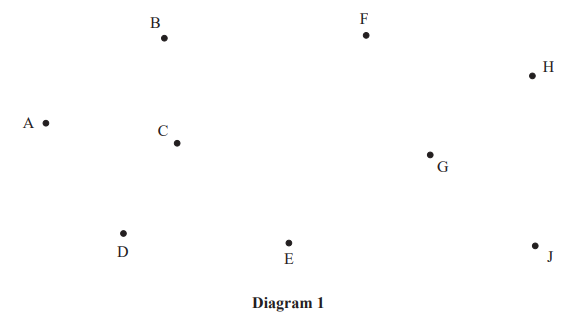
Draw the minimum spanning tree using the vertices given in Diagram 1 .

Diagram 1 shows scattered black dots labelled A to J on a white background, with no apparent pattern or connection.
4e
1 mark

State the weight of the minimum spanning tree.

5a
6 marks
Graph showing nodes A to H connected by lines with weights: includes edges AE, EF, FG, GH, HD, DE, EB, and others, forming a network of paths.

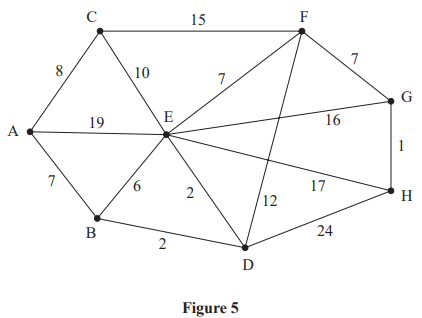
Figure 5 models a network of roads. The number on each edge gives the length, in km, of the corresponding road. The vertices, A, B, C, D, E, F, G and H, represent eight towns. Bronwen needs to visit each town. She will start and finish at A and wishes to minimise the total distance travelled.

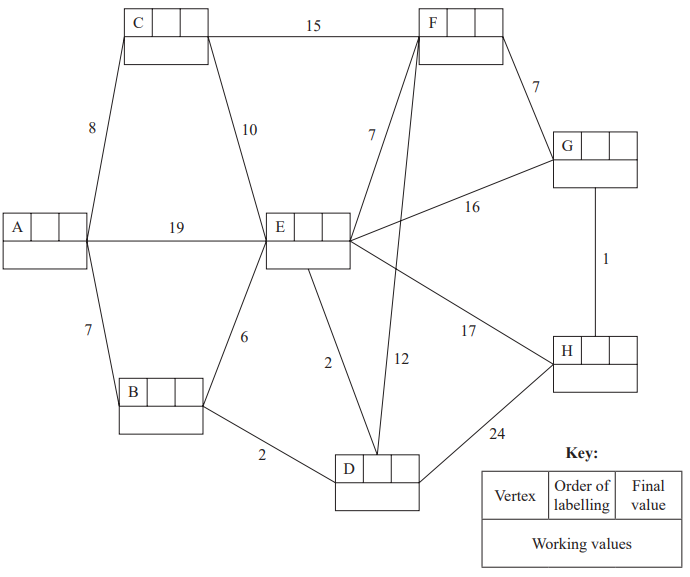
By applying Dijkstra’s algorithm, starting at A, complete the table of least distances.

Graph diagram with vertices A to H connected by weighted edges. Each vertex has a grid for labelling order and values. Key explains grid usage.

A

B

C

D

E

F

G

H

A

-

B

-

14

2

4

11

18

19

C

14

-

12

10

15

22

23

D

2

12

-

2

9

16

17

E

4

10

2

-

7

14

15

F

11

15

9

7

-

7

8

G

18

22

16

14

7

-

1

H

19

23

17

15

8

1

-

5b
2 marks

Starting at A, use the nearest neighbour algorithm to find an upper bound for the length of Bronwen’s route. Write down the route that gives this upper bound.

5c
4 marks

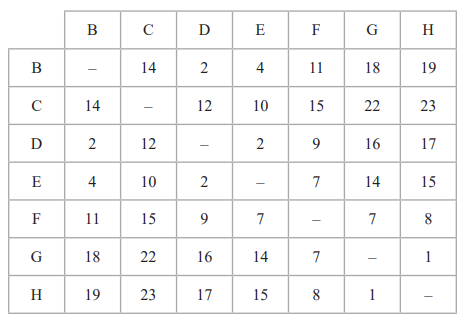
A reduced network is formed by deleting A and all arcs that are directly joined to A.

(i) Use Prim’s algorithm, starting at C, to construct a minimum spanning tree for the reduced network. You must clearly state the order in which you select the arcs of your tree.

(ii) Hence, calculate a lower bound for the length of Bronwen’s route.

Table showing distances with rows and columns labelled B to H. The diagonal shows dashes. Each cell contains a number representing a distance.
5d
2 marks

Using only the results from (b) and (c), write down the smallest interval that you can be confident contains the length of Bronwen’s optimal route.

6a
3 marks

The table below represents a complete network that shows the least costs of travelling between eight cities, A, B, C, D, E, F, G and H.

A

B

C

D

E

F

G

H

A

-

36

38

40

23

39

38

35

B

36

-

35

36

35

34

41

38

C

38

35

-

39

25

32

40

40

D

40

36

39

-

37

37

26

33

E

23

35

25

37

-

42

24

43

F

39

34

32

37

42

-

45

38

G

38

41

40

26

24

45

-

40

H

35

38

40

33

43

38

40

-

Srinjoy must visit each city at least once. He will start and finish at A and wishes to minimise his total cost.

Use Prim’s algorithm, starting at A, to find a minimum spanning tree for this network. You must list the arcs that form the tree in the order in which you select them.

6b
1 mark

State the weight of the minimum spanning tree.

6c
1 mark

Use your answer to (b) to help you calculate an initial upper bound for the total cost of Srinjoy’s route.

6d
4 marks

Show that there are two nearest neighbour routes that start from A. You must make the routes and their corresponding costs clear.

6e
1 mark

State the best upper bound that can be obtained by using your answers to (c) and (d).

6f
3 marks

Starting by deleting A and all of its arcs, find a lower bound for the total cost of Srinjoy’s route. You must make your method and working clear.

6g
2 marks

Use your results to write down the smallest interval that must contain the optimal cost of Srinjoy’s route.

7a
2 marks
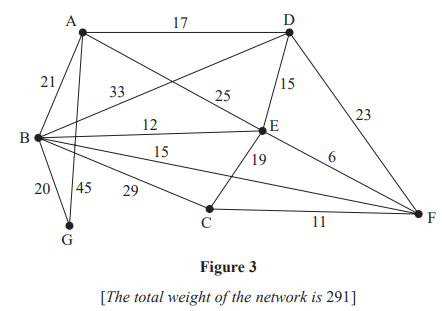
Diagram of a network graph with seven nodes, labelled A to G. Edges connect nodes with weights, totalling 291. Nodes are linked with various lines and numbers.

Figure 3 models a network of roads. The number on each edge gives the length, in km, of the corresponding road. The vertices, A, B, C, D, E, F and G, represent seven towns. Derek needs to visit each town. He will start and finish at A and wishes to minimise the total distance travelled.

By inspection, complete the two copies of the table of least distances.

A

B

C

D

E

F

G

A

-

21

17

25

31

41

B

21

-

26

27

12

15

20

C

26

-

17

11

46

D

17

27

-

15

47

E

25

12

17

15

-

6

32

F

31

15

11

6

-

35

G

41

20

46

47

32

35

-

7b
2 marks

Starting at A, use the nearest neighbour algorithm to find an upper bound for the length of Derek’s route. Write down the route that gives this upper bound.

7c
1 mark

Interpret the route found in (b) in terms of the towns actually visited.

7d
3 marks

Starting by deleting A and all of its arcs, find a lower bound for the route length.

7e
5 marks

Clive needs to travel along the roads to check that they are in good repair. He wishes to minimise the total distance travelled and must start at A and finish at G.

By considering the pairings of all relevant nodes, find the length of Clive’s route. State the edges that need to be traversed twice. You must make your method and working clear.

8a
2 marks
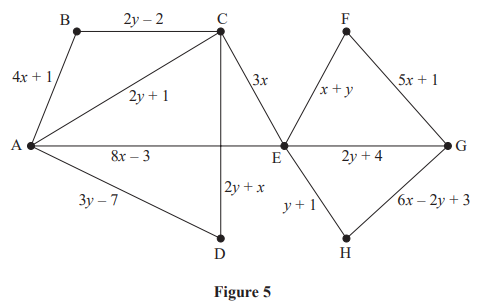
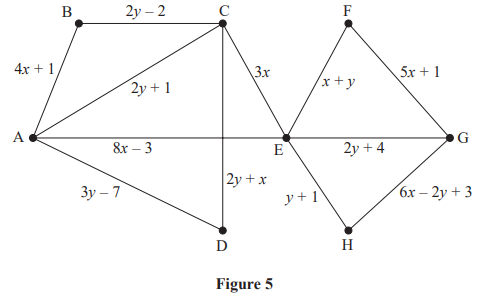
Geometric figure with two polygons, labelled points A to H. Lines are marked with algebraic expressions, such as 4x + 1 and 2y - 2, representing their lengths.

Figure 5 shows a weighted graph that contains 12 arcs and 8 vertices.

It is given that

  • no two arcs have the same weight

  • x and y are positive integers

  • arc CD is not in the minimum spanning tree for the graph

Explain why y less than x plus 7

8b
3 marks

It is also given that when Prim’s algorithm, starting at A, is applied to the weighted graph, AB is the first arc selected.

Show that y greater than 2 x and write down and simplify two further constraints on the values of x and y.
8c
4 marks

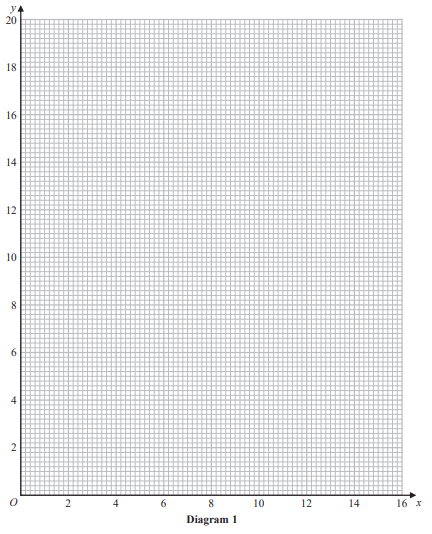
Represent these four constraints on Diagram 1.

Graph paper with x-axis labelled 0 to 16 and y-axis 0 to 20, divided into small squares; titled "Diagram 1".
8d
2 marks

Using Diagram 1 only, write down the possible pairs of values that x and y can take in the form (x comma y)

8e
4 marks

The minimum spanning tree for the weighted graph in Figure 5 has total weight 73 Six of the seven arcs in the minimum spanning tree are AB, AD, BC, CE, EF and GH.

Geometric diagram with two polygons, ABCDE and EFGH, connected at point E, featuring labelled sides with algebraic expressions and points A to H.

Determine the value of x and the value of y. You must make your method and working clear.

9a
2 marks

Explain the difference between the classical and the practical travelling salesperson problems.

9b
2 marks

The table below shows the distances, in km, between seven museums, A, B, C, D, E, F and G.

A

B

C

D

E

F

G

A

-

25

31

28

35

30

32

B

25

-

34

24

27

32

39

C

31

34

-

40

35

27

29

D

28

24

40

-

37

35

36

E

35

27

35

37

-

28

31

F

30

32

27

35

28

-

33

G

32

39

29

36

31

33

-

Fran must visit each museum. She will start and finish at A and wishes to minimise the total distance travelled.

Starting at A, use the nearest neighbour algorithm to obtain an upper bound for the length of Fran’s route. Make your method clear.

9c
1 mark

Starting at D, a second upper bound of 203 km was found.

State whether this is a better upper bound than the answer to (b), giving a reason for your answer.

9d
4 marks

A reduced network is formed by deleting G and all the arcs that are directly joined to G.

(i) Use Prim’s algorithm, starting at A, to construct a minimum spanning tree for the reduced network. You must clearly state the order in which you select the arcs of your tree.

(ii) Hence calculate a lower bound for the length of Fran’s route.

9e
1 mark

By deleting A, a second lower bound was found to be 188 km.

State whether this is a better lower bound than the answer to (d)(ii), giving a reason for your answer.

9f
2 marks

Using only the results from (c) and (e), write down the smallest interval that you can be confident contains the length of Fran’s optimal route.

10a
2 marks

The table below shows the distances, in metres, between six vertices, A, B, C, D, E and F, in a network.

A

B

C

D

E

F

A

-

18

23

17

28

19

B

18

-

20

11

-

24

C

23

20

-

-

25

13

D

17

11

-

-

-

22

E

28

-

25

-

-

-

F

19

24

13

22

-

-

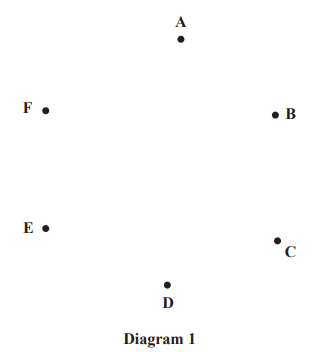
Draw the weighted network using the vertices given in Diagram 1 .

Diagram 1 shows dots labeled A to F arranged in a hexagonal pattern with one dot at each vertex.
10b
3 marks

Use Kruskal’s algorithm to find a minimum spanning tree for the network. You should list the edges in the order that you consider them and state whether you are adding them to your minimum spanning tree.

10c
2 marks

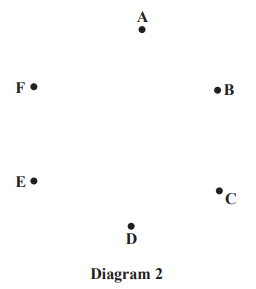
Draw the minimum spanning tree on Diagram 2 and state its total weight.

Six equidistant dots labelled A to F forming a hexagonal shape, with A at the top and D at the bottom, titled Diagram 2 below.

Weight of minimum spanning tree _________________________________

11a
3 marks
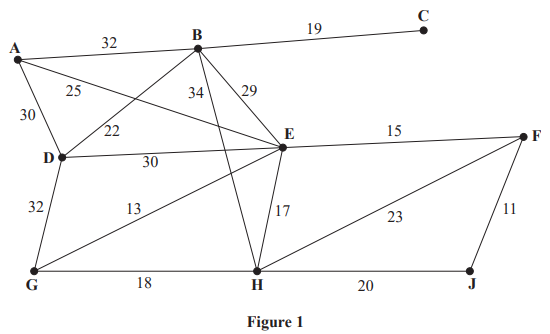
Geometric diagram with nine labelled points (A-J) interconnected by lines, each marked with distances. Points form a network of triangles.

Define the terms

(i) tree,

(ii) minimum spanning tree.

11b
3 marks

Use Kruskal’s algorithm to find the minimum spanning tree for the network shown in Figure 1. You must clearly show the order in which you consider the edges. For each edge, state whether or not you are including it in the minimum spanning tree.

11c
2 marks

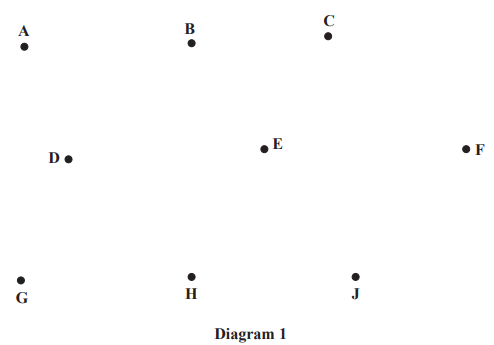
Draw the minimum spanning tree using the vertices given in Diagram 1 below and state the weight of the minimum spanning tree.

Diagram 1 with nine labelled dots A to J in a grid-like pattern, each dot evenly spaced apart on the page.
12a
6 marks
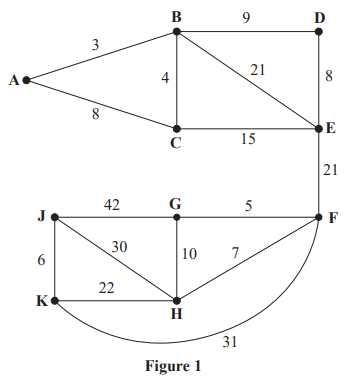
Geometric diagram with points A to K connected by lines, each labelled with distances. Shapes include triangles and quadrilaterals. Figure 1 is noted below.

Figure 1 represents a network of roads between ten villages, A, B, C, D, E, F, G, H, J and K. The number on each edge represents the length, in kilometres, of the corresponding road. The local council needs to find the shortest route from A to J.

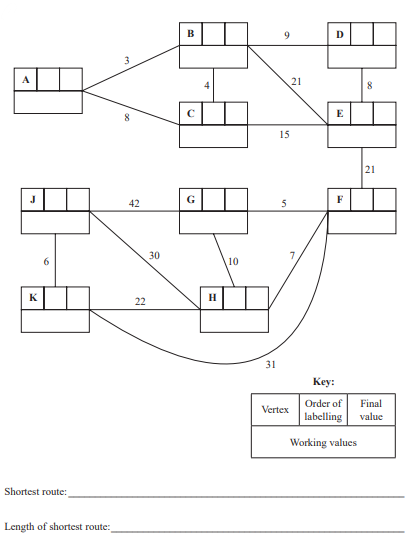
Use Dijkstra’s algorithm to find the shortest route from A to J. State the route and its length.

Diagram of a network with labelled vertices A-K connected by edges with numerical values. A key explains vertex labelling and values. Spaces for shortest route details.
12b
2 marks

During the winter, the council needs to ensure that all ten villages are accessible by road even if there is heavy snow. The council wishes to minimise the total length of road it needs to keep clear.

Use Prim’s algorithm, starting at A, to find a minimum connector for the five villages A, B, C, D and E. You must clearly state the order in which you select the edges of your minimum connector.

12c
2 marks

Use Kruskal’s algorithm to find a minimum connector for the five villages F, G, H, J and K. You must clearly show the order in which you consider the edges. For each edge, state whether or not you are including it in your minimum connector.

12d
1 mark

Calculate the total length of road that the council must keep clear of snow to ensure that all ten villages are accessible.