Hardest IGCSE Chemistry Questions & How to Answer Them

Written by: Philippa Platt
Reviewed by: Richard Boole
Published

Contents
- 1. Key Takeaways
- 2. Why Some IGCSE Chemistry Questions Are So Hard
- 3. How to Approach Difficult Chemistry Questions
- 4. Hardest IGCSE Chemistry Questions by Topic
- 5. Extended response questions
- 6. Advice for practical based questions
- 7. Exam Tips
- 8. Common Mistakes Students Make (and How to Avoid Them)
- 9. Frequently Asked Questions
- 10. Final Thoughts
- 11. References:
Struggling when those really tough Chemistry questions appear in your IGCSE exam? Trust me, you’re not the only one! Every year, students across the UK come up against questions that make them hesitate, doubt themselves, or wonder whether they’ve even revised the right topic.
But is the subject's reputation for being difficult really deserved? For a teacher's perspective on this, check out our in-depth guide: Is IGCSE Chemistry Hard?.
As a chemistry teacher with nearly 20 years of classroom experience, I’ve seen exactly where students slip up, and more importantly, what helps them overcome those tricky moments. The good news? With the right approach and a bit of guided practice, even the hardest IGCSE Chemistry questions become completely manageable.
Let's look at why some questions feel so challenging and how you can answer them with confidence.
Key Takeaways
Before we get into the hardest question types, there are a few golden rules I always share with my classes:
Command words are your secret weapon
Words like “explain”, “evaluate” and “justify” are clues.
They tell you exactly how much detail to give and what kind of answer the examiner is looking for.
Always show your working
Don’t just write the final number.
If the method is there, you can still pick up marks even if the final answer isn’t perfect.
Good structure = easier marks
Set out your answer in clear, logical steps or short paragraphs.
This makes it much easier for the examiner to follow your thinking and reward you for it.
Weird-looking questions aren’t a trap
When a question is set in an unfamiliar context, it’s not there to trick you.
It’s just checking whether you can use your chemistry knowledge in a new situation.
The science underneath is still the same.
Why Some IGCSE Chemistry Questions Are So Hard
Let’s be real, not all Chemistry questions are made equal. Some you can answer without thinking, while others feel like they’ve been written in code. So what actually makes certain IGCSE Chemistry questions so challenging?
They demand multi-step thinking
The toughest questions rarely test just one skill. Instead, they expect you to link several ideas together.
You might need to recall a definition, carry out a calculation, and explain your reasoning, all in the same answer.
They rely on abstract concepts
Topics like equilibrium or atomic structure involve particles and processes you can’t see. Unlike a simple classroom experiment, these ideas are theoretical. This can make them harder to picture and understand.
They use unfamiliar contexts
Examiners love placing familiar chemistry into unfamiliar scenarios, unusual reactions, industrial settings, or real-world applications. This isn’t meant to throw you off; it’s a way of checking whether you can apply your understanding, not just memorise facts.
The mark scheme is detailed
Higher-mark questions often have several specific marking points. Even if you understand the idea, missing a key term or explanation can mean missing out on marks.
Calculations become more complex
It’s not just about choosing the right formula.
You may need to rearrange equations, convert units, use significant figures correctly, and keep your working clear, all while under time pressure.
The upside?
Once you understand why these questions are difficult, you can use targeted strategies to overcome them. And that’s where real progress begins.
How to Approach Difficult Chemistry Questions
Okay, time to get practical. When you’re staring at a question that makes your brain ache, use this step-by-step game plan:
1. Read the question twice (properly!)
Don’t skim. The fastest way to lose marks is to miss a tiny detail. On your second read, underline or highlight key bits like numbers, substances, and any specific instructions.
2. Crack the command word
What is the question actually asking you to do, describe, explain, or evaluate? Each one needs a different style of answer:
Describe = Say what you see or what happens.
Explain = Say why it happens (using words like “because” or “so”).
Evaluate = Weigh up pros and cons or make a judgement about something.
3. Look at the marks available
Circle the number of marks. A 1-mark question needs one clear point. A 6-mark question needs several points or a detailed, layered answer. Let the marks guide how much you write.
4. Figure out what you’re dealing with
What information have they given you? Is there data, a table, a graph? Which formula might you need? Which topic is being tested? Often, just identifying the topic (e.g. electrolysis, moles, bonding) unlocks the method.
5. Plan your answer in your head first
Don’t rush straight into writing. Spend 10–15 seconds deciding what you’re going to do.
For calculations: jot down the formula first.
For longer answers: quickly think through the key points you need to include.
6. Show every step of your working
Even if you’re sure you’re right, write out each stage clearly. If you slip up on one small step, you can still earn method marks for the rest of your working.
7. Ask: “Does this answer make sense?”
Check your final result.
A negative temperature?
A pH of 25?
A mass larger than what you started with?
Those are red flags. If something looks unrealistic, go back and hunt for a mistake.
Before we dive into the examples, it's crucial to know your exam board. The structure of the papers differs between CIE, Oxford AQA and Edexcel. This will affect where you're most likely to encounter these challenging questions. For a full breakdown, check out our guide on: How many IGCSE Chemistry papers are there?
Hardest IGCSE Chemistry Questions by Topic
Let's tackle some genuinely challenging questions across the key topics. These are based on real past paper questions that students typically find tough.
Titration calculations
Calculation questions can feel overwhelming because they often combine several steps. This example using a titration shows how to tackle them one stage at a time, so the maths becomes much more manageable.
A reaction between lithium and water produces 150 cm3 of lithium hydroxide (LiOH) solution. This lithium hydroxide solution is then completely neutralised by 24.85 cm3 of 0.100 mol/dm3
sulfuric acid (H2SO4). The equation for the neutralisation is:
2LiOH (aq) + H2SO4 (aq) → Li2SO4 (aq) + 2H2O (l)
Calculate the concentration, in mol/dm3, of the lithium hydroxide solution.
[3 marks]
(Source: Edexcel IGCSE (9–1), January 2020 Paper 2, Q5cii))
Why is this hard?
This question involves three linked calculation steps, each of which must be correct to reach the final answer. Many students lose marks by:
Forgetting to convert cm3 to dm3
Not applying the 1:2 mole ratio correctly
Dividing by volume in the wrong units
Not showing enough working for method marks
It’s a typical “chain calculation” where one small slip can affect the final concentration.
How to answer it:
Make sure all the units are the ones you need to use, e.g. cm3 not dm3
Calculate the moles of H2SO4
Use the ratio
Calculate the concentration of LiOH
Model answer:
Step 1: Convert the volume of H2SO4 to dm3:
24.85 cm3 ÷ 1000 = 0.02485 dm3
Step 2: Calculate moles of H2SO4:
moles = concentration x volume
moles of H2SO4 = 0.100 mol/dm3 x 0.02485 dm3
moles of H2SO4 = 0.002485 mol
Step 3: Use the mole ratio:
The equation shows H2SO4 : LiOH = 1 : 2.
So, the moles of LiOH needed is:
2 x 0.002485 mol = 0.00497 mol
Step 4: Convert the LiOH volume to dm3:
150 cm3 ÷ 1000 = 0.150 dm3
Step 5: Calculate the concentration of LiOH:
concentration = moles / volume
concentration of LiOH = 0.00497 ÷ 0.150
concentration of LiOH = 0.0331 mol/dm3
Top tip:
Always convert cm3 → dm3 before calculating moles.
Nearly all lost marks in titration questions come from mixing units.
Write “÷1000” on the page as a reminder before you start.
Bonding and structure
Structure and bonding questions often require precise scientific language. This example helps you practise describing a substance clearly using the correct key terms.
Example question
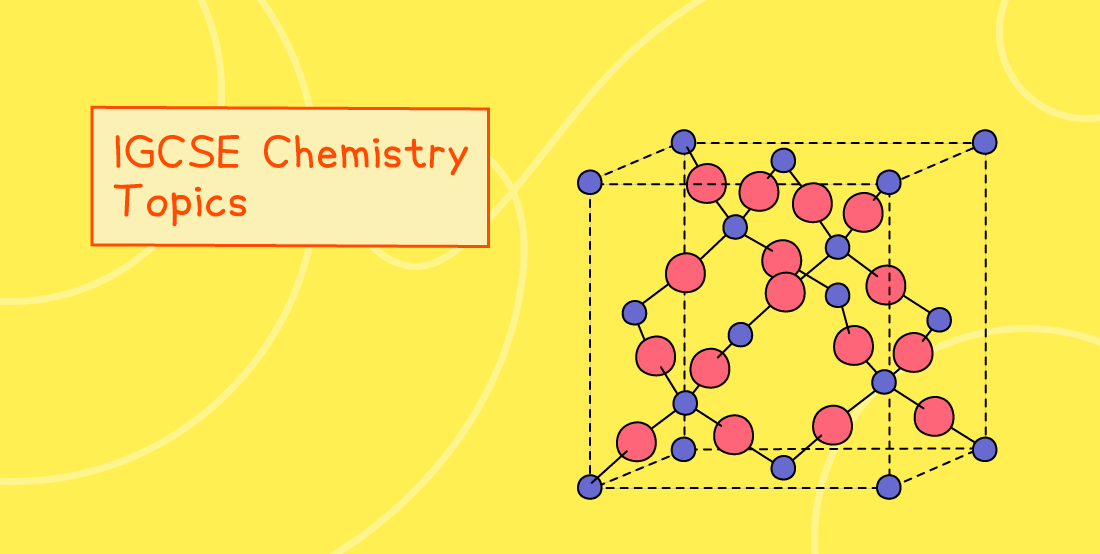
Diamond, graphite and silicon dioxide all have giant covalent structures. The diagram shows the structures of these three substances.
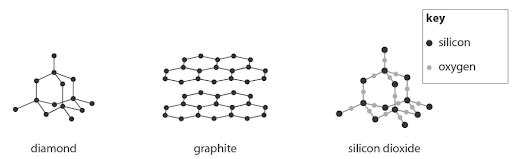
Explain why silicon dioxide has a high melting point.
[2 marks]
(Source: Edexcel IGCSE (9–1), June 2019 Paper 1, Q7a)
Why this is hard:
Students often mix up covalent bonds with intermolecular forces. Silicon dioxide is a giant covalent structure, not a simple molecule, so there are no intermolecular forces at all. Misusing terms (e.g., “more energy is needed” with no comparison) costs marks.
How to answer it:
State that silicon dioxide is a giant covalent lattice.
Each silicon atom is bonded to four oxygen atoms, and each oxygen atom is bonded to two silicon atoms.
Explain that these are strong bonds which must be broken to melt silicon dioxide, requiring a lot of energy.
Model answer:
Silicon dioxide has many covalent bonds therefore a large amount of thermal energy is required to break the bonds.
Top tip:
If the whole substance is a single three-dimensional giant covalent network (like silicon dioxide or diamond), never mention intermolecular forces.
If the substance has giant covalent layers (like graphite), you must mention the weak intermolecular forces between the layers.
Equations
Students often find balancing equations challenging. Examiners comment that ionic half-equations remain an area requiring considerable improvement across the board
This question was poorly answered by many students
When aqueous silver nitrate, AgNO3 (aq), is added to aqueous potassium chloride, a precipitate is formed.
Write the ionic equation for the reaction. Include state symbols.
[3 marks]
(Source: CIE IGCSE Paper 41 November 2022, Q2eiii)
Why this is hard:
Candidates found this question challenging because they struggled with the definition and requirements of an ionic equation for a precipitation reaction.
1. A common error was submitting a symbol equation instead of an ionic equation, or a mixed attempt that was neither correctly formulated.
2. Students failed to correctly identify the participating ions and differentiate them from the spectator ions.
3. The necessity of including correct state symbols ((aq) for the reactants and (s) for the precipitate) was often overlooked or incorrect. Examiners noted that only a small number of candidates knew that for a precipitation ionic equation, the reacting ions in aqueous solution (Ag+ and Cl−) must be shown as reactants on the left-hand side, and the solid precipitate (AgCl) must be the product on the right-hand side.
How to answer it:
The reaction involves two soluble ionic compounds combining to form:
One insoluble ionic compound (AgCl)
One soluble ionic compound (KNO3).
To correctly write the net ionic equation, you must identify which ions combine to form the precipitate and omit the spectator ions (those that remain dissolved).
Model answer:
Ag+ (aq) + Cl− (aq) → AgCl (s)
Top tip:
When writing an ionic equation for precipitation, always start by identifying the precipitate (the solid product). The ionic reactants must be the constituent ions of that precipitate, correctly balanced and shown as aqueous species (aq). Ignore all spectator ions (like K+and NO3− in this case), as they do not change state or bonding during the reaction.
Energy Changes
Bond-energy questions test both your chemistry knowledge and your calculation skills. This example shows how to approach them methodically and avoid common mistakes.
Example Question:
The reaction between ethene and hydrogen can be represented using displayed formulae.
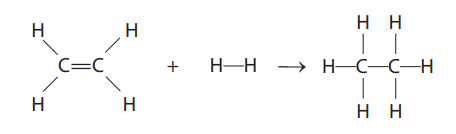
Bond | Bond energy in kJ/mol |
C=C | 612 |
C-H | 412 |
H-H | 436 |
C-C | 348 |
Use the bond energies in the table to calculate the enthalpy change, ΔH, in kJ/mol for this reaction.
[3 marks]
(Source: Edexcel IGCSE (9–1), January 2020 Paper 2, Q6c)
Why this is hard:
You need to correctly identify all bonds broken and formed, handle the stoichiometry, and remember that energy in and energy out have opposite signs.
How to answer it:
Calculate the energy required to break the bonds
Calculate the energy associated with forming the bonds
Calculate the difference
Model answer:
Step 1: Bonds broken (energy IN—positive)
C2H4 has 4 C–H bonds and 1 C=C bond: (412 x 4) + 612 = 2260 kJ
H2 molecules has 1 H-H bond: 436 x 1 = 436 kJ
Total energy in = 2260 + 436 = 2696 kJ
Step 2: Bonds formed (energy OUT—negative)
C2H6 has 412 x 6 bonds and 1 C-C bond: (412 x 6) + 348 = 2820 kJ
Total energy out = 2820 kJ
Step 3: Overall energy change
Energy change = Energy in – Energy out
2696 – 2820 = –124 kJ
The negative value means energy is released, so the reaction is exothermic.
Top tip:
Draw out the molecules if it helps you count bonds.
Remember: bonds broken = energy needed (positive), bonds formed = energy released (negative).
Chemical Equilibria
Equilibrium questions often require you to apply a rule and explain your reasoning clearly. This example shows how to break the question into simple steps so your answer stays focused.
Example Question:
The Haber process produces ammonia:
N2 (g) + 3H2 (g) ⇌ 2NH3 (g) ΔH = –92 kJ/mol
A chemist increases the temperature of the reaction. Explain the effect this will have on the yield of ammonia and the rate of reaction. Use Le Chatelier's Principle in your answer.
[5 marks]
Why this is hard:
You need to apply Le Chatelier's Principle correctly and discuss the rate separately. Students often confuse yield with rate.
How to answer it:
Identify the reaction type.
ΔH is negative, so the forward reaction is exothermic.
Apply Le Chatelier's Principle for yield.
Increasing temperature favours the endothermic direction (the reverse reaction).
This means the equilibrium shifts to the left, producing less ammonia.
So, the yield decreases.
Now consider the rate.
Higher temperature means particles have more kinetic energy.
They collide more frequently and with more energy
So, the rate of reaction increases for both forward and backward reactions.
Model answer:
The forward reaction is exothermic (ΔH is negative).
According to Le Chatelier's Principle, increasing temperature favours the endothermic / reverse reaction to oppose the change. This shifts the equilibrium position to the left, so the yield of ammonia decreases.
However, the particles have more kinetic energy at higher temperatures. This means that they collide more frequently and with more energy above the activation energy. So, there are more successful collisions per second. This leads to a higher rate of reaction.
Top tip:
Always mention the direction of equilibrium shift and why.
Remember: rate and yield are different things!
Extended response questions
Extended-response questions, often worth 6 marks, are the 'mini-essay' questions of your exam. They aren't just testing what you know; they're testing how well you can communicate your understanding in a clear, logical argument.
To reach the top level, your answer must:
Contain the right scientific facts
Be well-structured and coherent
Use precise scientific language throughout.
Simply listing a few keywords won't be enough; you need to build a proper scientific explanation.
Example Question:
This example shows how to organise your thoughts to build a top-level answer and earn those marks confidently.
Ethanol can be manufactured by two different methods. The table gives some information about the two methods.
Hydration of ethene | Fermentation of glucose | |
Raw material | Crude oil | Sugar cane |
Rate of reaction | fast | slow |
Purity of ethanol | pure | impure |
Operating temperature | 300 °C | 30 °C |
Operating pressure | 60-70 atmospheres | 1 atmosphere |
Catalyst | Phosphoric acid | Enzymes in yeast |
Discuss the advantages and disadvantages of these two methods, using information from the table.
[6 marks]
(Source: Edexcel IGCSE (9–1), June 2021 Paper 2, Q5c)
Why this is hard:
This extended response question is particularly challenging because it requires you to be an expert not just in chemistry, but also in industrial strategy and economics! It's not enough to know the chemical equations; you need to provide a balanced, detailed discussion.
Here is why students often find this question difficult:
It requires a massive synthesis of topics
This isn't a simple recall question.
It demands that you combine knowledge from:
Organic chemistry (conditions, products)
Environmental chemistry (renewable vs. non-renewable resources)
Industrial principles (rate, purity, cost).
You must nail the comparison points
The question is essentially asking for a mini-essay (worth up to 6 marks).
You must clearly identify points of comparison (e.g., resources, temperature, process speed) and detail the advantages and disadvantages of each method.
Many students lose marks by only discussing why one method is better than the other, instead of contrasting them directly.
Contrasting conditions are a major trap
You must correctly recall the highly contrasting requirements:
Fermentation needs low temperature and pressure (around 30 oC and 1 atm),
Hydration needs high temperature and pressure (around 300 oC and 60-70 atm).
Getting these mixed up, or failing to link the harsh conditions (hydration) to higher energy and equipment costs, is a very common error.
Precision in process description is key
You must clearly explain how factors like speed affect the factory process.
For example, fermentation is slow and a batch process, while hydration is fast and a continuous process.
Vague or imprecise answers often limit the marks you can score.
The chemical details must be precise
You need to state that fermentation uses a renewable raw material (sugar cane/glucose) while hydration uses a non-renewable raw material (ethene from crude oil).
You also need to state that the impure ethanol from fermentation requires further, costly purification.
How to answer it:
Structure your answer to address one method's advantage and the corresponding alternative method's disadvantage.
Your answer should cover at least three advantages and three disadvantages in total.
Model answer:
Advantages of Fermentation (or Disadvantages of Hydration):
Fermentation uses renewable resources (glucose from sugar cane), whereas the ethene used for hydration comes from crude oil, which is non-renewable. Fermentation requires much lower temperatures (about 30 oC) and lower pressure (1 atmosphere). Using low temperatures and pressures means the energy costs are lower, and the process is inherently safer. Fermentation uses natural substances like enzymes in yeast as a catalyst.
Advantages of Hydration (or Disadvantages of Fermentation):
Hydration is a continuous process and is much faster. Fermentation is a slower batch process. Hydration produces pure ethanol. Fermentation produces impure ethanol, meaning extra steps and cost are required to purify it. Fermentation requires land to grow sugar cane, which could instead be used for food crops.
Top tip:
Focus on the opposing conditions and results. Always use specific values and precise chemical language. For example, rather than just saying "the hydration process is expensive," state specifically that "Hydration uses high pressure (60–70 atm), which requires more energy and costlier equipment". Remember to mention the comparative difference in purity (pure vs. impure) and rate (fast vs. slow).
Advice for practical based questions
Practical questions are mainly about being precise, describing what you actually see, and showing that you understand how a fair experiment works.
1. Writing observations and results
When you’re asked “what do you observe?” or “state the result,” stick to what you can see or measure.
Say what you see, not what you think it is.
For example:
“bubbles/effervescence,” “solid disappears,” “colour changes”
not “hydrogen gas is produced” (that’s a conclusion, not an observation)If something is added “dropwise then in excess,” give two observations.
One for a small amount, and one for what happens in excess.Electroplating: describe the visible changes at the electrodes.
“anode gets smaller,” “cathode turns shiny/pink/brown”
not “ions move to the cathode”Know your test colours.
For example, potassium flame test gives a lilac colour. These are easy marks if memorised.
2. Planning or improving an experiment
These questions want a method that is clear, fair, and measurable.
Be specific with amounts and units.
Write “25 cm³ of acid” or “2.0 g of solid,” not “some acid” or “an amount.”Make sure it’s a fair test.
Say what you will keep the same and what you will change.Write steps as a method, not a list of equipment.
Don’t start with “apparatus: beaker, thermometer…”
Build the apparatus into your steps naturally.Explain how your data proves the conclusion.
Example: “the drink that produces the most gas has the highest concentration.”Drying or evaporating: use heating to constant mass.
Heat, weigh, then heat and weigh again until the mass no longer changes.
3. Data recording and graphs
Marks here are often about accuracy and presentation.
Use the same decimal places each time.
If one reading is 25.0°C, the next shouldn’t be 26°C.Choose a sensible graph scale.
Your points should fill more than half the graph area.Plot neatly and draw a best-fit line.
Use clear crosses or dots, then a smooth curve or straight line of best fit.
Don’t join dot to dot with shaky lines.Show working on the graph if you use it to find a value.
4. Practical technique and safety
Rinsing must make sense.
Burette: rinse with the solution that will go in it.
Conical flask for titration: rinsing with distilled water is fine.
Give proper scientific reasons.
For example: electroplating prevents corrosion or makes a surface harder, not just “to coat it.”Safety gets marks.
Mention goggles, gloves for corrosives, and fume cupboards for toxic gases when relevant.
Exam Tips
Want to know the secrets that Chemistry teachers share with their top students? Here they are:
Learn command words inside out
Make flashcards for each one.
"Explain" needs reasoning.
"Describe" needs observation.
"Evaluate" needs judgement.
Get these right and you'll immediately gain marks
Practice with real past papers
There's no substitute for the actual exam experience. Time yourself, mark your work honestly, and learn from your mistakes
Create a formula sheet
Write down every equation you need to know (moles, concentration, energy, etc.) with examples. To make sure you've covered all the content, you can use our complete IGCSE Chemistry Topics by Exam Board: Full List article as your ultimate checklist
Stick it somewhere you'll see it daily
Don't skip the "easy" marks
State symbols, units, and showing working might seem trivial, but they add up. Many students lose 10+ marks across a paper just from missing these details.
Revise definitions word-perfectly
Questions like "What is meant by activation energy?" need precise answers. Close enough doesn't cut it for definition marks.
Make friends with unfamiliar contexts
When you see a question about a weird scenario you've never studied, don't panic. Identify what chemistry you do know and apply it. That's exactly what the examiner wants to see.
Common Mistakes Students Make (and How to Avoid Them)
Let's talk about the things that trip students up:
Not reading the question properly
Always read carefully and answer what's actually being asked.
For example, you see "electrolysis" and immediately write everything you know about electrolysis, but the question asked specifically about the negative electrode.
Confusing similar terms
One wrong word can cost you marks. Make a list of commonly confused terms and learn the differences. For example:
Exothermic vs endothermic
Oxidation vs reduction
Atom vs ion
Chlorine vs chloride
Rounding too early
If you round in step 2 of a 5-step calculation, your final answer may be wrong. Keep full calculator numbers until the very end, then round appropriately (usually 2–3 significant figures).
Not showing working
Imagine that you have a calculation question:
You do the calculation in your head.
You only write the final answer.
But, you made a small / simple mistake…
Zero marks.
Always show your method, even for "easy" questions.
Forgetting to balance equations
You know the products, but your equation has different numbers of atoms on each side. Check your balancing before moving on. Remember that this could have knock-on effects for subsequent calculations.
Panicking when the context is unfamiliar
Imagine that you are given a question about extracting chromium. Your first thought might be "I've never heard of chromium extraction!"
Don't worry, you're not supposed to have. The examiner is testing if you can apply your knowledge of extraction to a new metal. Break it down to basics.
Writing too much (or too little)
A 2-mark question needs 2 clear points, not a paragraph. A 6-mark question needs detailed explanation, not two sentences. Use the marks as your guide.
Frequently Asked Questions
What Topics Have the Hardest Questions in IGCSE Chemistry?
The toughest questions usually appear in a few predictable topics:
Quantitative Chemistry (moles, calculations)
Chemical Equilibria (Le Chatelier's principle)
Electrolysis
By focusing your revision on mastering the rules and formulas for these areas, you'll be well-prepared for the most challenging parts of the paper.
How Do I Improve My Confidence With Hard Chemistry Questions?
Practice is everything.
Start with easier questions to build your foundation, then gradually work up to the tough ones.
Use mark schemes actively, don't just check if you're right; study how the examiner wants the answer phrased.
Work through questions before looking at the answer.
It's tempting to read the solution first, but that doesn't build problem-solving skills.
Struggle a bit, try different approaches, then check your work.
Learn from your mistakes.
Keep a "mistakes book" where you write down questions you got wrong.
Add notes about why you got them wrong and how to get them right next time.
Review this regularly.
Examiner reports offer a real insight as to where students have gone wrong in past exams. Here are summaries of IGCSE examiner reports from 2023.
How Many Marks Are the Hardest Questions Usually Worth?
The trickiest questions are typically worth 4 - 6 marks and appear towards the end of each section or paper. These questions test multiple skills at once and often require extended answers.
Six-mark questions are special, they're usually "extended response" questions that test your ability to write coherently, link ideas, and use scientific terminology accurately. You'll need to structure your answer logically, like a mini-essay.
However, don't assume a 1-mark question is automatically easy. Sometimes a single-mark question asks for a precise definition or a specific term that you either know or don't. These can be just as challenging as multi-mark questions if you haven't revised thoroughly.
Final Thoughts
Here's the truth: mastering the hardest GCSE Chemistry questions isn't about being naturally gifted at science. It's about:
Learning how to think like an examiner.
Practising the tricky bits over and over.
Building your confidence one question at a time.
To take your preparation to the next level, discover the key strategies in our guide on How to Get an A* in IGCSE Chemistry.
The most effective approach to revision really does vary from student to student, so it’s worth experimenting until you find what suits you best. For more detailed strategies on planning your time and using active recall, read our complete guide on How to Revise for Chemistry IGCSE.
In my experience, the strongest revision plans combine different types of resources. For example:
Use your class notes, our revision notes and textbooks to build understanding.
Use past papers to practise exam technique.
Use flashcards for key definitions.
Watch videos and use diagrams to bring abstract processes to life.
Mixing these methods keeps revision fresh and helps you strengthen both your memory and your problem-solving skills.
The Save My Exams IGCSE Chemistry library contains all the resources you need:
References:
Exam board specifications
Question sources
Edexcel IGCSE (9–1), June 2019 Paper 1
Edexcel IGCSE (9–1), June 2019 Paper 1 Mark Scheme (opens in a new tab)
Edexcel IGCSE (9–1), January 2020 Paper 2R
Edexcel IGCSE (9–1), January 2020 Paper 2R Mark Scheme (opens in a new tab)
Edexcel IGCSE (9–1), June 2021 Paper 2
Edexcel IGCSE (9–1), June 2021 Paper 2 Mark Scheme (opens in a new tab)
Was this article helpful?
Sign up for articles sent directly to your inbox
Receive news, articles and guides directly from our team of experts.

Share this article

 written revision resources that improve your