Online Learning Statistics 2025: Insights from 5,000+ UK Students

Written by: Emma Dow
Reviewed by: Holly Barrow
Last updated
Contents
- 1. Key Takeaways: Top Online Learning Statistics 2025
- 2. The State of Online Learning in 2025
- 3. Online Learning Among UK Students (Primary Data)
- 4. Home-Educated vs Classroom-Educated Students
- 5. Subject-Specific Online Learning Statistics
- 6. Barriers to Online Learning
- 7. The Future of Online Learning for Students
- 8. Hybrid Learning
- 9. AI Tools in Online Revision
- 10. What This Means for Students
- 11. Appendix: Full List of 100 Online Learning Statistics
- 12. References
Students across the UK are turning to online learning in record numbers, but hard data on exactly how they study has been difficult to find.
We surveyed 5,643 UK students about their online learning habits, challenges, and outcomes. This article brings together over 100 statistics, combining our exclusive primary research with secondary data to give you the most comprehensive view of online learning in 2025.
As one of the UK's leading providers of online revision resources, Save My Exams has supported millions of students through their exams. And, we're uniquely positioned to analyse this data to understand what it means for the future of education.
Key Takeaways: Top Online Learning Statistics 2025
Here are the standout findings from our research:
87% of UK students use online resources "often".
77% report grade improvements of at least one level.
71% find online learning more effective than classroom learning for exam prep.
47% of students study online during evenings.
51% cite distraction as their biggest challenge.
89% of female vs. 85% of male students use online resources "often".
Sciences are the most popular subject for online learning, used by 29% of students.
27% of students find revision notes the most effective online learning tool.
Only 1% never use online resources.
41% of male vs. 37% of female students report 2+ level improvements in their grades.
26% of students have no set study routine when learning online.
Only 4% report no grade improvement.
55% of male vs. 49% of female students struggle with distraction.
23% cite motivation as their biggest challenge when studying online.
STEM subjects account for 50% of online resource usage.
8% feel overwhelmed by available material.
Video tutorials are rated the most effective online tool by 18% of students.
19% of students are unsure whether online learning affected their grades.
25% rely on past papers as their primary tool.
Only 7% of students study online during mornings.
The State of Online Learning in 2025
Online learning has evolved from a pandemic necessity into a permanent fixture of education. From school students revising for exams to professionals upskilling for career development, digital learning platforms now reach every corner of the education sector.
Understanding the broader context helps explain why UK students have embraced online revision so enthusiastically.
Global Online Learning Statistics
Online learning is now a mainstream way to access educational content for primary, secondary, higher education, and professional learners.
Between 2012 and 2022, Massive Open Online Courses - or MOOCs - reached over 220 million users. These are online courses that are free and accessible to all (Class Central). In 2023, there were over 19,000 MOOCs accessible to online learners (Virtue Market Research).
And, when it comes to geographical dominance, it’s North America that leads the e-learning market, accounting for a global share of over 36% in 2023 (Research and Markets). Approximately 60% of US learners think digital and online learning have improved their grades (McKinsey).
Growth of Online Learning Worldwide
The acceleration of online learning shows no signs of slowing down. Since 2000, online learning has soared by 900% (Learn Direct).
Fast forward to more recent years, and the global e-learning market was worth $399.3 billion in 2022 and is projected to grow at a compound annual growth rate (CAGR) of 14% until 2032 (Global Market Insights).
This is no surprise when you consider Coursera - a leading online education provider - has seen its registered learners more than double between 2019 (44 million) and 2021 (92 million). And, this pandemic trajectory isn’t letting up (World Economic Forum).
While the number of registered learners is exploding, the number of courses is too. LinkedIn Learning has over 21,000 courses, Open Sesame has 25,000, and Udemy has 213,000 (Forbes). This microlearning - online learning in short bursts - is popular. The microlearning market was worth $1.55 billion in 2024 (eLearning Industry).
Online learning can also narrow gender gaps in developing countries. Many women in these countries rely on this flexible way of learning, with 45% saying that they’d have to stop learning altogether if online learning wasn't an option (World Economic Forum).
And, while you may assume the USA is leading the growth of online learning, other regions are also surging. For example, in 2024, online education in Latin America was valued at about $4.21 billion. It is expected to grow at an average of 20.7% per year and could surpass $22.86 billion by 2033. (Online Learning Consortium).
Corporate eLearning Demand & Market Value
Businesses have rapidly adopted online learning for employee development, but they may not exploit its full impact, with employees only taking part in e-learning for an average of 24 minutes a week (Continu).
Nevertheless, the corporate e-learning market was worth $141.2 billion in 2022 and is expected to grow more than 15.5% per year from 2023 to 2032 (Global Market Insights). And this makes sense, given that companies that use e-learning report a 42% higher income per employee compared to those that don't (Psico-Smart). Plus, 66% of employers expect to see a return on their investment within twelve months of upskilling employees online (World Economic Forum).
These companies are forward-thinking. Over 50% of companies that use e-learning expect ‘a lot’, or ‘a great deal’ of AI influence as part of their online learning offerings in 2025 and beyond (Fosway).
UK Online Learning Statistics (Adults & Higher Ed)
In the UK, 52% of adults are currently learning or have taken part in learning in the past year (Learning and Work Institute). And, online learning plays a part in this. The UK has seen strong growth in digital education. In 2024, the market size of the online education and training sector in the UK was £4.7bn (IBIS World).
For some, simply being online in itself promotes digital skills, with 72% of UK adults believing that being on the Internet helps them to learn something new (Ofcom).
UK higher education institutions have been massively impacted by the growth of online learning. In 2017, over three-quarters of UK universities offered online degree programs (University of Birmingham). And in 2021/2022, 280,000 UK students were studying by distance learning, with most of their time spent online in some capacity (HESA).
Learning online is also eco-friendly, producing 85% fewer CO2 emissions per student than face-to-face classroom learning (Open University).
Online Learning Among UK Students (Primary Data)
The Save My Exams survey of 5,643 UK students provides an unprecedented insight into how young people use online learning for exam preparation.
Who We Surveyed: UK Student Demographics
Our survey was carried out to understand how students interact with online learning resources. Our aim was to:
Capture real student behaviours
Study patterns
Analyse outcomes to provide evidence-based insights
Level of Study
GCSE students represented 46% of respondents, making them the largest group in our survey.
A Level students accounted for 41% of responses, closely following GCSE students.
IGCSE students made up 10% of our sample, reflecting the international qualification's presence in UK schools.
International Baccalaureate (IB) students represented just 1% of respondents.
2% of students selected "Other" for their qualification level.
Gender Breakdown
54% of survey respondents identified as female.
43% of survey respondents identified as male.
3% of students preferred not to disclose their gender.
1% of respondents identified as non-binary.
Female students studying A Levels represented 46% of female respondents, whilst male A Level students made up 35% of male respondents.
Male respondents were more likely to be studying at GCSE level (49%) compared to female respondents (43%).
UK Regions Represented
97% of respondents were based in England.
2% of students indicated they were outside the UK.
Scotland represented 1% of responses.
Wales accounted for 1% of the sample.
Northern Ireland made up less than 1% of respondents.
How Students Use Online Learning
Understanding when and how often students use online resources shows us what’s working and what’s not.
Frequency of Online Revision
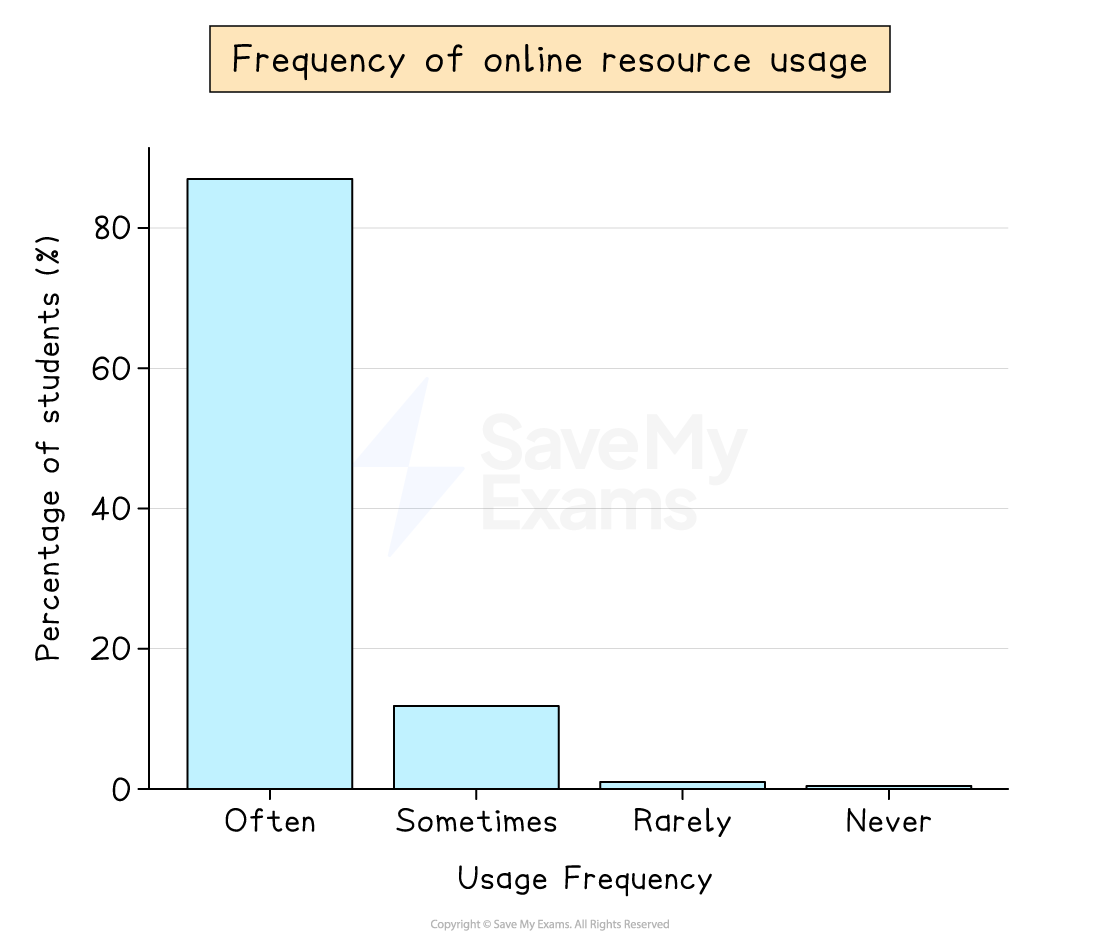
Most students use digital tools to support their studying, with online revision a core part of learning habits. Engagement is strong, though there are small differences between male and female students.
87% of UK students use online resources "often" to study.
A further 12% use online learning resources "sometimes".
Only 1% of students reported using online resources "rarely".
Less than 1% of students said they "never" use online resources to study.
Female students showed slightly higher engagement with online learning, with 89% using resources "often" compared to 85% of male students.
Male students were more likely to use online resources "sometimes" (13%) compared to female students (10%).
Time-of-Day Online Learning Patterns
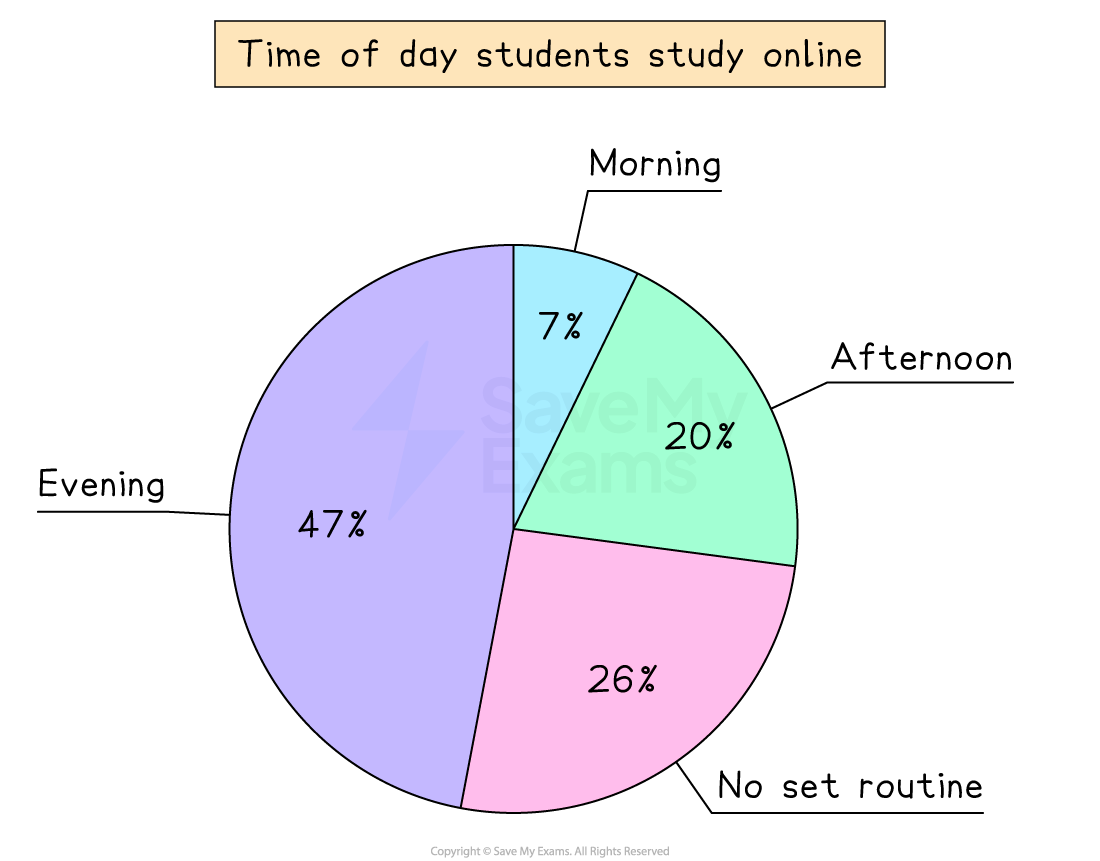
Online learners show clear preferences for when they choose to study, with evenings being the most common time for learning. However, some students still approach online learning without a consistent schedule.
47% of students most often study online during the evenings.
26% of students reported having no set routine for when they study online.
Afternoons were the preferred study time for 20% of respondents.
Only 7% of students study online during mornings.
Male students were slightly more likely to study in the evenings (49%) compared to female students (46%).
Female students were more likely to lack a set study routine (27%) than male students (24%).
Subjects Students Study Online the Most
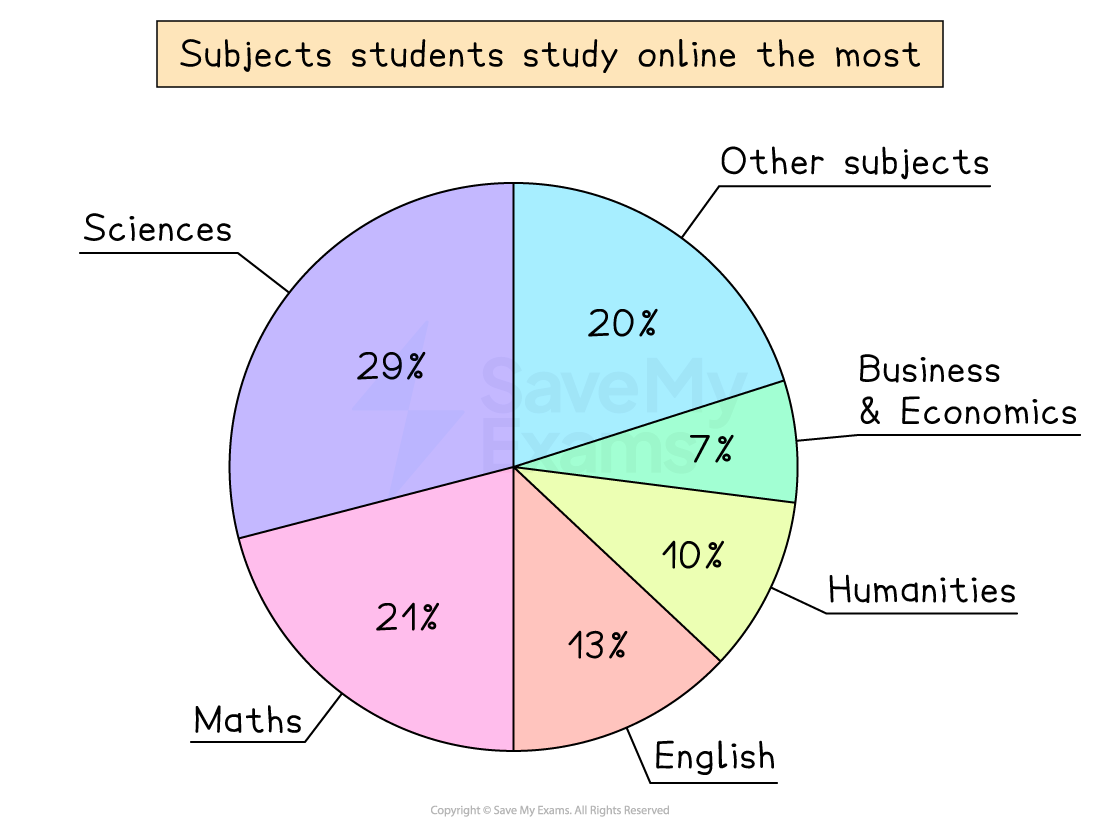
When it comes to what students choose to study online, STEM subjects dominate. While both male and female students share similar top choices, there are different preferences when looking beyond the most popular subjects.
Sciences (Biology, Chemistry, and Physics combined) were the most popular subjects for online learning, accounting for 29% of subject mentions.
Maths was the second most used subject for online learning at 21% of responses.
English represented 13% of online learning usage.
Humanities (History, Geography, and Religious Studies) accounted for 10% of mentions.
Business and Economics collectively made up 7% of online learning usage.
Female students showed a higher preference for social sciences (7% of female responses) compared to male students, who favoured IT/Computer Science (8% of male responses).
Sciences remained the top subject for both genders, with 30% of female responses and 29% of male responses.
Impact of Online Learning on Exam Performance
The most pressing question for students and educators is whether online learning improves grades. Our data provides clear answers.
Self-Reported Grade Improvement
Students feel that online learning boosts their grades. Most are seeing benefits, even if some aren’t totally sure yet.
77% of students believe online learning has improved their predicted or actual grades by at least one grade.
39% reported that online learning improved their grades by 2 or more levels.
19% of students were unsure whether online learning had affected their grades.
Only 4% reported no change in their predicted or actual grades from online learning.
Male students were slightly more likely to report improvements of 2+ grades (41%) compared to female students (37%).
Female and male students reported identical rates of 1-grade improvement at 38% each.
Online vs Classroom Learning Effectiveness
When it comes to getting ready for exams, most students feel online learning gives them an edge over the classroom environment.
71% of students find online learning more effective than classroom learning for exam preparation.
34% consider online learning "much more effective" for exam preparation.
21% of students feel online and classroom learning are about equal in effectiveness.
Only 8% find online learning "slightly less effective" than classroom learning.
Just 1% believe online learning is "much less effective".
Most Effective Online Study Tools
Students rely on a mix of tools to help them study online, but a few stand out as clear favourites.
27% of students identified revision notes as the most effective online learning resource.
25% of students identified past papers as the most effective online learning resource.
Quizzes and topic questions were rated most effective by 18% of students.
Video tutorials were the preferred resource for 18% of respondents.
Model answers were considered most effective by 6% of students.
Female students showed a stronger preference for quizzes and topic questions (20%) compared to male students (16%).
Male students rated past papers equally with revision notes at 27% each, whilst female students preferred revision notes (27%) over past papers (23%).
Challenges Students Face
Despite the clear benefits, online learning presents obstacles that affect student success. Identifying these challenges is the first step towards solving them.
Distractions
51% of students identified getting distracted as their biggest challenge when studying online, making distraction the most significant barrier to effective online learning by a big margin.
Male students reported higher rates of distraction (55%) compared to female students (49%).
Only 4% of students reported facing no challenges at all when studying online.
Motivation Challenges
23% of students cited staying motivated as their primary challenge with online learning, making motivation the second-largest barrier after distraction.
Both male and female students reported identical rates of motivation challenges, at 23% each.
Difficulty Understanding Content
8% of students overall found difficulty understanding content alone to be their biggest challenge.
8% of students felt overwhelmed by the amount of online material available.
Female students reported feeling more overwhelmed by online material (9%) than male students (5%).
Home-Educated vs Classroom-Educated Students
While our survey focused on mainstream UK students, research comparing home-educated and classroom-educated learners reveals important differences in how students approach online learning.
Hours Spent Studying Online
In 2024/25, 111,700 children were home-educated (Department of Education). For these children - and others learning online - there are different ways of accessing resources. Unique to home-educated students are online schools that generally recommend that students spend 3-4 hours a day studying online (Oxford Home Schooling).
Significantly, students from less well-off backgrounds don’t spend as much time learning online as their wealthier peers (BBC). This correlates with the fact that independent school pupils are twice as likely to get online lessons every day than their state school peers (Sutton Trust).
Dependence on Online Tools
In the US, 34% of high school age learners took at least one online course as part of their instruction. And, in 2016, 295,518 American K-12 learners enrolled in a virtual charter school (eLearning Inside).
Closer to home, in Hertfordshire, 82% of home-educating parents, responding to a local survey, stated that online resources were their greatest source of learning support (University of Hertfordshire).
It’s not just parents who recognise the importance of online learning. 67% of UK teachers believe that children will not be prepared for the world of work without access to online tools (GoStudent).
Differences in Device Use
Studies suggest that around 95% of higher education students in the United States own a laptop or smartphone and 33% own a laptop, tablet and smartphone (NSU Works). This means online resources are accessible to many university students.
However, this isn’t the same for younger learners in the UK. During the pandemic, 4% of children relied solely on mobile phones for online learning (Ofcom).
Differences in Distraction Levels
Studying online can lead to increased distraction temptations. 15% of students were found to check devices for non-learning activities over 30 times during online classes, whereas 24% of students in face-to-face classes never checked their digital devices (PubMed Central)
This could be due to stricter enforcement of Internet usage policies. 66% of students learning online reported no digital device policy, whereas 70% of students learning in-person classes had a digital device policy they had to stick to (PubMed Central).
Perceived Effectiveness & Confidence Gaps
Homeschooled students often outperform students in schools, with tests showing 15% to 30% higher scores on academic assessments (Lady Evelyn Independent School).
While online learning is becoming more popular, students are becoming less confident in their ability to succeed in a tech-driven world, decreasing from 77% to 61% in just two years (Find Tutors).
Subject-Specific Online Learning Statistics
Understanding which subjects thrive in digital formats helps students and educators focus their efforts.
Which Subjects Benefit Most from Online Tools?
STEM subjects collectively account for 50% of online learning resource usage among UK students (Save My Exams survey, 2025).
In Turkey, students who used digital devices for learning at school for up to an hour a day scored 14 points higher in Maths than those who didn’t use them at all (PISA).
Gamification of foreign language learning with apps is effective at engaging users. Those that achieve a 7-day streak on Duolingo are 3.6 times more likely to stick with their language acquisition long term (Orizon).
As of 2025, AI-related courses have become the most popular type of online learning (Class Central).
Barriers to Online Learning
While learning online is becoming more accessible and popular across the globe, there are still challenges that many would-be students and education institutions have to overcome.
60% of students new to online learning found it boring and lacked motivation (London College of Professional Studies).
In a 2024 study, it was found that 54% of students preferred classroom-based learning, as it helped boost focus and motivation (Save My Exams).
In America, 77% of chief online learning officers think that AI will be a necessity by 2027, but only 23% have developed strategies to prepare for its implementation (Forbes).
The Future of Online Learning for Students
Online learning continues to evolve at break neck speed. Emerging technologies and new teaching methods are reshaping how students revise and prepare for exams.
Hybrid Learning
85% of higher education institutions have integrated hybrid learning into their curriculum (Educause).
In 2024, the first school teaching in a hybrid way opened as part of Dukes Education (Anderson Quigley).
Only 16% of secondary schools have total bans on mobile devices, and 48% allowed regular use at permitted times (UK Parliament).
A study found that using both human and AI tutoring together helps students learn better than using AI tools on their own, especially for lower attaining students (Cornell University).
Using AI teaching assistants in online courses helped students save time — cutting study hours by around 27% on average (Cornell University).
AI Tools in Online Revision
The percentage of students using AI tools, such as ChatGPT, has increased from 53% in 2024 to 88% in 2025 (HEPI).
68% of parents in the UK believe schools should be responsible for helping children safely use AI (GoStudent).
In 2024, just over 37% of teachers were worried about their students using AI (National Literacy Trust).
The global AI in education market was valued at $5.88 billion in 2024 and is expected to grow to $32.27 billion by 2030 (Grand View Research).
What This Means for Students
The findings from our survey of 5,643 UK students make one thing clear:
Online learning is transforming learning outcomes, study habits, and confidence in measurable ways.
Most students believe online learning improves their grades, the majority prefer it for exam preparation, and STEM subjects continue to lead the way in online resource usage.
As education evolves, the future of learning won’t be defined by digital or classroom environments alone, but by how well they work together. The goal remains the same:
Empowering students to learn in ways that are flexible, engaging, and capable of helping them achieve their full potential.
That’s what we strive to do at Save My Exams. Our revision resources are written by real examiners and expert teachers, and designed to match exam board specifications. Join over 2 million students and teachers using Save My Exams to master what matters, and boost your grades today.
Appendix: Full List of 100 Online Learning Statistics
87% of UK students use online resources "often" to study (Save My Exams Survey, 2025)
77% of students report that online learning has improved their grades by at least one level (Save My Exams Survey, 2025)
71% of UK students find online learning more effective than classroom learning for exam preparation (Save My Exams Survey, 2025)
47% of students study online during the evenings (Save My Exams Survey, 2025)
51% of students cite getting distracted as their biggest challenge (Save My Exams Survey, 2025)
89% of female students use online learning resources "often", compared to 85% of male students (Save My Exams Survey, 2025)
Sciences are the most popular subject for online learning at 29% (Save My Exams Survey, 2025)
27% of students find revision notes the most effective online learning tool (Save My Exams Survey, 2025)
46% of female respondents are studying A Levels, compared to 35% of male respondents (Save My Exams Survey, 2025)
41% of male students report grade improvements of 2+ levels, compared to 37% of female students (Save My Exams Survey, 2025)
GCSE students make up 46% of survey respondents (Save My Exams Survey, 2025)
97% of UK student survey respondents are based in England (Save My Exams Survey, 2025)
26% of students have no set study routine (Save My Exams Survey, 2025)
Only 4% of students report no improvement in their grades from online learning (Save My Exams Survey, 2025)
55% of male students struggle with distraction, compared to 49% of female students (Save My Exams Survey, 2025)
23% of students cite staying motivated as their biggest challenge (Save My Exams Survey, 2025)
Past papers are preferred by 25% of students (Save My Exams Survey, 2025)
20% of students use online learning during afternoons (Save My Exams Survey, 2025)
Maths is the second most popular subject for online learning at 21% (Save My Exams Survey, 2025)
Since 2000, online learning has soared by 900% (Learn Direct)
Between 2012 and 2022, Massive Open Online Courses - or MOOCs - reached over 220 million users (Class Central)
In 2023, there were over 19,000 MOOCs accessible to online learners (Virtue Market Research)
North America leads the e-learning market, accounting for a global share of over 36% in 2023 (Research and Markets)
Approximately 60% of US learners think digital and online learning have improved their grades (McKinsey)
The global e-learning market was worth $399.3 billion in 2022 and is projected to grow at a compound annual growth rate (CAGR) of 14% through to 2032 (Global Market Insights)
Coursera, a leading online education provider, has seen its registered learners more than double between 2019 (44 million) and 2021 (92 million). (World Economic Forum).
LinkedIn Learning has over 21,000 courses, Open Sesame has 25,000, and Udemy has 213,000 (Forbes)
Learning online produces 85% fewer CO2 emissions per student than face-to-face classroom learning (Open University)
The microlearning market was worth $1.55 billion in 2024. (eLearning Industry).
In 2024, online education in Latin America was valued at about $4.21 billion, and is expected to grow at an average of 20.7% per year and could surpass $22.86 billion by 2033. (Online Learning Consortium)
Employees only take part in e-learning for an average of 24 minutes a week (Continu).
The corporate e-learning market was worth $141.2 billion in 2022 and is expected to grow more than 15.5% per year from 2023 to 2032 (Global Market Insights)
Companies that use e-learning report a 42% increase in income per employee compared to those that don't (Psico-Smart)
66% of employers expect to see a return on their investment within twelve months of upskilling employees online (World Economic Forum)
Over 50% of companies that use e-learning expect ‘a lot’, or ‘a great deal’ of AI influence as part of their online learning offerings in 2025 and beyond (Fosway)
In 2024, the market size of the online education and training sector in the UK was £4.7bn (IBIS World)
In the UK, 52% of adults are currently learning or have taken part in learning in the past year (Learning and Work Institute)
72% of UK adults believe that being on the Internet helps them to learn something new (Ofcom)
In 2017, over three-quarters of UK universities offered online degree programs (University of Birmingham)
In 2021/2022, 280,000 UK students were studying by distance learning, with most of their time spent online in some capacity (HESA)
12% of students use online learning resources "sometimes" (Save My Exams, 2025)
Only 1% of students reported using online resources "rarely" (Save My Exams, 2025)
Less than 1% of students said they "never" use online resources to study (Save My Exams, 2025)
Male students were more likely to use online resources "sometimes" (13%) compared to female students (10%) (Save My Exams, 2025)
Only 7% of students study online during mornings (Save My Exams, 2025)
Male students were slightly more likely to study in the evenings (49%) compared to female students (46%) (Save My Exams, 2025)
Female students were more likely to lack a set study routine (27%) than male students (24%) (Save My Exams, 2025)
English represented 13% of online learning usage (Save My Exams, 2025)
Humanities (History, Geography, and Religious Studies) accounted for 10% of mentions (Save My Exams, 2025)
Business and Economics collectively made up 7% of online learning usage (Save My Exams, 2025)
Female students showed a higher preference for social sciences (7% of female responses) compared to male students, who favoured IT/Computer Science (8% of male responses) (Save My Exams, 2025)
Sciences remained the top subject for both genders, with 30% of female responses and 29% of male responses. (Save My Exams, 2025)
39% of students reported that online learning improved their grades by 2 or more levels (Save My Exams, 2025)
19% of students were unsure whether online learning had affected their grades (Save My Exams, 2025)
Female and male students reported identical rates of 1-grade improvement at 38% each (Save My Exams, 2025)
34% consider online learning "much more effective" for exam preparation (Save My Exams, 2025)
21% of students feel online and classroom learning are about equal in effectiveness (Save My Exams, 2025)
Only 8% find online learning "slightly less effective" than classroom learning (Save My Exams, 2025)
Just 1% believe online learning is "much less effective" (Save My Exams, 2025)
Quizzes and topic questions were rated most effective by 18% of students (Save My Exams, 2025)
Video tutorials were the preferred resource for 18% of respondents (Save My Exams, 2025)
Model answers were considered most effective by 6% of students (Save My Exams, 2025)
Female students showed a stronger preference for quizzes and topic questions (20%) compared to male students (16%) (Save My Exams, 2025)
Male students rated past papers equally with revision notes at 27% each, whilst female students preferred revision notes (27%) over past papers (23%) (Save My Exams, 2025)
Only 4% of students reported facing no challenges at all when studying online (Save My Exams, 2025)
Both male and female students reported identical rates of motivation challenges at 23% each (Save My Exams, 2025)
8% of students overall found difficulty understanding content alone to be their biggest challenge (Save My Exams, 2025)
8% of students felt overwhelmed by the amount of online material available (Save My Exams, 2025)
Female students reported feeling more overwhelmed by online material (9%) than male students (5%) (Save My Exams, 2025)
It is recommended that home-schooled students spend 3-4 hours a day studying online (Oxford Home Schooling)
Students from less well-off backgrounds don’t spend as much time learning online as their wealthier peers (BBC)
This correlates with the fact that independent school pupils are twice as likely to get online lessons every day than their state school peers (Sutton Trust)
In the US, 34% of high school age learners took at least one online course as part of their instruction (eLearning Inside)
In 2016, 295,518 American K-12 learners were enrolled in a virtual charter school (eLearning Inside)
In 2024/25, 111,700 children were home-educated (Department of Education)
In Hertfordshire, 82% of home-educating parents, responding to a local survey, stated that online resources were their greatest source of learning support (University of Hertfordshire)
Studies suggest that around 95% of higher education students in the United States own a laptop or smartphone and 33% own a laptop, tablet and smartphone (NSU Works).
During the pandemic, 4% of children relied solely on mobile phones for online learning (Ofcom)
15% of students were found to check devices for non-learning activities over 30 times during online classes, whereas 24% of students in face-to-face classes never checked their digital devices (PubMed Central)
66% of students learning online reported they didn’t have access to a digital device policy, whereas 70% of students learning in-person classes had a digital device policy they had to stick to (PubMed Central)
Homeschooled students often outperform students in schools, with tests showing 15% to 30% higher scores on academic assessments (Lady Evelyn Independent School)
While online learning is becoming more popular, students are becoming less confident in their ability to succeed in a tech-driven world, decreasing from 77% to 61% in just two years (Find Tutors)
45% of women in developing countries say that they’d have to stop learning altogether if online learning wasn't an option (World Economic Forum)
STEM subjects collectively account for 50% of online learning resource usage among UK students (Save My Exams survey, 2025)
In Turkey, students who used digital devices for learning at school for up to an hour a day scored 14 points higher in Maths than those who didn’t use them at all (PISA)
People who achieve a 7-day streak on Duolingo are 3.6 times more likely to stick with their language acquisition long term (Orizon)
As of 2025, AI-related online courses are the most popular (Class Central)
60% of students new to online learning found it boring and lacked motivation (London College of Professional Studies).
In a 2024 study, it was found that 54% of students preferred classroom-based learning as it helped boost focus and motivation (Save My Exams)
In America, 77% of chief online learning officers think that AI will be a necessity by 2027, but only 23% have developed strategies to prepare for its implementation (Forbes)
85% of higher education institutions have integrated hybrid learning into their curriculum (Educause)
In 2024, the first school teaching in a hybrid way opened as part of Dukes Education (Anderson Quigley)
The percentage of students using AI tools, such as ChatGPT, has increased from 53% in 2024 to 88% in 2025 (HEPI)
Only 16% of secondary schools have total bans on mobile devices, and 48% allowed regular use at permitted times (UK Parliament)
67% of UK teachers believe that children will not be prepared for the world of work without access to online tools (GoStudent)
In 2024, just over 37% of teachers were worried about their students using AI (National Literacy Trust)
68% of parents in the UK believe schools should be responsible for helping children safely use AI (GoStudent)
The global AI in education market was valued at $5.88 billion in 2024 and is expected to grow to $32.27 billion by 2030 (Grand View Research)
A study found that using both human and AI tutoring together helps students learn better than using AI tools on their own, especially for lower attaining students (Cornell University)
Using AI teaching assistants in online courses helped students save time — cutting study hours by around 27% on average (Cornell University)
References
Primary Research:
Save My Exams Online Learning Survey (2025) - Survey of 5,643 UK students
Secondary Sources:
Global Market Insights - E-Learning Market Analysis (opens in a new tab)
Global Market Insights - Corporate E-Learning Market Size (opens in a new tab)
World Economic Forum - Growth in Online Learning (opens in a new tab)
World Economic Forum - Equality, Gender, Inclusion (opens in a new tab)
Virtue Market Research (opens in a new tab)
Research and Markets (opens in a new tab)
Online Learning Consortium (opens in a new tab)
McKinsey (opens in a new tab)
Forbes - On-Demand Video Learning (opens in a new tab)
eLearning Industry (opens in a new tab)
Psico-Smart (opens in a new tab)
Continu (opens in a new tab)
Fosway (opens in a new tab)
Ofcom - Online Nation (opens in a new tab)
Ofcom - Media use and attitudes (opens in a new tab)
IBIS World (opens in a new tab)
University of Birmingham (opens in a new tab)
HESA (opens in a new tab)
University of Hertfordshire (opens in a new tab)
Oxford Home Schooling (opens in a new tab)
BBC (opens in a new tab)
E-Learning Inside (opens in a new tab)
PubMed Central (opens in a new tab)
NSU Works (opens in a new tab)
Lady Evelyn Independent School (opens in a new tab)
Sutton Trust (opens in a new tab)
Find Tutors (opens in a new tab)
PISA (opens in a new tab)
Orizon (opens in a new tab)
Class Central - MOOC Statistics (opens in a new tab)
Class Central - 100 Most Popular Courses (opens in a new tab)
London College of Professional Studies (opens in a new tab)
Forbes - Online Leaning’s Moment (opens in a new tab)
Educause (opens in a new tab)
HEPI (opens in a new tab)
Grand Review Research (opens in a new tab)
Department of Education (opens in a new tab)
Learn Direct (opens in a new tab)
Open University (opens in a new tab)
GoStudent (opens in a new tab)
Cornell University - Improving Student Learning (opens in a new tab)
Cornell University - Revolutionising Student Learning (opens in a new tab)
Learning and Work Institute (opens in a new tab)
Was this article helpful?
Sign up for articles sent directly to your inbox
Receive news, articles and guides directly from our team of experts.

Share this article







 written revision resources that improve your