Practical: Factors Affecting Enzyme Activity (SQA National 5 Biology): Revision Note
Exam code: X807 75

Written by: Cara Head
Updated on
Investigating the effect of temperature on enzyme activity
Amylase is an enzyme that digests starch into maltose
Iodine solution is used to test for the presence of starch
Iodine solution has a yellow-brown colour
In the presence of starch, iodine changes colour from yellow-brown to blue-black
It is possible to investigate the effect of temperature on the activity of the enzyme amylase
Examiner Tips and Tricks
Note that this practical is a 'suggested practical' in the specification, rather than content that all students are expected to learn. Some schools may choose to complete alternative practicals, or may miss out practical work that is not realistic, e.g. due to equipment or time constraints.
Apparatus
Measuring syringe / cylinder
Starch solution
Test tubes
Water baths at a range of different temperatures
Thermometer
Iodine solution
Spotting tile
Amylase solution
Stopwatch
Glass rod
Paper towel
Method
Add 5 cm³ starch solution to a test tube and place the tube in a water bath at 20°C; leave the tube in the water until a thermometer shows that its contents have reached 20°C
Add a drop of iodine solution to each well of a spotting tile
Add 2 cm³ of amylase to the starch solution and start the timer
Immediately use a glass rod to transfer a drop of the reaction mixture to the first iodine well and observe any colour change
Clean the pipette with a paper towel
Repeat steps 4-5 every 30 seconds until the iodine no longer changes colour
Record the time taken for the starch to be completely broken down
This will be the first well showing no colour change
Repeat the test twice more at 20°C to
This allows any anomalous results to be identified
Repeat steps 1-8 at other temperatures, e.g. 30°C, 40°C, 50°C, 60°C
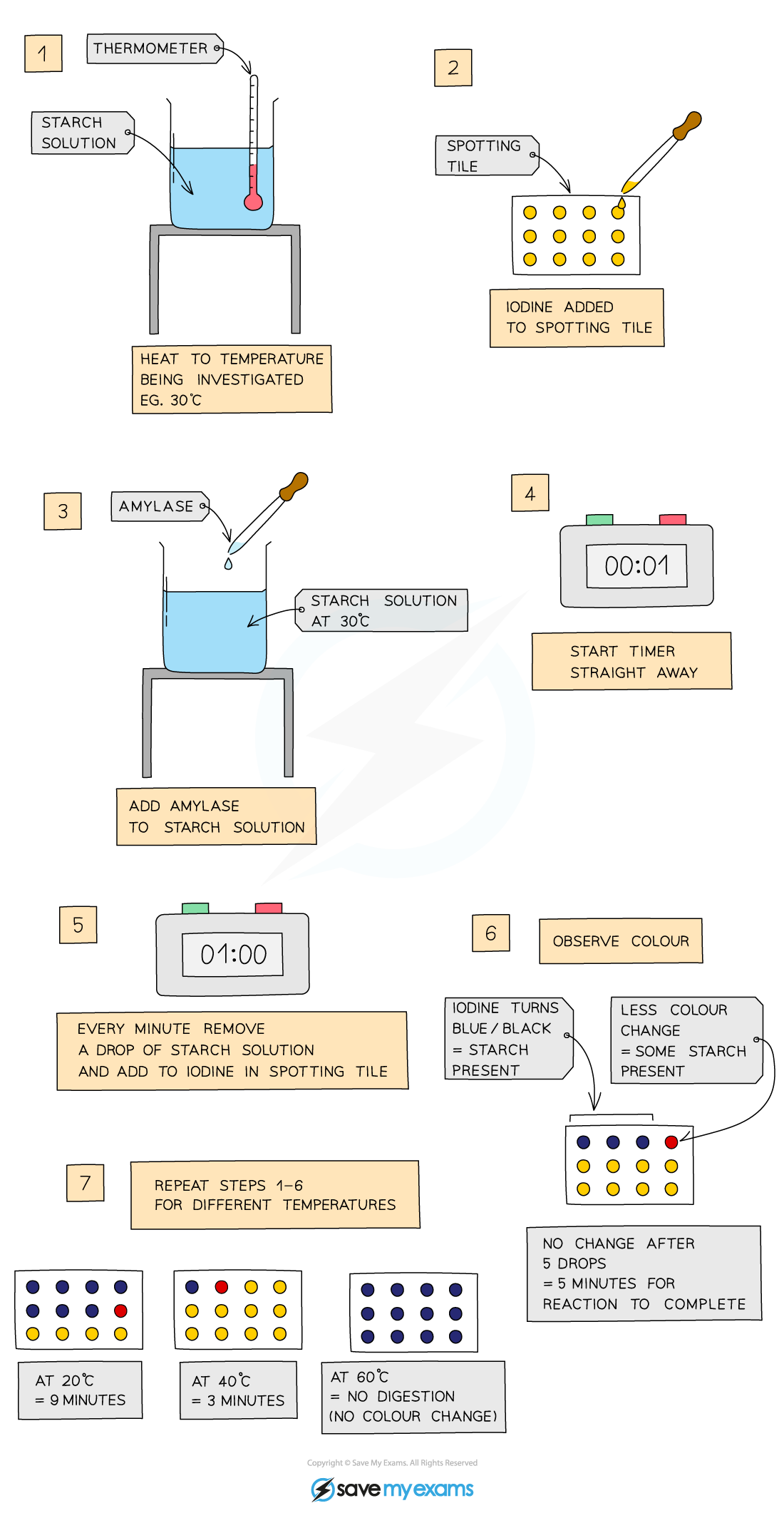
Expected results
We would expect this investigation to show that:
at the optimum temperature the iodine will stop turning blue-black in the shortest time period
This is because the enzyme is working at its fastest rate and has digested all the starch in the solution
at lower temperatures the iodine will take longer to stop turning blue-black
This is because the amylase enzyme is working slowly as it is below its optimum
at high temperatures the iodine will remain blue-black throughout the whole investigation
This is because the amylase enzyme has become denatured and so can no longer bind with the starch
Limitations
Limitation | Suggested solution |
|---|---|
Checking every 30 seconds is not very precise; the true endpoint may occur between checks | Check with iodine more frequently, e.g. every 15 seconds |
Colour change assessments can be subjective | Use a white background and standard light Agree a colour chart for comparison |
The glass rod may be contaminated by the previous sample | Use fresh disposable sticks for each well, or rinse and dry the rod thoroughly between dips |
Inconsistent mixing when the amylase is added to the starch | Use a standard technique for mixing, e.g. invert the tube twice, or stir for a set time period |
Investigating the effect of pH on enzyme activity
It is possible to investigate the effect of pH on the activity of the enzyme amylase
Examiner Tips and Tricks
Note that this practical is a 'suggested practical' in the specification, rather than content that all students are expected to learn. Some schools may choose to complete alternative practicals, or may miss out practical work that is not realistic, e.g. due to equipment or time constraints.
Apparatus
Iodine
Spotting tile
Measuring syringe
Amylase solution
Test tube
Buffer solutions at a range of pH levels
Starch solution
Stopwatch
Glass rod
Paper towel
Method
Add a drop of iodine solution to each well of a spotting tile
Use a measuring syringe to place 2 cm³ amylase into a test tube
Add 1 cm³ pH 2 buffer solution to the same tube
Use a syringe to measure out 2 cm³ starch solution
Add the starch solution to the amylase / buffer solution, and start the stopwatch while mixing the new solution
Immediately transfer a drop of the reaction mixture to an iodine well using a glass rod; observe any colour change
Clean the glass rod with a paper towel
Repeat every 30 seconds until the iodine no longer changes colour
Record the time taken for the reaction to complete
This will be the first well showing no colour change
Repeat the test twice more at pH2
This allows any anomalous results to be identified
Repeat steps 1-10 with buffers of different pH values (e.g. pH4, pH6 and pH8
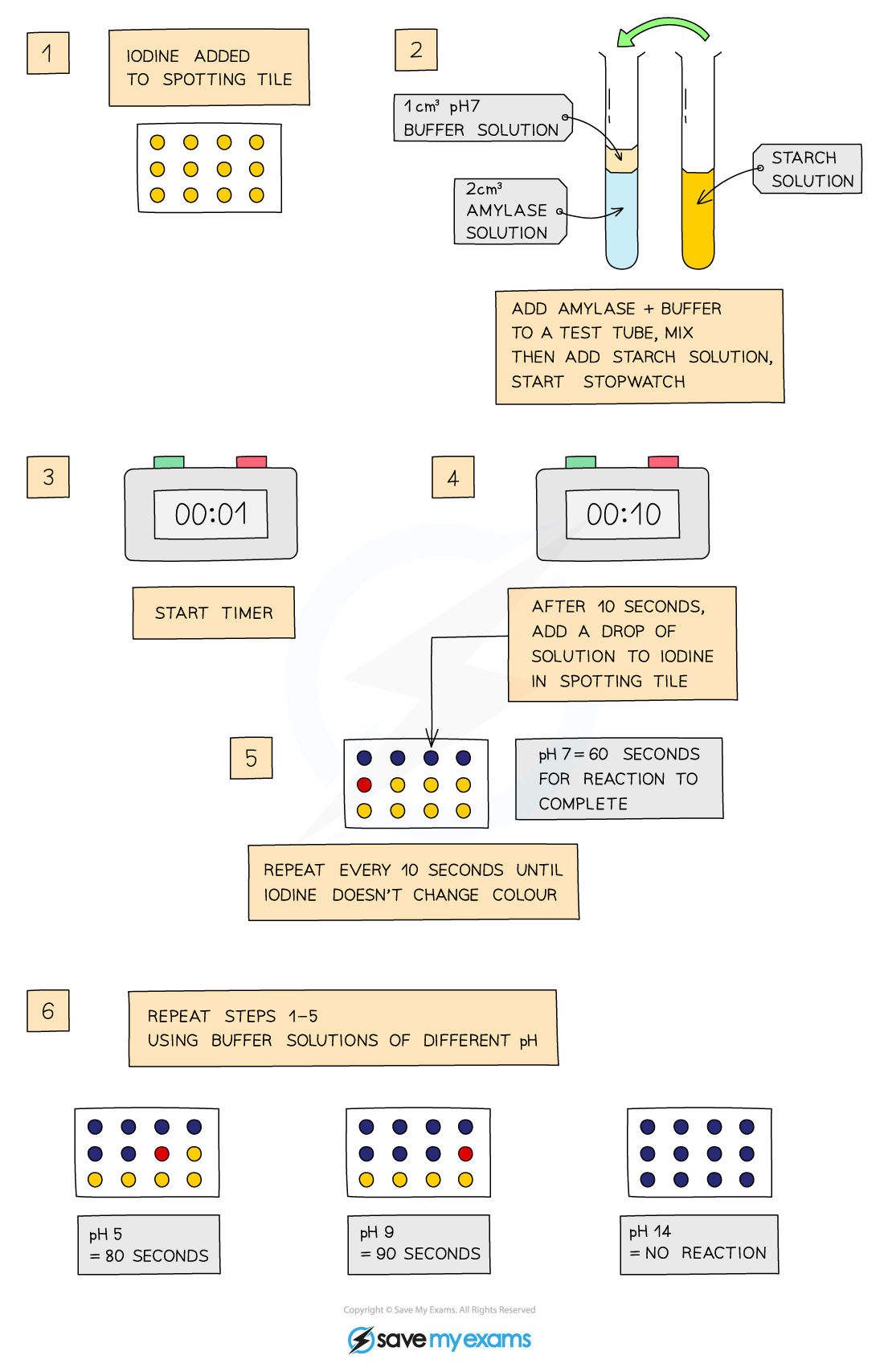
Expected results
We would expect this investigation to show that:
at the optimum pH the iodine will stop turning blue-black within the shortest amount of time
This is because the enzyme is working at its highest rate and digests all the starch quickly
At higher or lower pH levels the iodine will take longer to stop turning blue-black, or may continue to turn blue-black for the entire investigation
This is because on either side of the optimum pH, the enzymes are starting to become denatured and are unable to bind with the starch
Limitations
Limitation | Suggested solution |
|---|---|
Temperature may not be the same for all repeats | Keep all tubes in a constant-temperature water bath |
Checking every 30 seconds is not very precise; the true endpoint may occur between checks | Check with iodine more frequently, e.g. every 15 seconds |
Colour change assessments can be subjective | Use a white background and standard light Agree a colour chart for comparison |
The glass rod may be contaminated by the previous sample | Use fresh disposable sticks for each well, or rinse and dry the rod thoroughly between dips |
Inconsistent mixing when the amylase is added to the starch | Use a standard technique for mixing, e.g. invert the tube twice, or stir for a set time period |

Unlock more, it's free!
Join the 100,000+ Students that ❤️ Save My Exams
the (exam) results speak for themselves:

Was this revision note helpful?