Practical: Competing for Resources (SQA National 5 Biology): Revision Note
Exam code: X807 75

Written by: Naomi Holyoak
Updated on
Investigating interspecific competition
It is possible to investigate the effect of interspecific competition by determining whether growing two plant species together slows their growth in comparison with growing them alone
Examiner Tips and Tricks
Note that this practical is a 'suggested practical' in the specification, rather than content that all students are expected to learn. Some schools may choose to complete alternative practicals, or may miss out practical work that is not realistic, e.g. due to equipment or time constraints.
Apparatus
Seeds of two fast-growing species with similar requirements, e.g.:
radish and lettuce
cress and mustard
Small pots or trays, e.g. 9 cm pots
Standard compost
Plant labels
Tray to catch water
Light source, e.g. bright windowsill or growth lights
Measuring cylinder
Watering can or spray bottle
Ruler
Balance
Method
Prepare pots: fill each pot with the same mass / volume of compost
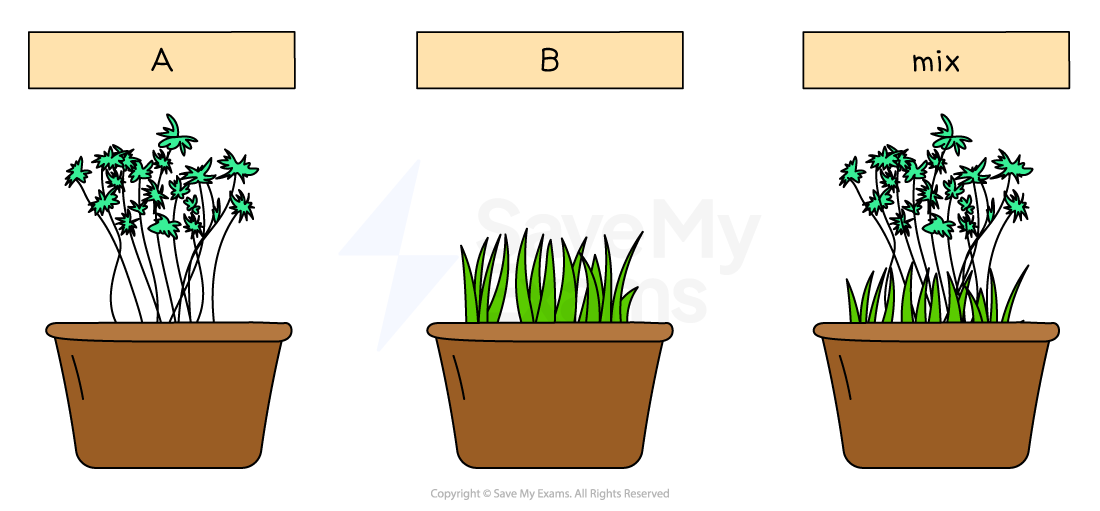
Sow seeds: sow seeds into 15 pots or compartments as follows:
monoculture A: sow five pots, each containing 10 seeds of species A
monoculture B: sow five pots, each containing 10 seeds of species B
mixed: sow five pots, each containing 5 seeds of A + 5 seeds of B
Place pots on a tray and put tray in a well-lit location
Water using a set volume of water, e.g. 50 mL per pot, on the same schedule
Avoid overwatering, e.g. you may decide to water only when the soil feels dry
Thin the seedlings so that each pot contains equal numbers
This is only necessary if some seeds fail to germinate
Measure growth weekly for 2–3 weeks; record:
height (mm): measure the height of all the seedlings in each pot
leaf number, e.g. count the number of leaves on each plant and calculate a total for each pot
Harvest and record the final mass of plant material in each pot
remove seedlings from soil and gently wash roots;
blot dry to remove excess water
measure fresh mass of each pot by species (separate A and B in the mixture)
Analysis:
Calculate mean height and mean leaf number per plant
Compare mean height, mean leaf number and final mass of the mixture vs its two monocultures for each species
Expected results
If interspecific competition is important, each species will grow less in the mixture than in its own monoculture, so will have lower mean height / leaf number, and lower final mass
One species may be the stronger competitor and may be affected less by being grown in a mixture, while the weaker species may show a larger reduction in growth
If resources are not limiting, growth may be similar across treatments
Limitations
Limitation | Possible solution |
|---|---|
Light gradient across a windowsill gives some pots more light | Randomise positions of pots on the tray Rotate tray daily |
Soil variation, e.g. in nutrients and compaction levels | Mix a single batch of compost thoroughly Avoid pressing soil into pots |
Time period may be too short to show the effects of competition | Carry out investigation for longer than 3 weeks |
Species differ naturally in growth rate | Always compare each species to its own monoculture as the baseline |
Different water retention between pots | Weigh pots to equal mass after watering |
Investigating intraspecific competition
It is possible to investigate the effect of intraspecific competition by determining whether growing many individuals of the same species at high density slows their growth in comparison with growing the same species at low density
Examiner Tips and Tricks
Note that this practical is a 'suggested practical' in the specification, rather than content that all students are expected to learn. Some schools may choose to complete alternative practicals, or may miss out practical work that is not realistic, e.g. due to equipment or time constraints.
Apparatus
12–20 shallow trays or plant pots of identical size
Seed compost
Marker pens and labels
Rapid-germinating seeds, e.g. mustard seeds, weighed out into packs of different mass, e.g.
High density = 10 g
Medium density = 5 g
Low density = 2 g
Metal spoon
Measuring cylinder
Spray bottle / watering can
Transparent lids or cling film
Light source or bright windowsill
Ruler
Digital balance
Method
Prepare trays:
Fill each tray to the same depth and level the surface
Label trays clearly with density and replicate number
Sow seeds:
Collect three pre-weighed seed packs of the same species labelled low, medium and high density
For each tray, sprinkle the whole pack evenly over the soil; if provided, mix the seeds with a small spoon of dry sand first to aid distribution
Lightly press the seeds onto the soil so they make good contact, e.g. with the back of a dry spoon
Initial watering:
Use a measuring cylinder to measure out a set volume of water
Add water to each tray using a watering can or spray bottle until evenly moist
Cover with lids/cling film until germination starts (24–48 h), then remove covers
Growth conditions:
Position: keep all trays together in the same bright place; set them in a simple grid and swap positions once a day
Light & temperature: ensure that all trays receive the same number of hours of light per day, and that they are kept at the same temperature
Watering: check tray moisture levels daily using touch, and if the soil feels dry, or almost dry, add the same volume of water to each tray
Duration:
Grow seedlings for 7–14 days
Growth should be measurable, but severe crowding or collapse of plants should be avoided
Measurements:
Survival: count seedlings per tray
Morphology: select a random sample of, e.g. 10 seedlings per tray, and measure shoot length and leaf number
Biomass:
harvest the seedlings in each tray
wash off excess soil and blot dry with a paper towel
measure the total fresh mass of plant material per tray
Calculations & analysis: possible analysis could include:
calculate:
density = surviving seedling number ÷ tray area
mean biomass per plant = total biomass ÷ number of surviving plants
plot on a graph:
density (x axis) vs mean mass per plant (y axis)
density (x axis) vs total biomass per tray (y axis)
Expected results
If intraspecific competition is important, we may expect to see that:
average seedling size / mass decreases as density increases
seedling survival rates decrease as density increases
total biomass per tray increases from low to medium density, then levels off at high density as resources become limiting, e.g.
seedlings shade each other
water and minerals are shared between more roots
If resources are not limiting, growth may be similar across densities with little difference between treatments
Limitations
Limitation | Possible solution |
|---|---|
Uneven sowing of seeds, resulting in a range of densities per tray | Use a grid/template to distribute seeds Pre-mix seeds with dry sand to spread evenly (this can help to see where very small seeds land) |
Watering inconsistency, e.g. due to some trays retaining water more effectively | Water to target mass per tray rather than using a target volume of water |
Compost may vary in nutrient content | Use compost from the same supplier Thoroughly mix compost batch before adding to trays |
Measurement bias, i.e. selecting “nice” seedlings to measure | Use random sampling, e.g., pre-selected grid coordinates |
Edge effects in trays, i.e. seedlings in some parts of the tray get more light and better air circulation | Only measure seedlings from the central part of each tray Use larger trays to reduce the proportion of seedlings affected |

Unlock more, it's free!
Join the 100,000+ Students that ❤️ Save My Exams
the (exam) results speak for themselves:

Was this revision note helpful?