1

1 mark
A culture of 350 bacterial cells was genetically engineered to produce a human protein.
Only 210 cells successfully produced the protein.
The percentage success was
40
60
67
140
Was this exam question helpful?
Exam code: X807 75
A culture of 350 bacterial cells was genetically engineered to produce a human protein.
Only 210 cells successfully produced the protein.
The percentage success was
40
60
67
140
Was this exam question helpful?
Interferon is a type of protein made naturally by cells of the immune system. It can be manufactured by genetic engineering and is used to treat viral infections.
Interferon was one of the first human proteins to be manufactured by transferring genes between organisms.
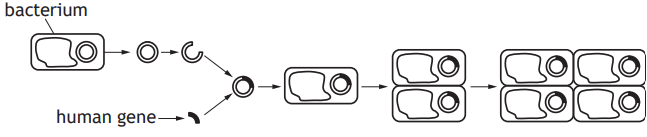
(i) What is a gene?
[1]
(ii) Describe one use of enzymes in the process of genetic engineering.
[1]
Before its manufacture by genetic engineering, interferon was extracted from white blood cells.
45 000 litres of blood were needed to produce 400 g of interferon.
Calculate how many litres of blood were required to produce 1 g of interferon.
[1]
..........................litres
(ii)
During its manufacture by genetic engineering, 85 mg of interferon can be produced per litre of bacterial culture.
Calculate the mass in grams of interferon produced in 45 000 litres.
[1]
(1 g = 1000 mg)
.............................g
Name another type of protein produced by the immune system in response to pathogens.
Was this exam question helpful?
The following stages occur during the process of genetic engineering:
gene inserted into plasmid
plasmid cut open
plasmid extracted from bacterial cell
gene extracted from chromosome.
Which of the following shows the stages in the order they occur?
2 format('truetype')%3Bfont-weight%3Anormal%3Bfont-style%3Anormal%3B%7D%3C%2Fstyle%3E%3C%2Fdefs%3E%3Ctext%20font-family%3D%22math12bba9f4124283edd644799e0ce%22%20font-size%3D%2216%22%20text-anchor%3D%22middle%22%20x%3D%2210.5%22%20y%3D%2216%22%3E%26%23x2192%3B%3C%2Ftext%3E%3C%2Fsvg%3E) 4 1 3
4 1 3
2 1 3 4
4 2 1 3
4 3 2 1
Was this exam question helpful?
A sample of 350 bacterial cells were modified to produce a human protein.
Only 210 of these cells successfully produced the protein.
The percentage success was
60%
67%
140%
167%
Was this exam question helpful?
The diagram shows some of the stages in the transfer of a section of DNA from one cell to another.
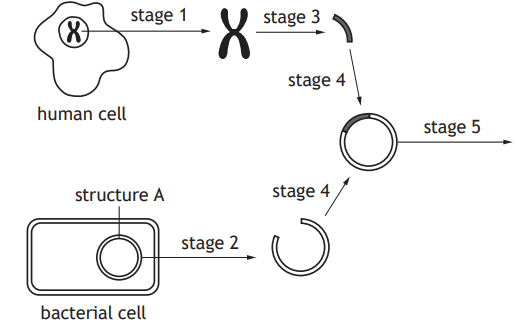
Name the process shown by the diagram.
Name structure A.
Describe what happens during stage 5.
Was this exam question helpful?
Penicillin was the first antibiotic used to treat bacterial infections.
Bacteria have been genetically engineered to produce large quantities of penicillin.
The diagram represents some stages of this process.
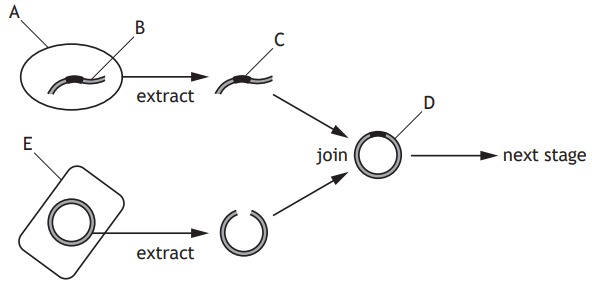
Using information from the diagram, complete the table.
Structure | Letter |
Bacterial cell | |
Gene for penicillin | |
D |
Describe the next stage in the production of penicillin.
Was this exam question helpful?