1
1 mark
The function of an inter neuron is to carry electrical impulses from
a motor neuron to a sensory neuron
an effector to a sensory neuron
a sensory neuron to a motor neuron
a motor neuron to an effector
Was this exam question helpful?
Exam code: X807 75
The function of an inter neuron is to carry electrical impulses from
a motor neuron to a sensory neuron
an effector to a sensory neuron
a sensory neuron to a motor neuron
a motor neuron to an effector
Was this exam question helpful?
Which row in the table identifies features of the hormone glucagon?
Site of production | Target organ | Effect | |
A | pancreas | liver | glycogen |
B | liver | pancreas | glycogen |
C | pancreas | liver | glucose |
D | liver | pancreas | glucose |
Was this exam question helpful?

The table shows the number of people recorded as having diabetes in Scotland over a 5-year period.
Year | Number of people with diabetes |
1 | 278 000 |
2 | 284 000 |
3 | 291 000 |
4 | 298 000 |
5 | 304 000 |
Predict the number of people likely to have diabetes in year 10 if the average yearly increase continues.
330 000
336 500
582 000
608 000
Was this exam question helpful?
The diagram represents parts of the human nervous system.
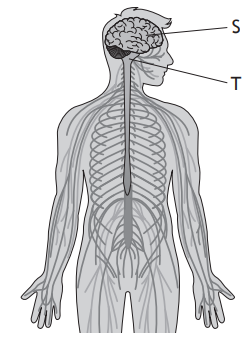
The central nervous system (CNS) consists of the brain and one other structure.
Name the other structure.
The structures labelled S and T in the diagram are parts of the brain.
(i) Name structure S.
[1]
(ii) Give the function of structure T.
[1]
State the role of receptors in the nervous system.
Was this exam question helpful?
Which statement describes a function of the cerebrum?
Remembering the rules of rugby.
Increasing heart rate during a sprint.
Co‑ordinating movement of muscles when playing football.
Maintaining balance during yoga.
Was this exam question helpful?
Which row in the table identifies a hormone, its site of production and its target tissue?
Hormone | Site of hormone production | Target tissue | |
A | insulin | liver | pancreas |
B | glycogen | pancreas | liver |
C | glucose | liver | pancreas |
D | glucagon | pancreas | liver |
Was this exam question helpful?
A study was carried out to investigate the relationship between age and reaction time.
The results are shown in the graph.
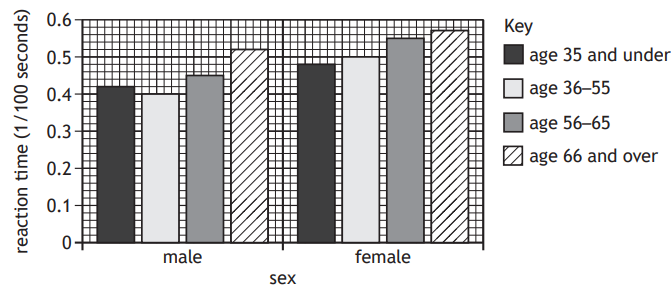
Which of the following conclusions is correct for these results?
Reaction time always increases with age for both males and females.
Reaction time always decreases with age for both males and females.
Females have a lower reaction time than males in each age group.
Males have a lower reaction time than females in each age group.
Was this exam question helpful?
The diagram represents a reflex arc when a person touches a cactus plant.
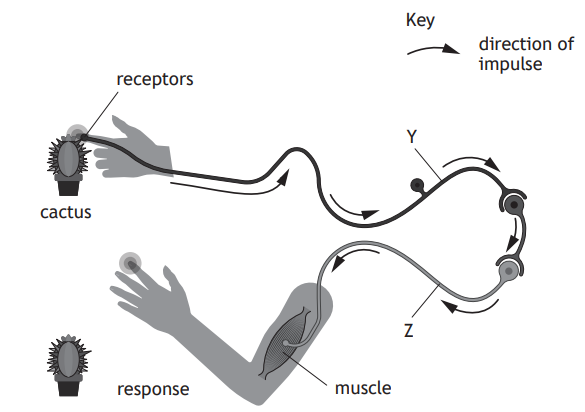
(i) Identify neurons Y and Z.
[2]
Neuron Y................................................................................
Neuron Z................................................................................
(ii) State how messages are transferred at a synapse.
[1]
Identify the effector in this reflex arc.
State the function of a reflex.
Was this exam question helpful?
Which row in the table shows the functions controlled by each part of the brain?
Cerebrum | Medulla | Cerebellum | |
A | coordination and balance | breathing and heart rate | conscious thought |
B | breathing and heart rate | conscious thought | coordination and balance |
C | conscious thought | breathing and heart rate | coordination and balance |
D | conscious thought | coordination and balance | breathing and heart rate |
Was this exam question helpful?
Hormones are
electrical messengers that travel along neurons
chemical messengers that travel along neurons
electrical messengers that travel in the bloodstream
chemical messengers that travel in the bloodstream.
Was this exam question helpful?
The graph shows the number of people in Scotland with type 2 diabetes over a period of nine years.
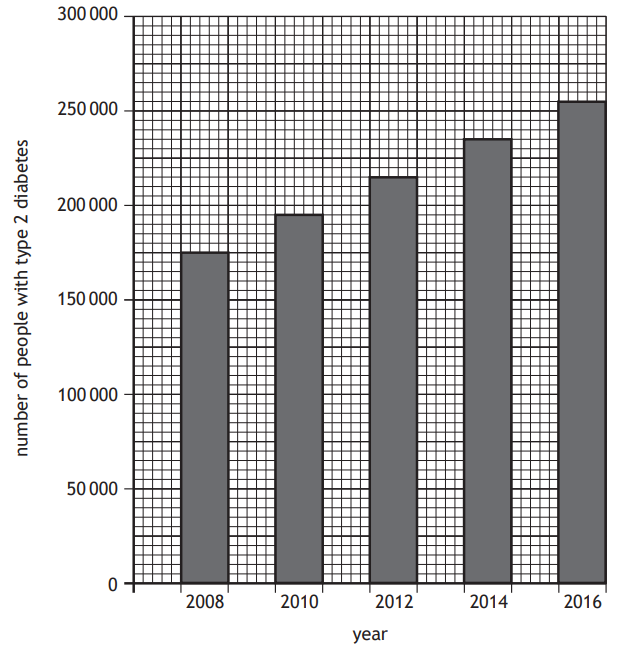
(i) Identify the number of people with type 2 diabetes in 2012.
[1]
(ii) If the trend shown continued, predict the number of people that would be expected to have type 2 diabetes in 2018.
[1]
Insulin is a hormone involved in the regulation of blood glucose.
(i) Insulin has an effect on cells in the liver
Explain why insulin does not affect cells in other organs.
[1]
(ii) Describe the reaction that occurs in the liver cells in response to insulin.
[1]
Name the type of glands that release hormones into the bloodstream.
Was this exam question helpful?
A patient is diagnosed with a tumour in the part of the brain labelled X.
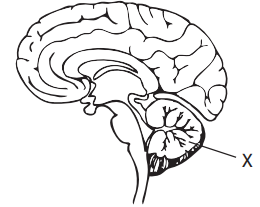
Which of the following effects on brain function might the patient experience due to the tumour?
Memory loss
Irregular heart rate
Increased breathing rate
Loss of balance
Was this exam question helpful?
Which of the following shows the pathway involved in a reflex arc after a person touches a very hot object?
Sensory neuron format('truetype')%3Bfont-weight%3Anormal%3Bfont-style%3Anormal%3B%7D%3C%2Fstyle%3E%3C%2Fdefs%3E%3Ctext%20font-family%3D%22math12bba9f4124283edd644799e0ce%22%20font-size%3D%2216%22%20text-anchor%3D%22middle%22%20x%3D%2210.5%22%20y%3D%2216%22%3E%26%23x2192%3B%3C%2Ftext%3E%3C%2Fsvg%3E) brain motor neuron
brain motor neuron
Sensory neuron inter neuron motor neuron
Motor neuron brain sensory neuron
Motor neuron inter neuron sensory neuron
Was this exam question helpful?
The flowchart shows how the water concentration of blood in the human body is controlled by a hormone.
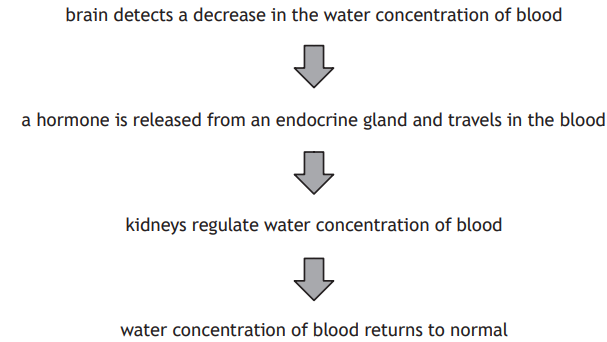
The target tissue for this hormone is the:
brain
endocrine gland
kidneys
blood
Was this exam question helpful?
Insulin is involved in the regulation of blood glucose.
Which row in the table describes the response to an increased concentration of insulin in the blood?
Concentration of glycogen in the liver | Concentration of glucose in the bloodstream | |
A | increases | increases |
B | increases | decreases |
C | decreases | increases |
D | decreases | decreases |
Was this exam question helpful?
Multicellular organisms require efficient communication amongst their cells, tissues and organs.
(i) Name the chemical messengers carried from one part of the human body to another in the blood.
[1]
(ii) Explain why only the target tissues are affected by these chemical messengers.
[2]
Chemical messengers are also found in plants.
Name a transport structure through which these chemicals could flow to move around the plant.
Was this exam question helpful?