Reproduction (SQA National 5 Biology): Exam Questions

Exam code: X807 75

21 mins7 questions
1
Sme Calculator
1 mark

The table gives data on the number of eggs produced and the percentage of eggs surviving to adulthood in three different organisms.

Organism

Number of eggs produced

Number surviving to adulthood

Percentage of eggs surviving to adulthood

Brown trout

3000

270

9

Salmon

2000

150

7.5

Common frog

23

5

The number of eggs produced by the common frog was

  • 28

  • 115

  • 437

  • 460

2a1 mark

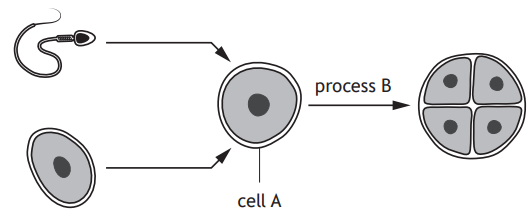
The diagram represents some of the events that occur during reproduction and early growth in humans.

Diagram showing sperm and egg merging into cell A, labelled; process B leads to a four-cell cluster, each cell containing a nucleus.

Name the site of sperm production in the body.

2b1 mark

Describe how the chromosome complement of a sperm cell differs from cell A.

2c1 mark

Name process B.

2d1 mark

Early embryos contain stem cells.

What feature of stem cells makes them important in early embryo development?

31 mark

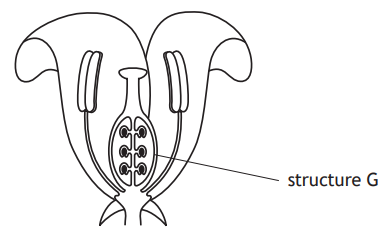
The diagram shows the main parts of a flower.

Diagram of a flower's reproductive structure, labelled "structure G," showing stamens, style, and ovary with curly lines indicating internal details.

Which row in the table identifies structure G and the chromosome complement of the cells it produces?

Structure G

Chromosome complement of cells produced

A

ovary

haploid

B

ovary

diploid

C

ovule

haploid

D

ovule

diploid

4a3 marks

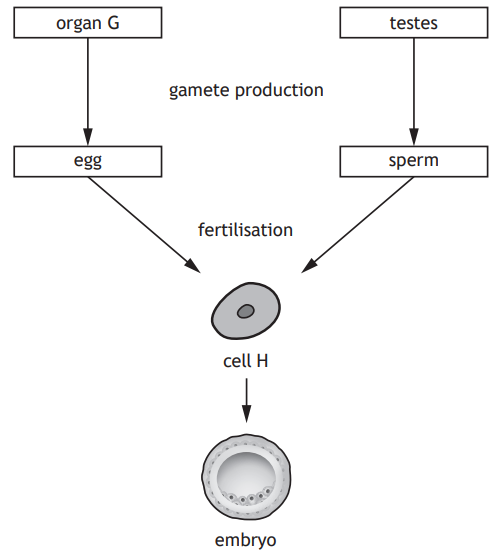
The diagram relates to reproduction in humans.

Diagram showing gamete production in organ G and testes, leading to fertilisation, forming cell H, and developing into an embryo.

(i) Name organ G.

[1]

(ii) Describe what happens during fertilisation.

[1]

(iii) Name cell H.

[1]

4b1 mark

Name the unspecialised cells that can be obtained from an embryo at a very early stage.

5
Sme Calculator
1 mark

A man is fertile if his semen contains a minimum of 20 million sperm per cm3 and at least 75% of the sperm cells are active.

The table shows the results of semen analysis from four sperm samples.

Identify the sample that was from an infertile man.

Sample

Number of sperm in sample
(million/cm3 )

Inactive sperm
(%)

A

25

20

B

23

30

C

22

25

D

20

15

    6a2 marks

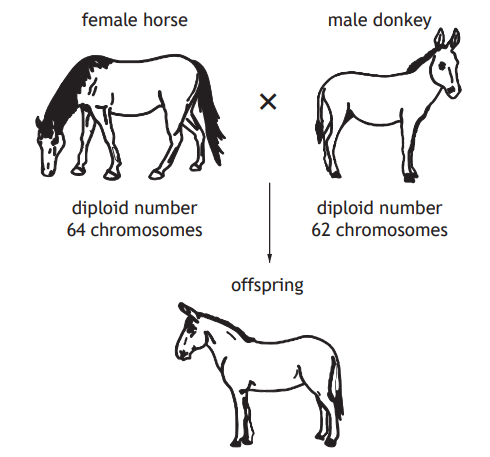
    The diagram shows a cross between a horse and a donkey and the resulting offspring.

    The diploid number of chromosomes for the horse and donkey are given.

    Diagram showing a female horse with 64 chromosomes and a male donkey with 62 chromosomes producing a mule offspring.

    The horse and the donkey produce gametes required for reproduction.

    (i) Name the type of gamete produced by the female horse in this cross.

    [1]

    (ii) Name the organ where the gametes of the male donkey are produced.

    [1]

    6b1 mark

    Name the cell produced when the nuclei of male and female gametes fuse.

    6c
    Sme Calculator
    2 marks

    (i) State the diploid number of chromosomes in the offspring in this cross.

    [1]

    (ii) This offspring is not fertile.

    Using this information, give a conclusion about horses and donkeys.

    [1]

    7a1 mark

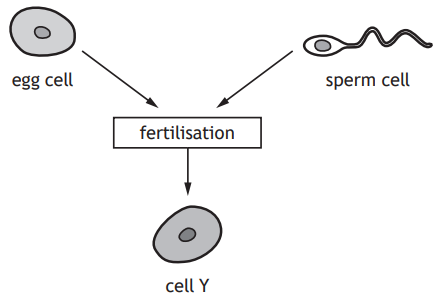
    The diagram shows the process of fertilisation in animals.

    Diagram of fertilisation showing an egg cell and sperm cell merging to form cell Y. Arrows indicate the process and direction of fertilisation.

    Name the organ that produces egg cells.

    7b1 mark

    Underline one option in the brackets to complete the following sentence.

    Cell Y contains a {haploid/diploid} number of chromosomes.

    7c
    Sme Calculator
    2 marks

    In vitro fertilisation (IVF) is a technique that can be used to help people with fertility problems to have a baby.

    The table shows the results of IVF treatments for women of different ages.

    Age of woman (years)

    IVF treatments resulting in births (%)

    Under 35

    32.2

    35–37

    27.7

    38–39

    22.0

    40–42

    14.0

    43–44

    4.4

    45+

    1.9

    (i) Calculate how many times greater the chance of a 38 year old woman giving birth to a baby is compared to that of a 44 year old woman.

    [1]

    ...................................times greater

    (ii) Calculate the number of births likely to occur if an IVF clinic treated 250 women aged 41.

    [1]

    .........................births

    7d1 mark

    One of the causes of fertility problems is that some sperm are unable to swim to the egg due to a lack of energy.

    Name the organelle that is low in number in these affected sperm.