Variation and Inheritance (SQA National 5 Biology): Exam Questions

Exam code: X807 75

16 mins7 questions
1
Sme Calculator
1 mark

In guinea pigs, short coat is dominant to long coat.

A group of heterozygous guinea pigs were crossed and a total of 72 offspring were produced.

Identify how many of the offspring would be expected to have short coats.

  • 18

  • 36

  • 54

  • 72

2a
Sme Calculator
3 marks

The ability of a person to roll their tongue is a dominant characteristic represented by the symbol R.

(i) A male with the genotype Rr and a female with genotype rr had a child who was unable to roll their tongue.

State the genotype of their child.

[1]

(ii) Tick () one box to identify whether the child’s genotype is homozygous or heterozygous and give a reason for your choice.

[1]

Homozygous square Heterozygous square

Reason......................................................................................

(iii) The male and female are having another child.

Predict the percentage chance that this child will be able to roll their tongue.

[1]

............................%

2b1 mark

State which type of variation is shown by tongue-rolling ability.

31 mark

The height of some cattle was measured, and the presence or absence of horns was noted.

Which row in the table is correct?

Feature

Type of variation

Type of inheritance

A

horns

continuous

single gene

B

height

continuous

polygenic

C

height

discrete

single gene

D

horns

discrete

polygenic

    4a3 marks

    Progressive retinal atrophy (PRA) is a rare condition in some dogs, such as cockapoos, that can result in blindness.

    A fluffy dog with curly fur sits on a rock, tongue out, in a blurred natural setting, conveying a playful and cheerful mood.

    PRA is caused by the inheritance of the recessive form of a particular gene, which is represented by r.

    Depending on their genotype, a dog’s phenotype can be described as affected, unaffected or a carrier.

    A cockapoo breeder tested the DNA of a female dog and three male dogs before choosing which pair to breed. The results are shown in the table.

    Dog

    Genotype

    Phenotype

    Female

    Rr

    carrier

    Male 1

    Rr

    carrier

    Male 2

    rr

    Male 3

    RR

    (i) Complete the table by adding the phenotype for male 2 and male 3.

    [1]

    (ii) State the term used to describe the genotype of a carrier of PRA.

    [1]

    (iii) The breeder selected a male based on their DNA results for this condition.

    The offspring were as follows:

    4 unaffected and 4 carriers

    Which male was chosen to breed with the female?

    [1]

    Male.....................................

    4b1 mark

    Another breeder did not carry out DNA tests before breeding a pair of cockapoos. All their offspring were affected by PRA.

    Give the genotypes of the parents in this cross.

    Male genotype................................ cross timesFemale genotype ..................................
    4c1 mark

    Give the term used to describe different forms of a gene.

    51 mark

    In mice, the dominant form of one gene (B) determines black coat colour and the recessive form (b) determines brown coat colour.

    If two heterozygous mice were crossed, the expected phenotypes of the offspring would be

    • 3 black : 1 brown

    • 1 black : 1 brown

    • all black

    • all brown

    61 mark

    A recessive allele is expressed in an individual’s phenotype when the:

    • dominant allele has not been inherited from either parent

    • dominant allele has been inherited from only one parent

    • recessive allele has been inherited from only one parent

    • recessive allele has not been inherited from either parent

    7a1 mark

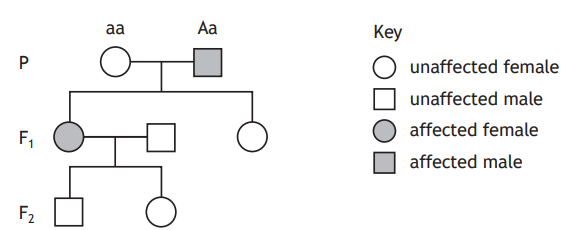
    Cholesterol is a fatty substance found in blood. High cholesterol levels can be caused by a condition known as familial hypercholesterolemia (FH).

    The following diagram shows part of a family tree showing the inheritance of FH.

    ‘A’ represents the FH allele.

    ‘a’ represents the non-FH allele.

    Pedigree chart showing genetic inheritance with 3 generations. Includes both affected and unaffected males (squares) and females (circles). Key provided.

    Use the information given about the male in the parental generation to explain how it is known that the FH allele is dominant.

    7b
    Sme Calculator
    1 mark

    The unaffected female in the F2 generation has a child with a male who is homozygous dominant for FH.

    State the percentage chance of their child having FH.

    ......................%

    7c1 mark

    Identify the type of variation shown by FH.