Newton’s Laws (SQA National 5 Physics): Exam Questions

Exam code: X857 75

45 mins11 questions
1
Sme Calculator
5 marks

During a cycle race, a cyclist rides behind their team‑mate along a straight, flat section of road.
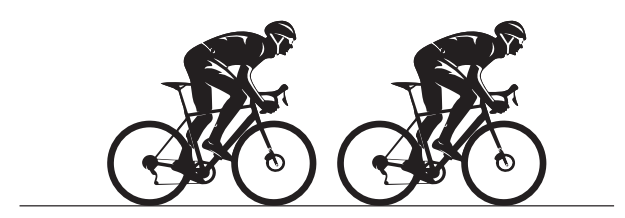
Two cyclists riding road bikes in a streamlined position, wearing helmets, depicted in black silhouette on a white background.

(i) The cyclist and bike have a combined mass of 74 kg.

The cyclist produces a forward force of 54 N.

The total frictional force acting on the cyclist and bike is 22 N.

Determine the acceleration of the cyclist and bike.

[4]

(ii) Explain, in terms of the forces acting on the cyclist, the advantage of cycling behind a team‑mate.

[1]

21 mark

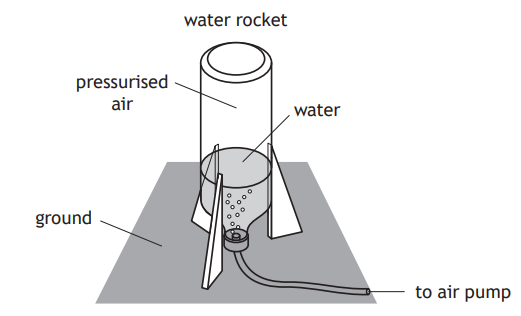
A student is investigating the motion of water rockets.

Diagram of a water rocket on the ground, labelled with pressurised air, water, and a tube connected to an air pump.

Air is pumped into the rocket until the pressure of the air inside is large enough for the water rocket to launch upwards.

The rocket launches because:

  • the rocket pushes down on the ground and the ground provides a reaction force pushing up on the rocket

  • the rocket pushes down on the water and the water provides a reaction force pushing up on the rocket

  • the water pushes down on the ground and the ground provides a reaction force pushing up on the water

  • the force applied by the water on the ground is greater than the weight of the rocket producing an unbalanced upward force

  • the weight of the rocket decreases as water is pushed out of the rocket producing an unbalanced upward force.

3
Sme Calculator
9 marks

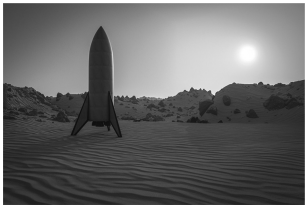
A spaceship on Mars is being prepared for the return journey to Earth.

A rocket stands on a barren, rocky landscape with the sun low on the horizon, casting long shadows and highlighting the rippled sand surface.

The mass of the spaceship including fuel and crew is 1.3 cross times106 kg.

The rocket engines on the spaceship produce a constant upward thrust of 1.2 cross times107 N.

(i) Calculate the weight of the spaceship on Mars.

[3]

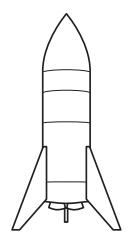
(ii) On the diagram below, show all the forces acting vertically on the spaceship just after it leaves the surface.

You must name these forces and show their directions.

[2]

Outline of a simple rocket with a conical top, cylindrical body, and four stabilising fins at the base, shown on a white background.

(iii) Determine the acceleration of the spaceship at launch.

[4]

41 mark

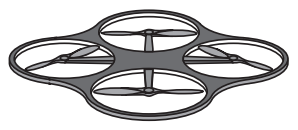
A quadcopter is a drone with four rotating blades.

Illustration of a quadcopter drone with four propellers enclosed within circular frames, viewed from above, displaying a simple, streamlined design.

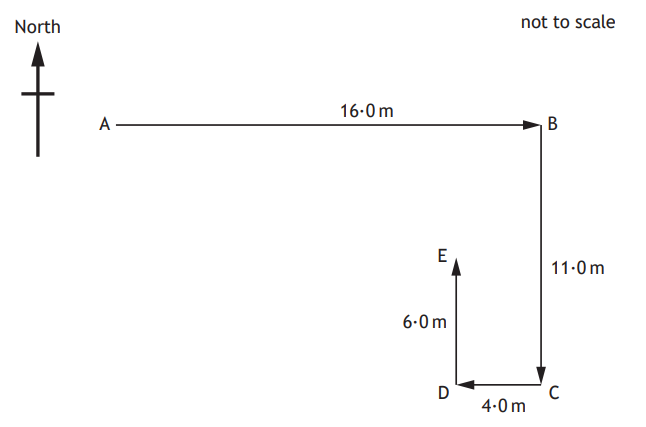
In a race, the quadcopter is flown along a route from point A to point E.

Diagram with points A to E: A to B is 16m east, B to C is 11m south, C to D is 4m west, and D to E is 6m north. Arrow indicates north.

After passing point E, the quadcopter hovers at a constant height.

Describe how the overall lift force provided by the four rotating blades compares to the weight of the quadcopter.

5
Sme Calculator
7 marks

A glider is accelerated from rest by a cable attached to a winch.

Diagram showing a glider connected to a winch by a cable on a flat surface, illustrating a winch launch method for aircraft.

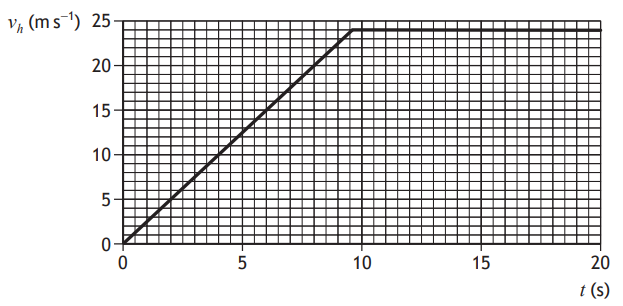
The graph shows the horizontal velocity vh of the glider for the first 20 s of its motion.

A velocity-time graph showing velocity increasing linearly from 0 to 25 m/s over 10 seconds, then staying constant from 10 to 20 seconds.

The glider is accelerated by a constant unbalanced force of 925 N.

(i) Show that the initial acceleration of the glider is 2·5 m s-2.

[2]

(ii) Calculate the mass of the glider.

[3]

(iii) At 2·0 s the cable pulls the glider with a force of 1200 N.

Diagram of a glider with an arrow pointing forward, labelled "1200 N," indicating the force applied in the direction of flight.

(A) Determine the size of the frictional forces acting on the glider at this time.

[1]

(B) Suggest one design feature of the glider that reduces the frictional forces acting on it.

[1]

62 marks

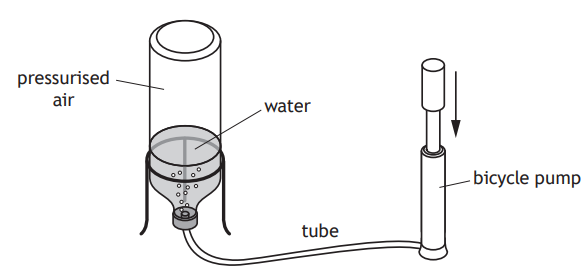
A water rocket consists of a plastic bottle partly filled with water. Air is pumped in through the water. When the pressure is great enough, the tube detaches from the bottle. Water is forced out of the bottle, which causes the bottle to be launched upwards.

Diagram of a setup using a bicycle pump connected to a tube, pressurising air in a water-filled bottle to create bubbles, labelled components.

At launch, the air in the bottle is at a pressure of 1·74 cross times105 Pa.

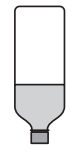
On the diagram below, show all the forces acting vertically on the bottle as it is launched.

You must name these forces and show their directions.

Illustration of an upside-down bottle with a grey liquid filling the lower half. The bottle has a narrow neck and screw cap at the bottom.
71 mark

A rocket is taking off from the surface of the Earth. The rocket engines exert a force on the exhaust gases.

Which of the following is the reaction to this force?

  • The force of the Earth on the exhaust gases.

  • The force of the Earth on the rocket engines.

  • The force of the rocket engines on the Earth.

  • The force of the exhaust gases on the Earth.

  • The force of the exhaust gases on the rocket engines.

8
Sme Calculator
1 mark

The size of the buoyancy force Fb acting on an object immersed in a fluid is given by the relationship

F subscript b equals rho g V

where: ρ is the density of the fluid in kg m−3

g is the gravitational field strength in Nkg−1

V is the volume of the object in m3.

The volume of an object that experiences a buoyancy force of 360 N when immersed in a fluid of density 1020 kg m−3 is

  • 0.036 m3

  • 0.33 m3

  • 3.5 m3

  • 28 m3

  • 37 000 m3

9a
Sme Calculator
7 marks

The triathlon is an endurance race consisting of three stages: swimming, cycling, and running.

The first stage of the triathlon is a 1.5 km open-water swim.

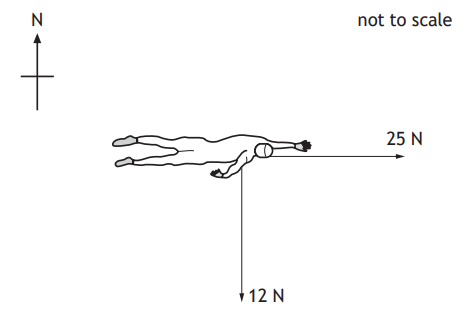
At one point during the swim, the unbalanced forward force on the triathlete is 25 N at a bearing of 090.

At this point, a current exerts a force on the triathlete of 12 N at a bearing of 180.

Diagram of a diver oriented north with forces: 25 N eastward and 12 N southward. North direction indicated by an arrow. Image marked "not to scale."

(i)

(A) By scale drawing or otherwise, determine the magnitude of the resultant of these forces.

[2]

(B) By scale drawing or otherwise, determine the direction of the resultant of these forces.

[2]

(ii)
The triathlete has a mass of 75 kg.

Calculate the acceleration of the triathlete.

[3]

9b1 mark

The second stage of the triathlon is a 40 km cycle.

Suggest one way in which the triathlete could reduce the frictional forces acting against them when cycling.

10
Sme Calculator
3 marks

NASA is planning a crewed mission to the Moon.

Part of the mission includes placing a spacecraft in orbit at an altitude of 140 km above the surface of the Moon.

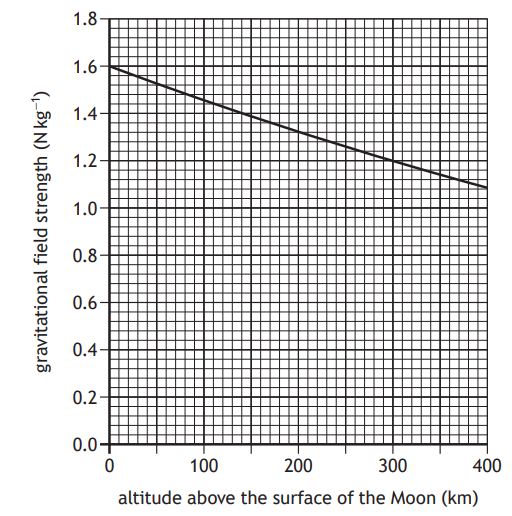
The graph shows the gravitational field strength at different altitudes above the surface of the Moon.

Line graph showing gravitational field strength (N/kg) decreasing with altitude (km) above Moon's surface. Starts at 1.6, drops to 0.9 over 400 km.

One of the astronauts selected for the mission has a mass of 67 kg.

Calculate the weight of this astronaut when they are at an altitude of 140 km above the surface of the Moon.

11
Sme Calculator
7 marks

A passenger aircraft is flying horizontally.

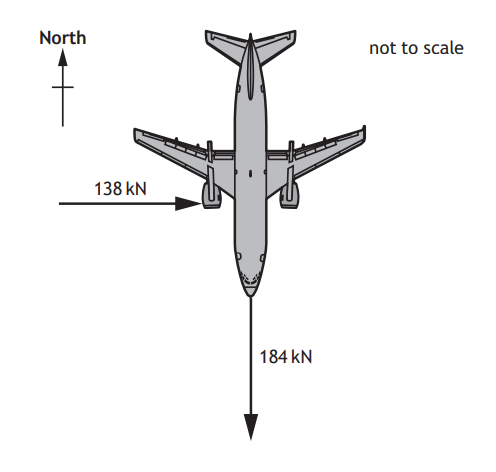
At one point during the flight the aircraft engines produce an unbalanced force of 184 kN due south (180).

At this point the aircraft also experiences a crosswind. The force of the crosswind on the aircraft is 138 kN due east (090).

Diagram of an aeroplane viewed from above, showing forces: 138 kN leftwards, 184 kN downwards. North is upwards; image not to scale.

(i) By scale diagram, or otherwise, determine:

(A) the magnitude of the resultant force acting on the aircraft;

[2]

(B) the direction of the resultant force acting on the aircraft.

[2]

(ii) The mass of the aircraft is 6·8 cross times104 kg.

Calculate the magnitude of the acceleration of the aircraft at this point.

[3]