Gravitational Potential Energy (SQA National 5 Physics): Revision Note
Exam code: X857 75

Gravitational potential energy
Gravitational potential energy is defined as:
The potential energy an object has due to its height in a gravitational field
To lift an object through a gravitational field, work must be done against gravity, or the weight of the object
Whenever work is done, energy is transferred, which means:
If an object is lifted, energy is transferred to it as gravitational potential energy
If an object is lowered, its gravitational potential energy is transformed into a different type of energy
Gravitational potential energy of an object lifted through a gravitational field
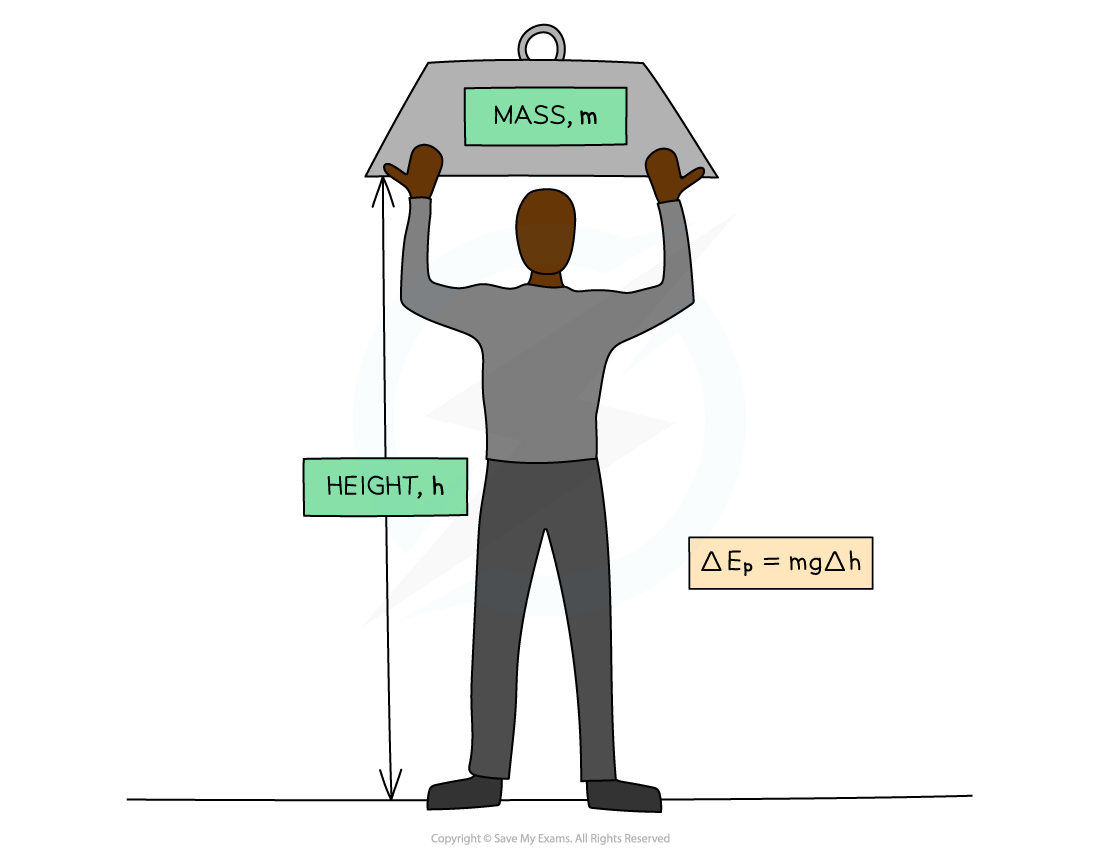
Calculating gravitational potential energy
The gravitational potential energy gained or lost by an object can be calculated using the relationship:
Where:
= gravitational potential energy, measured in joules (J)
= mass, measured in kilograms (kg)
= gravitational field strength, measured in newtons per kilogram (N kg-1)
= change in height, measured in metres (m)
This relationship is found from:
Change in potential energy = work done
Where:
the applied force is the weight,
the distance moved is the height,
Worked Example
A man climbs a flight of stairs that is, in total, 3.0 m higher than the floor. The man has a mass of 72 kg, and the gravitational field strength on Earth is approximately 9.8 N kg-1.
Calculate the energy transferred to the man as gravitational potential energy.
Answer:
Step 1: List the known quantities
Mass of the man,
Gravitational field strength,
Change in height,
Step 2: Write down the relationship between potential energy, mass, gravitational field strength, and height
Step 3: Calculate the gain in potential energy
Step 4: Round to an appropriate number of significant figures
The input values are to 2 s.f., therefore, the output value must be to 2 s.f.
Examiner Tips and Tricks
In the exam, you will generally be expected to round your answers to an appropriate number of significant figures.
Your answer can only be as accurate as your least accurate input value. Therefore, your final answer should round to the lowest number of significant figures of all your input values.

Unlock more, it's free!
Join the 100,000+ Students that ❤️ Save My Exams
the (exam) results speak for themselves:

Was this revision note helpful?
Build on this topic
