Potential Difference (SQA National 5 Physics): Revision Note
Exam code: X857 75

Potential difference
Potential difference, or voltage, is
A measure of the difference in energy per unit charge across two points in a circuit
Voltage is measured in units of volts (V)
1 volt is equivalent to the transfer of 1 joule of energy by 1 coulomb of charge, or 1 V = 1 J C-1
The potential difference between two points in a circuit is related to the amount of energy transferred between those points
The potential difference, or voltage, of a supply is
A measure of the energy given to the charge carriers in a circuit
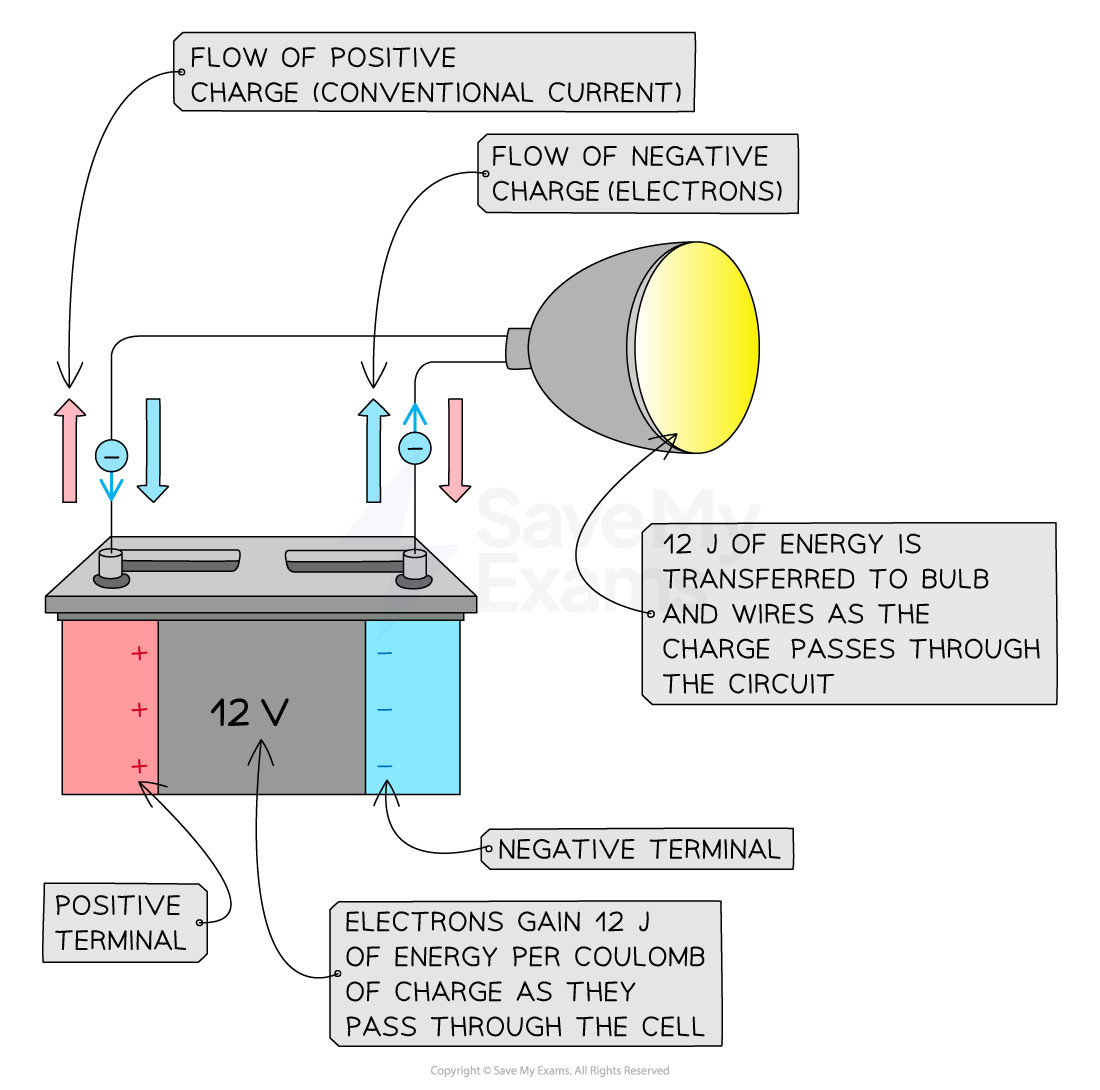
This means that, as electrons pass through a cell, they gain energy
For example, in a 12 V cell, every coulomb of charge passing through gains 12 J of energy
The potential difference, or voltage, across a component is
A measure of the energy given out by the charges as they pass through a component
This means that, as electrons pass through a circuit, they lose energy
For example, after leaving the 12 V cell, each coulomb of charge will transfer 12 J of energy to the wires and components in the circuit
The terminals of a cell make one end of the circuit positive and the other negative
This is the potential difference between two points that makes an electric current flow between them
Potential difference across a circuit

Unlock more, it's free!
Join the 100,000+ Students that ❤️ Save My Exams
the (exam) results speak for themselves:

Was this revision note helpful?
Build on this topic