Refraction of Light (SQA National 5 Physics): Revision Note

Exam code: X857 75

Leander Oates

Written by: Leander Oates

Reviewed by: Caroline Carroll

Updated on

Refraction of light

  • Refraction is defined as:

The change in direction of a ray of light when it travels from one medium to another
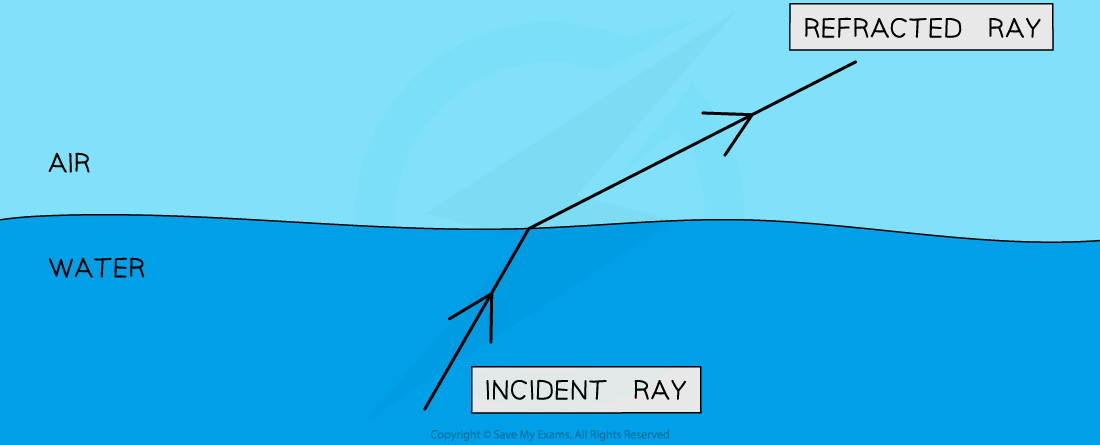
Diagram illustrating light refraction; an incident ray enters water from air, bending and continuing as a refracted ray. Labels indicate "air" and "water".
Waves can change direction when moving between materials due to a change in speed
  • Refraction of a wave occurs because the wave changes velocity upon entering a new medium
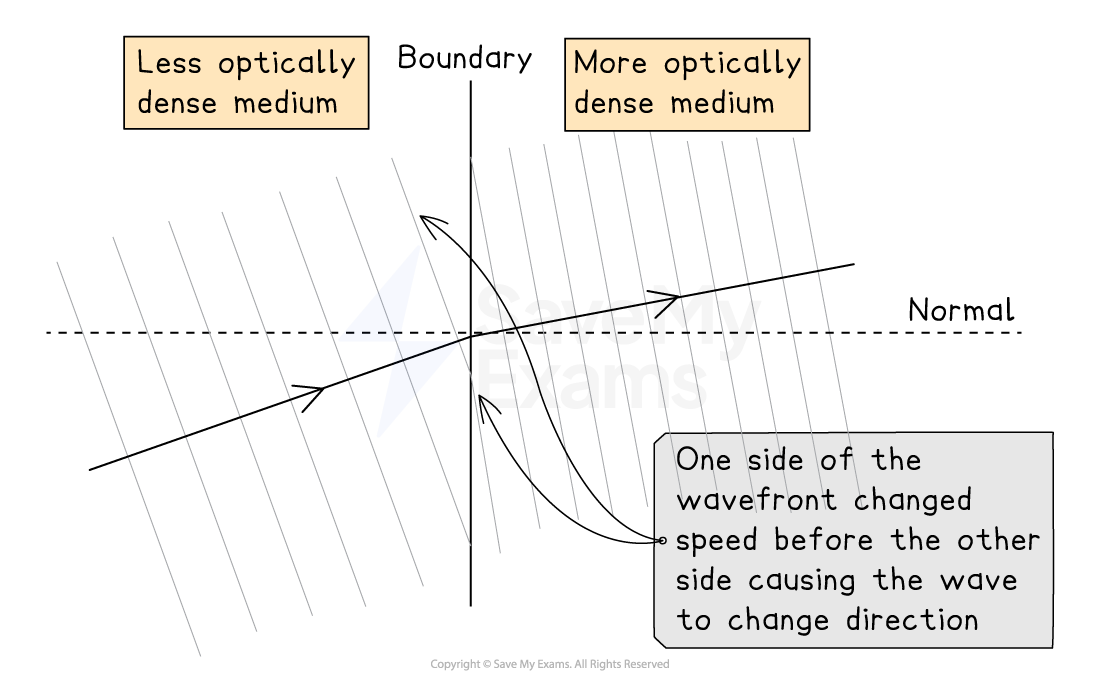
Diagram showing wave refraction as it passes from a less optically dense medium to an optically denser medium, with angles and directions marked, illustrating directional change.
Light changes direction due to a change in speed
  • If the waves slow down upon entering the new medium:

    • the wavefronts will cover less distance in the same amount of time

    • the wavefronts bunch together and the wavelength decreases

    • the wavefronts will bend towards the normal

  • If the waves speed up upon entering a new medium:

    • the wavefronts will cover more distance in the same amount of time

    • the wavefronts spread out and the wavelength increases

    • the wavefronts will bend away from the normal

  • The speed of the wave will only change if the ray approaches the boundary at an angle

    • When the wave enters the new medium perpendicularly, the ray will not change direction

Worked Example

Describe the path of light as it passes from air to glass at an angle of 0° to the normal.

Answer:

  • 0° to the normal is perpendicular to the surface

  • When light enters a new medium perpendicularly, its speed does not change

  • Therefore, the light will not change direction as it enters the glass

Unlock more, it's free!

Join the 100,000+ Students that ❤️ Save My Exams

the (exam) results speak for themselves:

Leander Oates

Author: Leander Oates

Expertise: Physics Content Creator

Leander graduated with First-class honours in Science and Education from Sheffield Hallam University. She won the prestigious Lord Robert Winston Solomon Lipson Prize in recognition of her dedication to science and teaching excellence. After teaching and tutoring both science and maths students, Leander now brings this passion for helping young people reach their potential to her work at SME.

Caroline Carroll

Reviewer: Caroline Carroll

Expertise: Physics & Chemistry Subject Lead

Caroline graduated from the University of Nottingham with a degree in Chemistry and Molecular Physics. She spent several years working as an Industrial Chemist in the automotive industry before retraining to teach. Caroline has over 12 years of experience teaching GCSE and A-level chemistry and physics. She is passionate about creating high-quality resources to help students achieve their full potential.