Cosmology (SQA National 5 Physics): Exam Questions

Exam code: X857 75

25 mins7 questions
1a1 mark

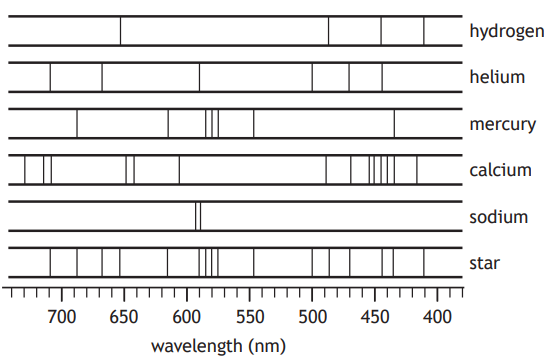
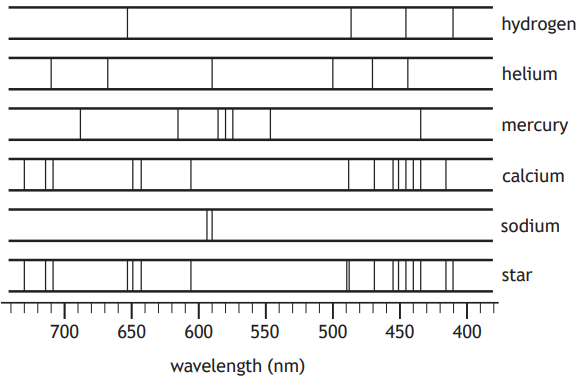
The line spectrum from the star is shown, along with the line spectra of the elements hydrogen, helium, mercury, calcium, and sodium.

Spectral lines of elements hydrogen, helium, mercury, calcium, sodium, and a star, marked at wavelengths from 400 to 700 nm on a horizontal axis.

Determine which of these elements are present in the star.

1b
Sme Calculator
2 marks

The star is 343 light‑years from Earth.

Show that the distance from the star to Earth is 3.2 cross times1018 m.

2a
Sme Calculator
7 marks

Read the passage and answer the questions that follow.

Making plans for Rigel

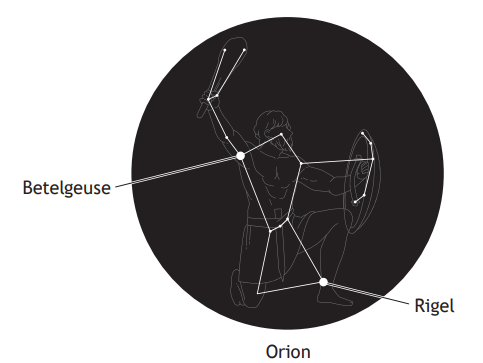
Betelgeuse might be regularly mentioned in the news but there are other supergiants in the night sky. One of these is Rigel, a blue supergiant star that makes up the ‘left foot’ of the constellation of Orion. It is approximately 8 million years old and is one of the brightest stars in our night sky.

Illustration of the Orion constellation with labelled stars Betelgeuse and Rigel; lines connect stars, forming a figure resembling a warrior with club and shield.

Blue supergiants, such as Rigel, are short‑lived and are destined to explode as a supernova. Even though Rigel is 860 light‑years from Earth, the supernova will be clear to see. Astronomers believe that it will be as bright as a half‑moon and will be visible in the sky during the day. However, the light show will only last a few months before it fades.

When it explodes, Rigel will throw debris into space at approximately 5% of the speed of light. Intense waves of radiation, including X‑rays and gamma rays, will be radiated into space. The core of the star will collapse into an extremely dense ball of nuclear matter called a neutron star.

It is not possible to predict exactly when Rigel will explode and there is the possibility that it has already happened, it just hasn’t been detected yet! The best estimate scientists have is that it will take place within the next million years, or so.

(i) Calculate the distance, in metres, from Rigel to Earth.

[3]

(ii) Determine the approximate speed of the debris that will be ejected from the star during the supernova explosion.

[1]

(iii) Calculate the time it would take for this debris to reach Earth.

[3]
2b1 mark

Explain why the supernova explosion may already have happened but has not yet been detected.

2c2 marks

Astronomers can identify elements present in stars by studying the spectrum of the light they produce.

A spectrum from a star is shown.

Abstract pattern with vertical black lines over a gradient grey background, creating alternating shaded columns and varied light intensity.

(i) State the type of spectrum shown.

[1]

(ii) Explain how the spectrum can be used to identify the elements present in the star.

[1]

3a1 mark

Astronomers studying a distant star analyse the light from the star that reaches Earth.

The line spectrum from the star is shown, along with the line spectra of the elements hydrogen, helium, mercury, calcium, and sodium.

Spectral lines comparison for hydrogen, helium, mercury, calcium, and sodium, with corresponding star spectrum, spanning wavelengths 700 to 400 nm.

Determine which of these elements are present in the star.

3b
Sme Calculator
4 marks

The star is 97 light-years from Earth.

(i) State what is meant by the term light-year.

[1]

(ii) Calculate the distance, in metres, from the star to Earth.

[3]

41 mark

A student makes the following statements about the Universe:

I One light-year is the time taken for light to travel from the Sun to the Earth.

II The approximate age of the Universe is 13.8 billion years.

III The ‘Big Bang’ theory describes the origin of the Universe.

Which of these statements is/are correct?

  • II only

  • III only

  • I and III only

  • II and III only

  • I, II and III

5a
Sme Calculator
3 marks

Launched in 2022, the James Webb Space Telescope (JWST) is the world’s premier space-based science observatory.

The NASA website states that the JWST will solve mysteries in our Solar System and probe the mysterious structures and origins of our Universe.

In 2023, the JWST was used to study the exoplanet LHS 475 b.

LHS 475 b orbits a star in the constellation Octans.

The star is 41 light-years from Earth.

Determine the distance, in metres, from this star to Earth.

5b1 mark

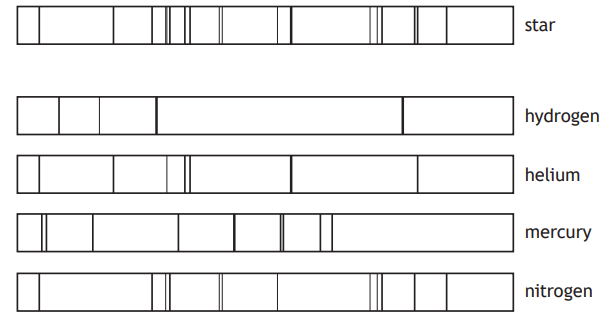
The line spectrum from a star is shown, along with the line spectra of the elements hydrogen, helium, mercury, and nitrogen.

Comparison of spectral lines from a star with hydrogen, helium, mercury, and nitrogen, showing various line patterns for each element.

Determine which of these elements are present in the star.

6
Sme Calculator
1 mark

The distance from the Sun to the star Sirius is 8·6 light years.

This distance is equivalent to

  • 2·2 cross times1014 m

  • 1·4 cross times1015 m

  • 3·4 cross times1015 m

  • 8·1 cross times1016 m

  • 9·5 cross times1016 m

71 mark

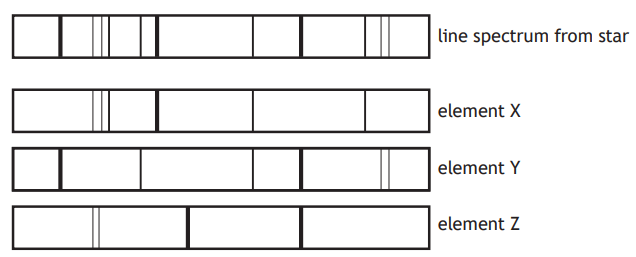
Light from a star is split into a line spectrum of different colours.

The line spectrum from the star is shown, along with the line spectra of the elements X, Y and Z.

Diagram showing a star's line spectrum compared to the spectra of elements X, Y, and Z, with varying lines and gaps indicating absorption features.

The elements present in this star are

  • X only

  • Y only

  • X and Y only

  • X and Z only

  • X, Y and Z