1
1 mark
A ray of red light passes through a glass block as shown.
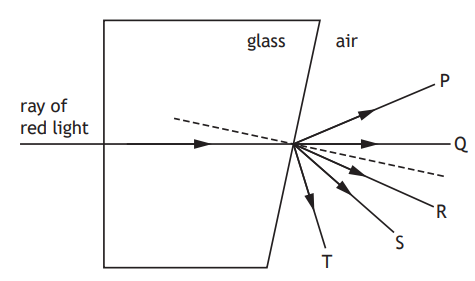
Which ray shows the path of the red light in air?
P
Q
R
S
T
Was this exam question helpful?
Exam code: X857 75
A ray of red light passes through a glass block as shown.
Which ray shows the path of the red light in air?
P
Q
R
S
T
Was this exam question helpful?
The use of analogies from everyday life can help improve the understanding of physics concepts.
Rows of students with arms linked together moving from a smooth pavement to sand can be used as an analogy for the refraction of light.
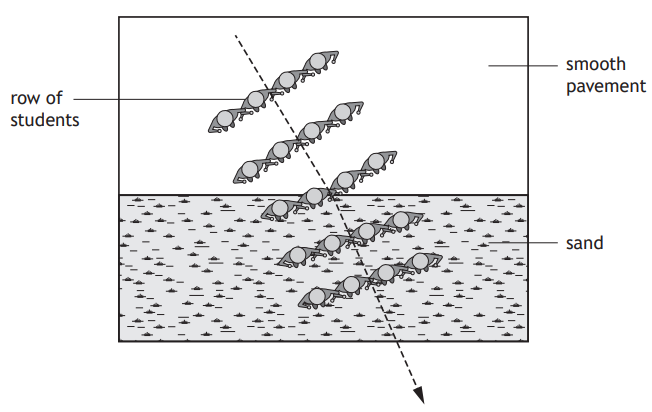
Using your knowledge of physics, comment on this analogy.
Was this exam question helpful?
A laser produces a narrow beam of concentrated light of one particular wavelength.
A ray of red light from a laser is directed into a semi‑circular glass block.
(i) When the ray of red light enters the block its speed changes.
State the name given to this effect.
[1]
(ii) Complete the diagram to show the path of the ray of red light through and out of the semi‑circular glass block.
[1]
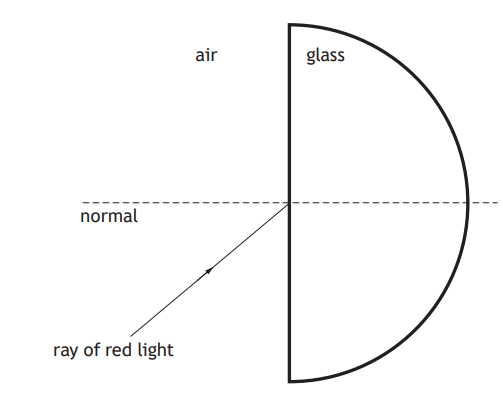
(iii) State how the wavelength of the red light in the glass compares to the wavelength of the red light in air.
[1]
Was this exam question helpful?
A ray of red light passes through a glass block as shown.
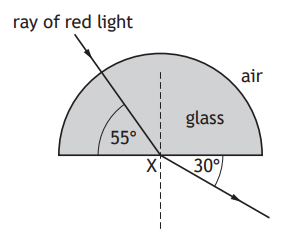
Which row in the table shows the angle of incidence and the corresponding angle of refraction at point X?
Angle of incidence | Angle of refraction | |
A | 35° | 60° |
B | 30° | 55° |
C | 35° | 30° |
D | 55° | 30° |
E | 60° | 35° |
Was this exam question helpful?
A student carries out an experiment to investigate the effect of different shaped glass blocks on the path of a ray of light.
The student directs a ray of red light at a triangular glass block as shown.
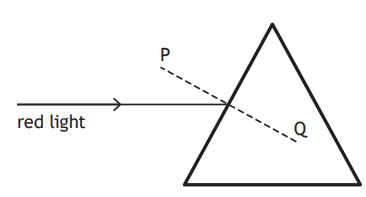
(i) Complete the diagram above to show the path of the ray of red light through and out of the glass block.
[2]
(ii) The diagram shows a dashed line PQ.
State the name given to this line.
[1]
(iii) On the diagram above, label an angle of incidence i.
[1]
The student replaces the triangular glass block with a rectangular block made of the same material. The path of the ray of red light is as shown.
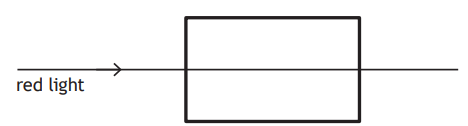
State whether the wavelength of the red light in this block is less than, the same as, or greater than the wavelength of the red light in the triangular glass block in (a).
Justify your answer.
Was this exam question helpful?
The diagram shows the path of a ray of red light as it passes through and out of a semicircular glass block.
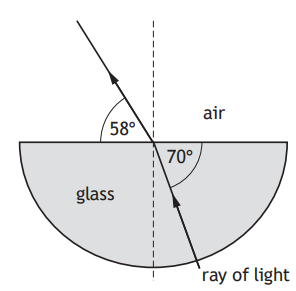
Which row in the table shows the angle of incidence in the glass and the angle of refraction in air?
Angle of incidence in glass | Angle of refraction in air | |
A | 20° | 32° |
B | 32° | 20° |
C | 58° | 70° |
D | 70° | 32° |
E | 70° | 58° |
Was this exam question helpful?
The student takes a picture of a firework exploding using their mobile phone. The firework produces red light.
The camera in the mobile phone uses a glass lens to focus rays of the red light onto a sensor as shown.
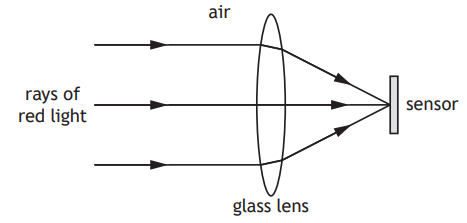
(i) Explain why the ray of red light passing through the centre of the lens does not change direction.
[1]
(ii) State whether the frequency of the red light in the lens is less than, equal to or greater than the frequency of the red light in air.
[1]
Was this exam question helpful?
A rain sensor is attached to the glass windscreen of a vehicle to automatically control the windscreen wipers.
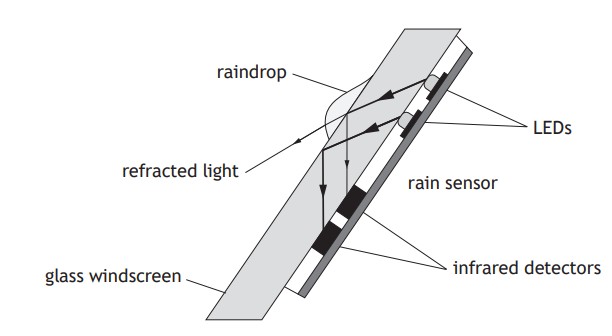
Infrared light is emitted from LEDs and is received by infrared detectors.
Some of the infrared light is refracted when travelling from the glass windscreen into a raindrop.
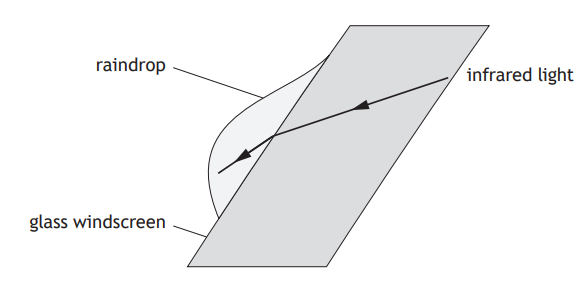
(i) On the diagram, draw and label:
(A) a normal;
[1]
(B) an angle of incidence i and an angle of refraction r.
[1]
(ii) State whether the wavelength of the infrared light in the raindrop is less than, equal to or greater than the wavelength of the infrared light in the glass.
You must justify your answer.
[2]
Was this exam question helpful?